
Bespoke Sail Shade Cost UK: Your Complete 2026 Pricing & Investment Guide
You might think you’re buying a piece of fabric, but in the reality of the British climate, you’re actually investing in tension. It’s a common frustration to see a “bargain” sail online for less than the price of a family meal and then receive a professional quote that looks entirely different. If you’ve been scratching your head over the massive price gap between high-street disposables and engineered systems, you’re not alone. Understanding the bespoke sail shade cost UK market requires looking past the cloth to the steel, the foundations, and the architectural rigging that keeps your investment from flying away during an October gale.
We know that justifying a premium outdoor project to a partner or a board of directors requires more than just aesthetic appeal. This guide provides total clarity on where the investment goes, from marine-grade 316 stainless steel to the high-density fabrics designed to block up to 98% of UV rays. We’ll break down the variables that dictate a professional quote, including wind load engineering and the essential groundworks that budget suppliers often overlook. By the end, you’ll have a clear framework to decide which level of shade truly suits your property for the next decade and beyond.
Key Takeaways
- Learn why UK wind and snow loads require a professional sail to be a fully engineered structure rather than a simple fabric cover.
- Identify the specific factors influencing bespoke sail shade cost UK, from premium fabric selections to the precision-engineered hardware required for high-tension stability.
- Understand why the fabric is only a fraction of the system, with deep concrete foundations and robust steel posts providing the backbone of a safe installation.
- Recognise the long-term ROI of a 15-year architectural investment compared to the “false economy” of budget shades that often fail within two seasons.
- Gain a clear framework for budgeting residential and commercial projects, including essential safety standards and fire-rating compliance.
The Reality of Bespoke Sail Shade Cost in the UK
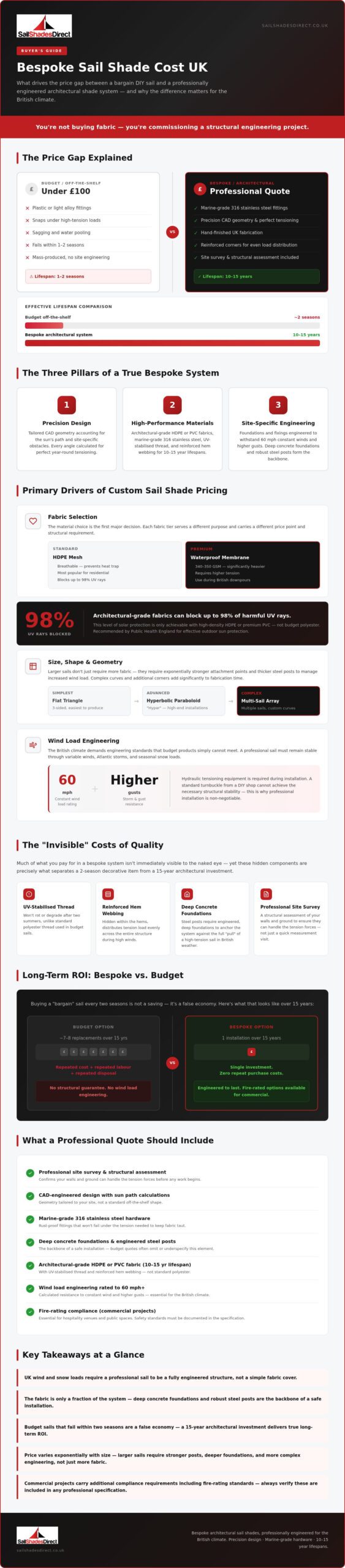
Understanding bespoke sail shade cost UK starts with a fundamental shift in perspective. You aren’t just buying a piece of fabric; you’re commissioning a structural engineering project. Whilst a quick search on retail sites might suggest a shade sail costs less than a hundred pounds, these are decorative items rather than architectural solutions. A true bespoke system relies on three pillars: precision design, high-performance materials, and site-specific engineering. To understand the basics, it helps to look at what a shade sail is in an architectural context. Unlike temporary garden ornaments, a bespoke system is designed to stay up through the variable British weather, managing the immense forces generated by wind and rain.
Bespoke vs. Standard: Why the Price Gap Exists
The gap in price reflects a gap in performance. Off-the-shelf sails often use plastic or light alloy fittings that can snap under the tension required to keep the fabric taut. In contrast, custom-made sails utilise marine-grade 316 stainless steel fittings. These won’t rust or fail when the wind picks up. We use precision CAD design to calculate the exact geometry of your space. This ensures perfect tensioning, which is the only way to prevent the sagging and water pooling that destroys cheaper alternatives. Every sail is a product of professional UK fabrication, where hand-finished quality replaces mass production. This level of craftsmanship ensures that every corner is reinforced to distribute load evenly across the entire structure.
The “Invisible” Costs of Quality
Much of what you pay for in a bespoke system isn’t immediately visible to the naked eye. It’s the UV-stabilised thread that won’t rot after two summers and the reinforced webbing hidden within the hems. These components are essential for surviving British winters and high-UV summer days. Before a single post is installed, a professional site survey is often required. This isn’t just a quick measurement; it’s a structural assessment to ensure your walls or ground can handle the “pull” of a high-tension sail. Key factors that drive this investment include:
- Design: Tailored geometry that accounts for the sun’s path and specific site obstacles.
- Material: Architectural-grade fabrics, like HDPE or PVC, with 10 to 15-year lifespans.
- Engineering: Foundations and fixings calculated to withstand 60mph constant winds and much higher gusts.
Finally, the installation itself requires specialised hydraulic tensioning equipment. You simply can’t achieve the necessary structural stability with a simple turnbuckle from a DIY shop. When you invest in a bespoke solution, you’re paying for the peace of mind that your shade won’t become a liability the moment a storm rolls in from the Atlantic.
Primary Drivers of Custom Sail Shade Pricing
Calculating a bespoke sail shade cost UK involves far more than just measuring square footage. Whilst budget calculators often rely on a simple “length times width” formula, professional systems are priced based on the structural forces they must manage. A larger sail doesn’t just require more fabric; it requires exponentially stronger attachment points and thicker steel posts to handle the increased wind load. Every additional corner or complex curve adds to the fabrication time and the precision required during the engineering phase. You’re paying for a system that remains stable when the wind picks up, not just a seasonal canopy.
Fabric Selection: From UV Protection to Full Waterproofing
Your choice of material is often the first major decision. Standard commercial-grade HDPE (High-Density Polyethylene) mesh is the most popular choice for residential gardens. It’s breathable, which prevents heat from being trapped underneath, and it provides exceptional protection. There is a clear public health rationale for needing shade, as high-quality architectural fabrics can block up to 98% of harmful UV rays. However, if you want to use your terrace during a British downpour, you’ll need a premium waterproof membrane. These fabrics are significantly heavier, typically around 340-350 GSM, and require much higher tension to prevent water from pooling in the centre.
The Impact of Shape and Geometry
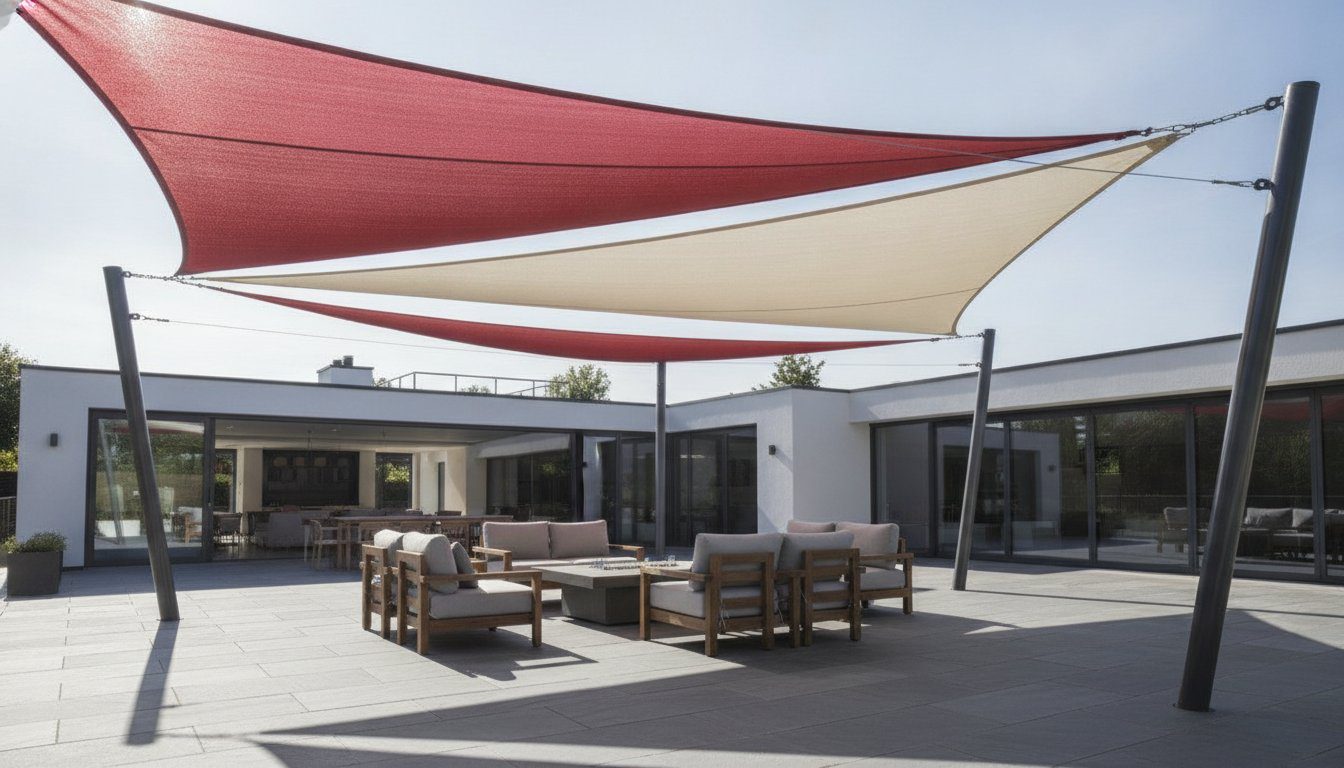
A flat, three-sided sail is the simplest to produce, but it’s rarely the most effective for long-term use. Most high-end installations utilise a hyperbolic paraboloid, or “hypar” shape. This involves setting attachment points at different heights to create a dramatic twist in the fabric. This isn’t just for aesthetics; the double-curvature provides superior stability in high winds and ensures rain runs off efficiently. Creating this shape requires complex CAD modelling and specialised cutting patterns. This process ensures the sail stays taut for years, which naturally carries a higher initial investment than a flat, saggy alternative.
Hardware and Attachment Points
The hardware is the literal backbone of your system. Wall-mounted anchors are a cost-effective solution if your property has solid masonry, but they require careful assessment to ensure the brickwork can take the load. If you don’t have suitable walls, you’ll need custom steel posts. These can be galvanised for a raw industrial look or powder-coated to match your window frames or garden colour scheme. We always recommend marine-grade 316 stainless steel for all turnbuckles and shackles to ensure they won’t seize or rust over time. If you’re unsure which configuration fits your space, you can view our range of bespoke sail shades to see how different hardware setups impact the final design.
Engineering and Installation: The Foundation of Your Investment
Many people are surprised to learn that the fabric sail itself typically represents only about 30% of the total structural system. When calculating the bespoke sail shade cost UK homeowners and developers must account for the massive forces these sails exert on their surroundings. A single 20-square-metre sail can generate several tonnes of “pull” in a moderate breeze. Without a robust engineering backbone, even the highest-quality fabric will eventually fail or, worse, cause structural damage to your property. This is why professional installation isn’t just a convenience; it’s a safety requirement that ensures your investment stays exactly where it belongs.
Foundations and Steelwork
The strength of a freestanding sail comes from what’s buried beneath the ground. Unlike flimsy “garden centre” poles that bend under the slightest pressure, architectural steel posts are chosen for specific diameter and wall thickness based on the sail’s size. For a standard residential installation, we often excavate holes up to a metre deep, filling them with substantial volumes of concrete to create a permanent anchor. This ensures the posts don’t lean over time as the soil shifts. We can seamlessly integrate these posts into your existing landscaping, whether that’s hiding them beneath new decking or finishing them to match your garden’s aesthetic.
The Professional Fitting Process
A professional fitting team does more than just hook a sail onto a post. They perform site-specific wind load calculations based on your local UK wind zone. This ensures the system can handle gusts that would shred a DIY alternative. One of the most critical elements is achieving the correct “pre-tension.” This involves using hydraulic pullers to stretch the fabric to its engineered limit, removing any potential for flapping. Flapping is what causes fabric fatigue and eventual tearing. By introducing a “twist” or hyperbolic shape, installers ensure the sail sheds both wind and rain effectively.
Following the official guidance on sun safety is much easier when you have a permanent, reliable structure that you don’t have to take down every time the clouds gather. When you consider the bespoke sail shade cost UK specialists quote, you’re paying for the expertise that prevents structural failure. For a deeper look at how these elements come together, check out Bespoke Sail Shades UK: The Ultimate Guide to custom outdoor shading. Our nationwide service means you get access to specialists who understand the unique soil conditions and weather patterns found across the country, ensuring your shade remains a safe, beautiful feature for years to come.
Commercial vs. Residential: Budgeting for Different Needs
While a residential project often aims to create a cosy “outdoor living room” feel, commercial installations operate under an entirely different set of rules. For a homeowner, the primary focus is usually aesthetics and personal comfort. For a business, the bespoke sail shade cost UK must be weighed against strict regulatory compliance and potential revenue generation. Commercial grade sails aren’t just larger versions of garden shades; they’re engineered to meet stringent fire ratings and public liability standards that simply don’t apply to private homes. This increased specification ensures that your investment remains a safe asset rather than a legal liability.
Bespoke Solutions for Pubs and Restaurants
Hospitality businesses use shading as a direct tool for revenue growth. By installing high-tension sails or giant umbrellas, a pub can significantly increase its “covers” during the unpredictable British summer. It’s about turning a rain-soaked patio into a premium dining space that attracts customers regardless of the forecast. Many businesses find that commercial shading solutions UK resources help them justify the initial spend by projecting how many extra days of trading the structure provides. We can also customise these systems with corporate colours and branding, ensuring the structure feels like an integrated part of your business identity rather than an afterthought.
Shading for Schools and Public Spaces
In playgrounds and public parks, the priorities shift toward maximum safety and durability. School installations require fabric with the highest possible UV protection to meet playground safety standards. We also have to consider the “human element” in public spaces, which often means using anti-climb post designs and vandal-resistant hardware. These structures must withstand heavy use and potential misuse, requiring a level of structural integrity that far exceeds a standard residential setup. Maintenance programmes are also a key part of the budget for public bodies, ensuring that the tension remains perfect and the fittings stay secure over a 10 to 15-year lifespan.
Whether you’re looking to transform a school playground or a busy restaurant terrace, our team can provide a detailed breakdown of the requirements for your specific sector. If you’re ready to see how a professional system can add value to your site, you can get a tailored quote for your project here.
ROI: Why Bespoke is the Most Cost-Effective Choice
When you’re looking at the initial bespoke sail shade cost UK, it’s easy to get distracted by the sticker price. However, the real value lies in the “cost per year” rather than the upfront cheque. Choosing a budget, off-the-shelf option is often a classic false economy. These mass-produced items are frequently made from low-grade plastics that degrade under UV exposure and shred during the first autumn storm. By the time you’ve replaced a cheap sail three or four times, you’ve already spent more than the cost of a single, professionally engineered system that would have lasted a decade.
A bespoke system is designed for a 10 to 15-year lifespan. It isn’t just a temporary cover; it’s an architectural addition that enhances the curb appeal and value of your property. Whether it’s a sleek residential terrace or a sprawling commercial beer garden, a high-tension sail projects a sense of quality and permanence. Our “can-do” attitude means we tackle the site-specific challenges standard sails simply can’t handle. We’ve solved problems for awkward angles, listed building restrictions, and high-exposure coastal locations where standard products would fail in weeks.
Calculating the 10-Year Cost of Ownership
Think about the replacement cycle. A budget fabric might last two seasons if you’re lucky. In contrast, architectural membranes are built to endure. Beyond the fabric itself, consider the energy savings. By strategically shading large glass facades or south-facing windows, you can significantly reduce indoor temperatures during summer. This lowers the demand on air conditioning and cooling systems, putting money back in your pocket. Maintenance is straightforward too; a simple annual check and occasional clean are usually all that’s required to keep your system in top condition. You’re buying time, comfort, and peace of mind.
Conclusion: Taking the Next Step
Every outdoor space is unique. That’s why a professional quote is the only reliable way to get an accurate price for your specific requirements. At Sail Shades Direct, we pride ourselves on being a personal, expert, and collaborative partner for your project. We don’t just sell products; we solve environmental problems and create beautiful, functional spaces that stand the test of time. Why settle for a temporary fix when you can invest in a permanent solution that adds genuine value to your life or business?
Are you ready to transform your space? Request a bespoke quote from Sail Shades Direct today and let’s start designing your perfect outdoor environment together.
Transform Your Environment with Architectural Precision
Investing in a professional shading system is about more than just escaping the sun; it represents a permanent, engineered asset that stands up to the British elements. We’ve explored how the bespoke sail shade cost UK reflects the precision of marine-grade stainless steel hardware and the security of expert engineering for high-wind environments. You now understand that the real value lies in a structure built to last fifteen years, rather than a temporary fix that fails after one season. Quality is always the most cost-effective choice in the long run.
Whether you’re enhancing a private garden or expanding a commercial terrace, the right design starts with an expert conversation. Our team provides UK-wide professional installation and over a decade of craftsmanship to ensure your project is a total success. It’s time to stop worrying about the wind and start enjoying your environment. Get Your Personalised Bespoke Sail Shade Quote and take the first step toward a beautifully shaded future today. We’re ready to help you bring your vision to life.
Frequently Asked Questions
How much does a bespoke sail shade cost on average in the UK?
A typical residential bespoke sail shade cost UK project usually falls between £2,300 and £4,300 for a two-sail system. This investment covers high-grade architectural fabric, marine-grade hardware, and professional nationwide installation. Larger or more complex commercial installations can exceed £5,500 depending on the structural requirements. The final price is always dictated by the specific wind loads and foundation needs of your site rather than just the fabric dimensions.
Is a bespoke sail shade more expensive than an arm awning?
Bespoke sail shades and high-quality arm awnings often sit in a similar price bracket, yet they offer different functional benefits. While an awning provides retractable shade, a bespoke sail is a permanent architectural structure designed to withstand much higher wind speeds. If your priority is a “set and forget” solution that adds a modern aesthetic and handles the British breeze without retracting, a sail shade often provides better long-term value.
Do I need planning permission for a bespoke sail shade in my garden?
Planning permission is typically not required for standard residential sail shades in the UK. However, you might need to consult your local authority if the structure exceeds 2.5 metres in height or covers an area larger than 30 square metres. Special rules also apply if you live in a listed building or a conservation area. We always recommend checking with your local planning office if your project is particularly large or prominent.
How long does a custom-made sail shade last in British weather?
A professionally installed, custom-made sail shade is designed to last between 10 and 15 years in the UK climate. This longevity is achieved through the use of UV-stabilised architectural fabrics and 316 marine-grade stainless steel fittings. Unlike budget alternatives that may only survive a single season, these engineered systems are built to endure constant tension and the variable forces of British wind and rain without sagging or tearing.
Can I install a bespoke sail shade myself to save on costs?
Whilst you can purchase “supply only” sails, we don’t recommend DIY installation for bespoke systems. The structural integrity of the project relies on precise pre-tensioning and deep concrete foundations that can handle several tonnes of force. An incorrectly installed sail is a significant safety risk in high winds. Professional fitting ensures the engineering is sound, protecting your property and ensuring your 10 to 15-year investment doesn’t fail prematurely.
What is the most expensive part of a sail shade installation?
The steel posts and their associated groundworks are usually the most significant portion of the bespoke sail shade cost UK. Because the fabric exerts immense “pull” on its anchor points, we must use heavy-duty architectural steel and substantial concrete foundations. These “invisible” costs are what separate a permanent structural solution from a temporary decoration. The fabric itself is often only 30% of the total system investment.
Are waterproof sail shades significantly more expensive than mesh ones?
Waterproof membranes are more expensive because the material is heavier and requires much higher structural tension to prevent water pooling. To keep a waterproof sail taut enough for rain to run off, we often need thicker steel posts and reinforced attachment points. Whilst standard HDPE mesh is excellent for UV protection and airflow, a waterproof system is a more complex engineering feat that demands a higher initial investment for year-round terrace use.
Does the colour of the fabric affect the price of the sail?
In most cases, the colour of the fabric does not change the base price of the sail. However, colour choice is vital for performance; darker shades often provide slightly higher UV protection and better glare reduction. We offer a wide palette of architectural colours to match your property’s aesthetic. Whilst the cost remains stable across standard ranges, choosing a very specialised or custom-dyed fabric for branding purposes may incur additional lead times or costs.