
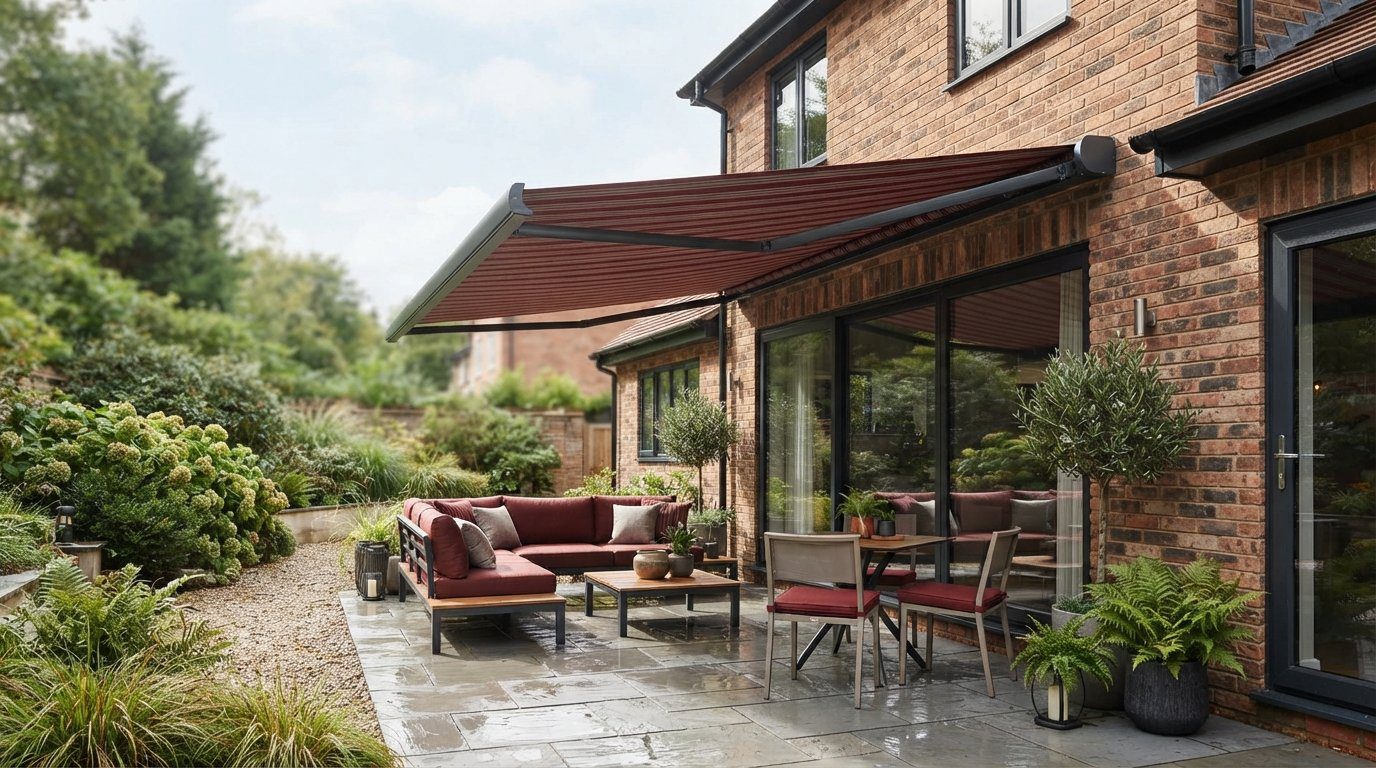
What to Consider When Buying a Patio Awning: The 2026 UK Buying Guide
A patio awning is far more than just a garden accessory; it is a precision-engineered structural extension of your home designed to bridge the gap between indoor comfort and the great outdoors. Understanding what to consider when buying a patio awning is the difference between a sagging, wind-battered sheet of polyester and a bespoke architectural feature that adds genuine value to your property. It’s natural to worry about how a retractable system will cope with the unpredictable UK weather, or to feel overwhelmed by the choice between manual cranks and high-tech motorised sensors. You want a solution that won’t fade under the summer sun or buckle during a sudden autumn downpour.
This 2026 guide is designed to remove that stress by providing a clear roadmap to choosing a high-end, durable awning tailored to the unique demands of our climate. We’ll explore everything from structural wind-resistance ratings and the latest smart-home integrations to the technical nuances of fabric longevity and professional installation requirements. Whether you’re looking to create a shaded sanctuary for summer hosting or a weather-protected spot for year-round utility, you’ll find the expert insights needed to invest with total confidence.
Key Takeaways
- Learn why a bespoke arm awning provides a millimetre-perfect fit and better durability than a basic off-the-shelf kit.
- Understand the technical standards for wind resistance and fabric technology that keep your shading solution looking fresh in the UK weather.
- Discover precisely what to consider when buying a patio awning, from the ease of motorised controls to the protection of a full-cassette design.
- Identify the structural essentials for a safe fit, including why spreader plates are often a necessity for modern extensions.
- Use our final checklist to match your awning’s cassette and fabric colours perfectly with your home’s existing aesthetic.
Why Quality Matters: Bespoke vs Off-the-Shelf Patio Awnings
Investing in your outdoor space should feel like a reward, not a chore. When you begin researching what to consider when buying a patio awning, the first fork in the road is the choice between a mass-produced retail kit and a bespoke, engineered solution. A cheap, off-the-shelf awning might look tempting on a screen, but these systems are often designed for milder climates where wind and rain are less of a factor. In the UK, a high-quality awning acts as a structural investment that enhances your property’s value and architectural appeal whilst providing a necessary reprieve from the elements.
The Limitations of Standard Retail Sizes
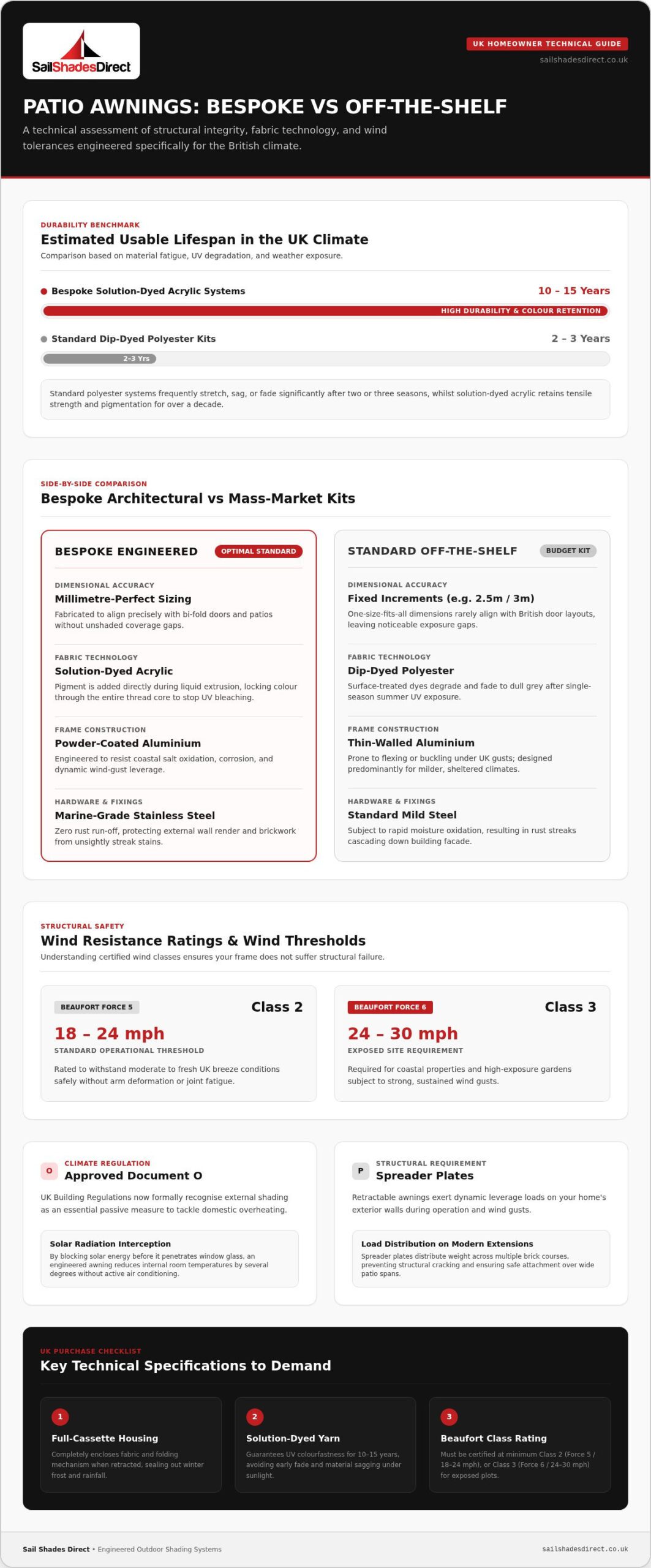
Retailers typically sell awnings in fixed increments, such as 2.5m or 3m widths. This “one size fits all” approach rarely aligns with the specific dimensions of British bi-fold doors or patio layouts, often leaving frustrating gaps in shade coverage. Bespoke fabrication allows for millimetre-perfect accuracy. This ensures the cassette sits flush against your brickwork and covers the entire desired area without looking like a “tacked-on” afterthought. You get a seamless transition from your kitchen or lounge to the terrace, tailored exactly to your home’s unique footprint.
Longevity and the British Climate
The British climate is famously temperamental. Standard garden awnings often rely on thin-walled aluminium and dip-dyed polyester fabrics that can stretch, sag, or fade within just two or three seasons. Professional-grade systems utilise robust retractable awning mechanisms and fabrics, such as solution-dyed acrylics, which maintain their colour and tensile strength for over a decade. These frames are built to withstand the dynamic leverage of wind gusts that would buckle a budget alternative. If you are looking to cover an exceptionally large or awkwardly shaped area where a traditional arm awning might not reach, you might also consider bespoke sail shades UK as a high-performance alternative.
Choosing a high-end system means you are prioritising craftsmanship and precision. High-quality indicators include:
- Powder-coated aluminium frames that resist coastal salt corrosion and oxidation.
- Stainless steel fixings that won’t leave unsightly rust streaks on your external render or brickwork.
- Solution-dyed acrylics that offer a lifespan of 10-15 years compared to the 2-3 years typical of polyester.
By prioritising quality from the outset, you avoid the hidden costs of frequent repairs and replacements. Ultimately, the most vital factor in what to consider when buying a patio awning is how well the system is engineered to protect your home and your lifestyle for years to come.
Technical Considerations: Fabrics, Frames, and Wind Ratings
Aesthetics might draw you in, but technical specifications ensure your investment survives its first British winter. When debating what to consider when buying a patio awning, the choice of fabric is paramount. Most high-end systems utilise solution-dyed acrylic rather than standard polyester. This process involves adding pigment to the yarn whilst it is still in liquid form, ensuring the colour runs through the entire thread. This technology prevents the fabric from fading into a dull grey after just one summer of UV exposure, maintaining its vibrancy and structural integrity for years.
These fabrics do more than just look good; they are critical for climate control. External shading is now recognised under UK Building Regulations Approved Document O as a vital passive measure to reduce domestic overheating. By blocking solar radiation before it hits your glass, a quality awning can reduce internal temperatures by several degrees, making your home more comfortable without relying on air conditioning.
Safety is equally important, particularly in exposed areas. Awnings are rated by wind classes based on the Beaufort scale. A standard Class 2 rating can withstand a Force 5 wind (approx. 18-24 mph), whilst a Class 3 rating is required for Force 6 (approx. 24-30 mph). Understanding these thresholds is a vital part of what to consider when buying a patio awning to ensure the frame doesn’t suffer structural damage during a sudden gust. If you’re unsure which rating your garden requires, you can explore our bespoke shading options for expert advice.
Choosing the Right Fabric for Your Lifestyle
Modern fabrics often feature nano-coatings that create a self-cleaning effect; dirt simply washes away with the next rain shower. You should also consider the “feel” of the shade. Darker fabrics are excellent for reducing glare and blocking up to 98% of UV rays, though they can feel slightly warmer underneath. Lighter tones reflect more heat, creating a brighter, cooler ambience. Most bespoke awnings use water-repellent acrylics designed for light showers, though they aren’t intended to act as a permanent umbrella during heavy cloudbursts.
Heavy-Duty Hardware and Engineering
The frame is the skeleton of your shading system. High-quality heavy duty arm awnings use thick-walled, powder-coated aluminium to prevent corrosion, especially in coastal postcodes. Inside these arms, powerful tension springs keep the fabric taut, preventing it from flapping or sagging. Every bolt and pin should be made from A2 or A4 grade stainless steel to prevent rust streaks from ruining your home’s exterior render. Precision engineering ensures that the mechanism operates smoothly every time, whether you are extending it for a morning coffee or retracting it as the sun sets.
Operational Mechanics: Manual, Motorised, or Automatic?
Deciding how your shading system functions is a pivotal part of what to consider when buying a patio awning. For smaller terraces or budget-conscious projects, manual operation remains a reliable, low-maintenance choice. These systems use a detachable crank handle to extend and retract the fabric. Whilst perfectly functional, they do require a degree of physical effort, especially for wider spans. Most modern homeowners now opt for motorised convenience, which replaces the manual labour with a quiet, powerful tubular motor hidden inside the cassette.
Before committing to an installation, it’s worth checking your permitted development rights, particularly if you live in a conservation area or a listed building. While most domestic awnings don’t require formal planning permission, the addition of electrical feeds for motorised systems must be handled with care to ensure compliance with building standards. A motorised system doesn’t just offer luxury; it provides a smoother, more controlled movement that protects the internal tensioning arms from the jerky motions often associated with manual cranking.
The Case for Motorisation
Motorisation is particularly beneficial for high-end, heavy-duty arm awnings where the fabric weight and spring tension are significant. With the touch of a button or a smartphone app, you can position your shade with millimetre precision. This consistent operation reduces wear and tear on the fabric and the folding arms, potentially extending the lifespan of the entire system. If you prefer a different aesthetic for your garden, you might want to compare these traditional systems with motorised rolling sun sails, which offer a contemporary, architectural look with the same effortless control.
Weather Sensors: Your Awning’s Insurance Policy
Automated sensors act as an invisible guardian for your investment. Wind sensors are perhaps the most critical; they detect vibration or air speed and automatically retract the awning if conditions become dangerous. This is essential in the UK, where a sudden gust can appear without warning. Sun sensors provide a different kind of value by deploying the awning when temperatures rise, keeping your indoor rooms cool even if you aren’t at home. Rain sensors can also be integrated, though their primary role is often to retract the fabric to prevent water from pooling and stretching the material.
Modern systems also integrate seamlessly with smart home ecosystems like Somfy TaHoma or Zigbee-compatible hubs. This allows you to schedule your shading or trigger it via voice commands, creating a truly connected outdoor living experience that responds to your daily rhythm. By choosing automation, you’re not just buying a product; you’re investing in peace of mind.
Installation and Structural Requirements for UK Homes
Even the most beautiful awning is only as good as the wall it is attached to. When evaluating what to consider when buying a patio awning, you must look beyond the fabric and focus on the structural integrity of your home’s exterior. UK properties present a diverse range of challenges, from traditional solid brickwork to modern timber frames and rendered lightweight blocks. A standard 4m by 3m extended awning can generate a dynamic pull-out force of between 250kg and 500kg during a sudden 30mph wind gust. This immense leverage means that standard mechanical expansion bolts are often insufficient. Instead, professional installers use chemical resin injection anchors to ensure the fixing is permanent and safe, particularly when dealing with aerated blocks like Celcon or Thermalite.
Electrical requirements are another vital factor for motorised systems. Any external power feed must comply with UK Building Regulations Part P, requiring an RCD-protected supply and an IP66-rated external socket or fused spur. This ensures your smart sensors and motors operate safely in all weather conditions, providing the reliability you expect from a high-end installation.
Mounting Challenges and Solutions
Many UK homeowners face difficulties with low eaves or single-storey extensions. Statistics suggest that roughly 60% of residential installations require specialist mounting hardware, such as spreader plates or gutter brackets, to distribute the weight safely. Spreader plates, typically between 600mm and 1000mm in length, are essential for bungalows or extensions where the top courses of brickwork lack the dead-weight compression of an upper floor. Without them, the leverage of the awning could actually peel the brickwork away from the structure. Additionally, your installer will ensure a minimum pitch of 14 degrees. This angle is necessary to ensure effective water runoff, preventing rain from pooling and causing the fabric to stretch or the motor to burn out.
The Professional Fitting Process
Attempting a DIY installation on a heavy-duty bespoke system is dangerous and usually voids your manufacturer’s warranty. These units are incredibly heavy, and the spring tension in the arms is significant. A professional site survey is the first step in the process. An expert will assess your wall substrate and measure the space to the millimetre, ensuring the cassette doesn’t interfere with downpipes or vents. Investing in professional awning installation ensures that every bracket is engineered for your specific facade, providing long-term safety and peace of mind.
Ready to transform your terrace with a safe, expertly fitted shading solution? Enquire about our bespoke arm awnings today to start your project with a professional survey.
The Final Checklist: Making Your Bespoke Selection
Choosing the right shading system is the final step in transforming your terrace into a functional, stylish extension of your home. By now, you’ve seen that what to consider when buying a patio awning goes far beyond simple aesthetics. It’s a balance of millimetre-perfect sizing, high-performance fabric selection, and robust structural engineering. Before you finalise your project, ensure your checklist includes a cassette colour that complements your existing architecture. Most premium systems offer a vast range of RAL colours, allowing you to match the aluminium housing to your window frames or bi-fold doors for a truly integrated look.
Don’t forget to think about how you’ll use the space as the sun goes down. Integrated LED lighting bars built into the awning arms or the cassette underbelly can extend your patio utility well into the evening, creating a warm, inviting atmosphere for hosting. Whether you’re prioritising UV protection for a children’s play area or seeking a sophisticated backdrop for alfresco dining, every detail should be tailored to your specific lifestyle requirements.
Designing for Your Specific Use Case
The requirements for a residential garden often differ significantly from those of a high-traffic business environment. If you are a business owner looking to enhance a pub garden or a restaurant terrace, commercial shading solutions UK require a different scale of durability and often incorporate giant umbrellas or coupled awning systems to cover vast spans. For homeowners, the focus is often on seamless operation and discreet aesthetics. Whatever your goal, consider adding 3D motion sensors; these are a small investment that provides significant protection by automatically retracting the system if the wind picks up whilst you’re busy entertaining guests.
Why Sail Shades Direct is Your Ideal Partner
At Sail Shades Direct, we pride ourselves on a “can-do” attitude that tackles even the most complex architectural challenges. We aren’t a faceless corporation; we’re a privately owned, expert-led team with over 10 years of experience in fabricating and fitting bespoke shading across the UK. We understand that every home is unique, which is why we offer a personal touch and a deep portfolio of technical mastery to ensure your installation is flawless. We take the stress out of the process by handling everything from the initial site survey to the final electrical sign-off.
Your perfect outdoor environment is only a conversation away. If you’re ready to review what to consider when buying a patio awning for your specific property, we’re here to help. Contact us today to organise a bespoke design consultation and take the first step toward a more versatile, stylish patio.
Ready to Transform Your Outdoor Living Space?
Your garden deserves a shading solution that is as resilient as it is beautiful. We’ve explored the technical and structural essentials, from the importance of wind class ratings to the necessity of professional spreader plates for modern UK homes. Now that you understand exactly what to consider when buying a patio awning, you can move away from the frustration of flimsy retail kits and towards a millimetre-perfect, bespoke installation.
At Sail Shades Direct, we bring over 10 years of expertise to every project, offering a personal touch that only a privately owned business can provide. Our team handles the entire process with national UK coverage, ensuring your arm awning is tailored to your specific requirements and fitted for long-term safety. Don’t let the unpredictable British weather dictate how you use your terrace.
Enquire about your bespoke patio awning today and let our shading experts create a durable, stylish environment that you can enjoy for years to come! We’re ready to help you bring your vision to life with precision and care.
Frequently Asked Questions
Do I need planning permission for a patio awning in the UK?
Most retractable awnings fall under Permitted Development rights and don’t require formal planning permission. However, if your property is Grade I or II listed, or situated within a Conservation Area, you must consult your local planning authority before proceeding. It’s also vital to ensure the structure doesn’t project over a public highway. Assessing these legalities is a key part of what to consider when buying a patio awning to avoid future enforcement issues.
Can I use my patio awning in the rain?
High-quality arm awnings are designed primarily for sun protection and light rain showers. Whilst the solution-dyed acrylic fabrics are water-repellent, they aren’t intended for heavy cloudbursts or prolonged winter wetness. To prevent water pooling, which can stretch the fabric or damage the motor, your system must be installed with a minimum 14-degree pitch. Always retract the canopy during heavy rain or snow to maintain its structural integrity and prevent hydraulic sagging.
What is the maximum wind speed an awning can handle?
The wind resistance depends on the awning’s EN 13561 classification. A Class 2 rating, which is the recommended baseline for most UK homes, can handle Beaufort Scale Force 5 winds, roughly 18 to 24 mph. For coastal or exposed hillside locations, a Class 3 rating is necessary for Force 6 winds. Integrating a 3D motion sensor is a smart way to automate protection, ensuring the system retracts safely before wind speeds reach dangerous levels.
How much maintenance does a bespoke patio awning require?
Bespoke systems are designed for longevity but do require occasional care to stay in peak condition. You should lightly brush off loose debris like leaves or bird fouling and wash the fabric with lukewarm water and mild soap once a year. It’s also sensible to inspect the wall fixings and lubricate the folding arm hinges with a dry silicone spray. These simple steps ensure your investment remains a stylish and functional part of your home for many years.
Can an awning be fitted to a house with external wall insulation?
Yes, an awning can be fitted to houses with external wall insulation, but it requires specialist engineering. Standard brackets cannot be crushed against the insulation; instead, we use thermally broken stand-off spacers anchored into the structural masonry. Assessing your wall substrate is a vital part of what to consider when buying a patio awning to ensure the installation is safe and doesn’t compromise your home’s thermal envelope or the aesthetic finish of your render.
What is the difference between a full-cassette and a semi-cassette awning?
A full-cassette awning provides the highest level of protection because the fabric, arms, and motor are completely enclosed within a sealed aluminium housing when retracted. This is ideal for the UK climate as it prevents moss and dirt buildup during winter. A semi-cassette model leaves the arms and the underside of the fabric roll partially exposed. Whilst semi-cassettes are often more budget-friendly, the full-cassette remains the most popular choice for homeowners seeking maximum durability and a discreet look.
How long does a professional awning installation take?
A professional installation typically takes between four and six hours for a standard residential arm awning. This timeframe includes the precise mounting of brackets, chemical resin anchoring, and the commissioning of any motorised sensors or smart-home hubs. More complex projects involving large spreader plates or extensive electrical hardwiring might extend to a full day. Our expert team ensures the site is left clean and that you’re fully briefed on how to operate your new system.
Are motorised awnings noisy to operate?
Modern motorised systems are remarkably quiet and discreet. High-end tubular motors produce a gentle hum that is barely audible over natural garden sounds. You won’t have to worry about disturbing the peace whilst enjoying a morning coffee or hosting an evening dinner. This quiet operation is a significant benefit of choosing a professional motor over the clunky, noisy mechanisms often found in entry-level, mass-produced alternatives. It ensures a seamless transition between shade and sun without any mechanical disruption.