Average Cost of a Retractable Awning Installed UK: 2026 Price Guide
Is the cheapest awning actually the most expensive mistake you’ll make this year? It’s a common concern, especially when a bargain kit might fail after just one unpredictable British winter. When you’re researching the average cost of a retractable awning installed UK wide, the real value isn’t found in the lowest price tag; it’s found in the cost per year of reliable, high-performance shade. You want an outdoor space that feels like a sanctuary, not a source of stress regarding structural integrity or electrical safety.
We know that choosing between manual cranks and sophisticated motorised systems can feel confusing. This guide provides total clarity on the investment required for professional-grade installations, ranging from entry-level options to premium bespoke solutions. We’ll break down how different cassette designs protect your fabric, which wind-resistance features are essential for your location, and how to navigate electrical regulations with ease. You’ll finish this article with the confidence to select a system that adds genuine value to your home for a decade or more.
Key Takeaways
- Understand the three main price tiers and how the average cost of a retractable awning installed UK varies based on cassette design and engineering quality.
- Learn why motorised arm awnings have become the modern standard for convenience and how they integrate with weather sensors to protect your investment.
- Discover why a professional structural survey is essential to ensure your property can safely manage the leverage of an extended awning.
- Identify why bespoke solutions outlast budget alternatives by using weather-resistant fabrics and precision-engineered frames tailored to your home.
- Uncover the key variables that drive installation costs, from specialised spreader plates for modern extensions to high-performance fabric coatings.
The UK Price Landscape for Retractable Awnings in 2026
Understanding the average cost of a retractable awning installed UK wide in 2026 requires looking beyond the initial sticker price. Recent shifts in global material costs, particularly for high-grade aluminium and solution-dyed acrylic fabrics, have influenced the market significantly. Whilst you might see tempting offers in DIY stores, these “off-the-shelf” prices rarely account for the essential structural components or the specialist labour required for a safe, long-lasting fit. A professional-grade system is an investment in your property’s architecture, meaning the total cost reflects the engineering precision needed to handle the leverage of an extended arm against your wall.
Realistic expectations are vital when planning your outdoor space. Most standard residential models are retractable lateral arm awnings, which rely on high-tension springs to keep the fabric taut. In 2026, the price landscape is defined by the quality of these internal mechanisms and the level of protection offered by the cassette. A fully installed price doesn’t just buy the product; it covers a comprehensive structural survey, heavy-duty fixings, and the technical expertise to ensure the unit remains level and secure through years of British weather.
Entry-Level vs. Mid-Range Investment
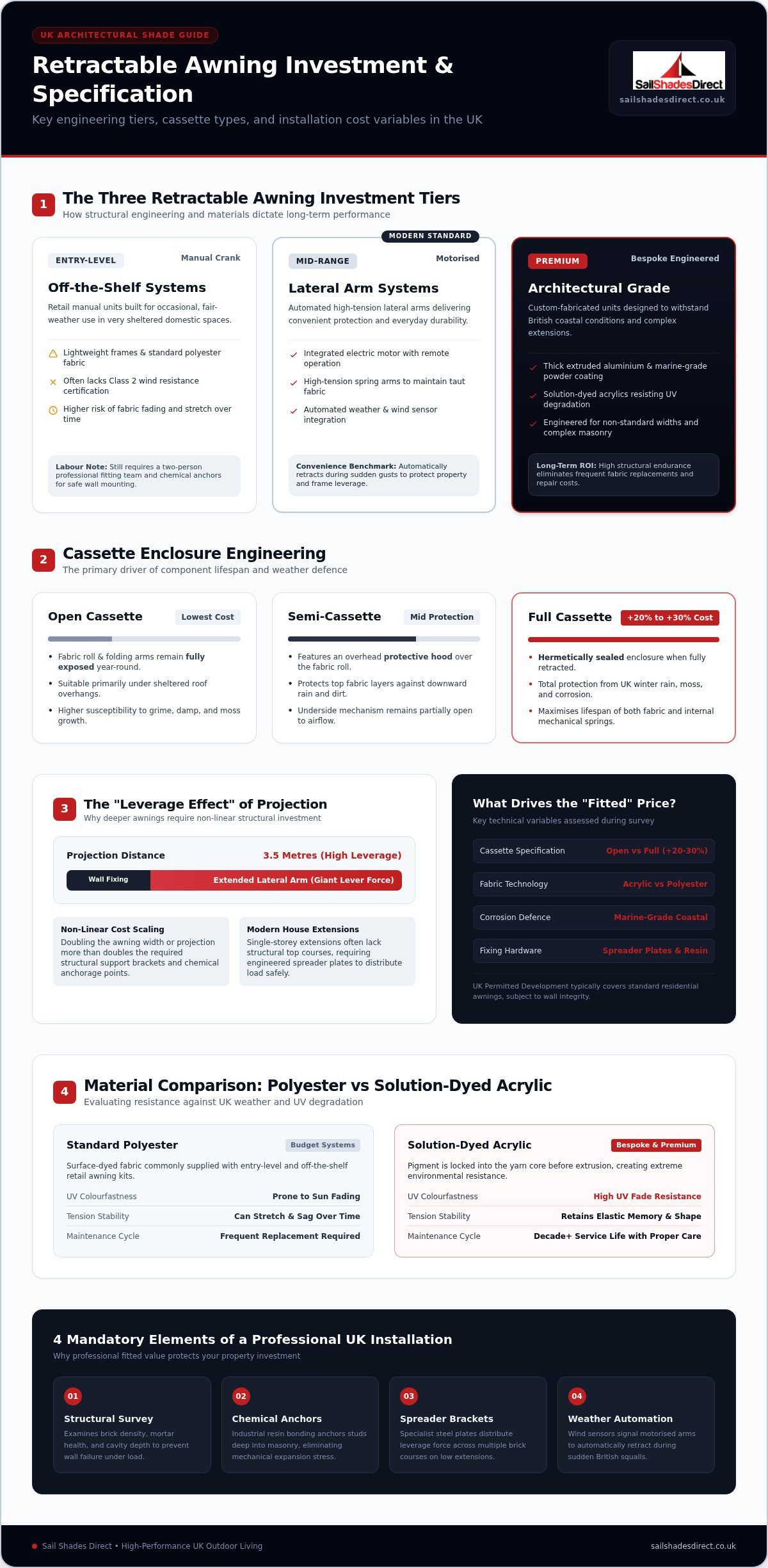
National retailers often supply entry-level manual systems that appeal to those on a tighter budget. These units typically feature lightweight frames and basic polyester fabrics, which can be prone to fading or stretching over time. They’re suitable for occasional use in very sheltered spots, but they often lack the “class 2” wind resistance required for more exposed UK gardens. It’s also vital to remember that labour costs for a basic fitting stay remarkably consistent regardless of product quality. You’ll still need a two-person team and professional-grade chemical anchors to ensure the installation is safe, which can make the total “fitted” price of a budget unit feel surprisingly high compared to the product’s base cost.
The Premium Bespoke Bracket
Investing in the premium bracket means choosing architectural-grade arm awnings designed for decades of service. These systems use thicker extruded aluminium and marine-grade coatings that won’t corrode in coastal air. The real value here lies in custom fabrication. If your home has a non-standard width or requires the awning to be mounted onto a complex extension, a bespoke approach is often the only safe solution. These premium systems offer a much higher long-term ROI because they use solution-dyed acrylics that resist UV degradation. You aren’t just paying for the name; you’re paying for a “can-do” engineering spirit that solves structural challenges whilst reducing the frequency of expensive fabric replacements or mechanical repairs.
Key Variables: What Drives the Cost of Your Installation?
While the average cost of a retractable awning installed UK wide provides a useful baseline, your property’s specific requirements will ultimately shift the dial. It is rarely a linear price increase. Doubling the width of a system often requires more than double the structural support. Every variable, from the type of cassette to the weight of the fabric, plays a role in the final investment. Most residential projects fall under UK permitted development rights guidance, but the physical constraints of your wall often dictate the engineering needs.
The style of cassette you choose is a significant cost driver. An open cassette is the most budget-friendly, but it leaves the fabric and mechanism exposed to the elements year-round. A semi-cassette offers a top-cover “hood” for protection, whilst a full-cassette system completely hermetically seals the unit when retracted. A full cassette typically costs 20% to 30% more than simpler designs, but it pays for itself by preventing moss and weather corrosion, significantly extending the life of the internal components.
Location also changes material requirements. If you live in a coastal area or an exposed hillside, standard fixings won’t suffice. You’ll need marine-grade powder coating and stainless steel components to resist salt-air corrosion. These specialized materials ensure your system remains functional and aesthetically pleasing, even in the harshest British climates.
Size and Projection Requirements
Size is the most obvious variable, but the “projection” (how far the awning extends) is what really tests the engineering. A deeper projection acts like a giant lever against your house. If you want a 3.5-metre extension, you aren’t just buying more fabric; you’re paying for high-tensile springs and reinforced arm joints. For wide spans or modern extensions with minimal brickwork, we often use bespoke spreader plates to distribute the weight safely. If you’re unsure about the structural capacity of your patio doors, exploring heavy-duty arm awnings can provide the necessary stability for larger coverage areas.
Material Selection and Frame Durability
Fabric technology has advanced rapidly. Standard polyester is inexpensive but often degrades within two to three years under UV exposure. Solution-dyed acrylic is the professional choice, offering a lifespan of 10 to 15 years and superior colour fastness. These fabrics often include self-cleaning coatings that use the “lotus effect” to shed dirt during rain showers. When combined with a precision-engineered aluminium frame, these materials transform a simple sunshade into a permanent architectural fixture that withstands the test of time.
Manual vs. Motorised: Evaluating the Cost-to-Convenience Ratio
Selecting the right operation method is a pivotal decision that influences the average cost of a retractable awning installed UK homeowners expect. While manual crank handles remain a functional entry point, the market has shifted dramatically towards automation. The price gap between a manual system and an integrated tubular motor is often seen as a luxury, but it’s actually an investment in the system’s longevity. For larger installations, particularly heavy duty arm awnings, motorised operation is now the standard recommendation. These robust systems require significant torque to deploy and retract correctly; a motor ensures this happens smoothly every time, preventing the mechanical strain that often occurs with uneven manual cranking.
Modern motorisation isn’t just about avoiding a workout; it’s about intelligent protection. A motorised system allows for the integration of smart sensors that act as a silent guardian for your investment. Whether you’re relaxing inside or away from home, these systems respond to the environment in real-time. It’s this “set and forget” capability that provides the greatest peace of mind, especially given the unpredictable nature of British weather. When you weigh the cost against the potential price of repairing a wind-damaged frame, the value of automation becomes clear.
The Cost of Automation and Smart Sensors
The real magic of a motorised system lies in its ability to think for itself. Integrating wind, sun, and rain sensors adds a layer of protection that manual systems simply can’t match. A 3D motion sensor fitted to the front rail can detect sudden gusts and auto-retract the fabric before damage occurs. This is why we always suggest looking for British Blind and Shutter Association accredited installers who understand how to configure these smart systems for the specific wind loads of your property. Beyond safety, the convenience of smartphone app integration or voice control through home automation hubs transforms your patio into a truly modern living space. Choosing reputable motor brands like Somfy or Elero ensures you have access to reliable spare parts and long-term software support.
Maintenance and Long-Term Reliability
It’s a common misconception that more technology means more things to go wrong. In reality, motorised awnings often outlast their manual counterparts because they ensure the fabric is always held at the correct tension. This prevents “bagging” or over-stretching, which are common issues when a manual handle is over-cranked by mistake. If a manual gearbox fails, it can be a fiddly repair, whereas modern tubular motors are designed as sealed, maintenance-free units. From an operational standpoint, these motors are incredibly efficient, costing just pennies in electricity to run for an entire season. By removing the physical effort of winding a heavy arm, you’re much more likely to use your awning frequently, ensuring you get the full lifestyle benefit from your investment.
Professional Installation: Why the Fitted Price Matters
The “fitted” element of your quote is often where the most significant value lies, yet it’s frequently the most misunderstood. When calculating the average cost of a retractable awning installed UK residents should look for, you aren’t just paying for time; you’re paying for structural certainty. A fully extended arm awning acts as a massive cantilever, exerting hundreds of kilograms of force on your property’s masonry. If the mounting fails, the damage to your home can be catastrophic. Professional fitting ensures that these forces are safely transferred into the structural heart of your building rather than just the surface brickwork.
Whilst it’s tempting to view installation as a secondary cost, it’s actually the foundation of your awning’s 10-plus year lifespan. A professional team brings the “can-do” attitude required to solve complex architectural challenges, ensuring that your investment doesn’t just look good on day one, but remains safe during a sudden summer gust. This expertise is what separates a long-term home improvement from a temporary fixture that might compromise your property’s integrity.
Structural Surveys and Mounting Complexity
A professional installation begins long before a drill touches the wall. A thorough structural survey identifies potential weak points like crumbling mortar, blown bricks, or modern timber-frame constructions that require specialist handling. For many UK homes, particularly single-storey extensions or bungalows, standard brackets aren’t enough. We often utilise bespoke spreader plates to distribute the load across a larger surface area, preventing the leverage from pulling bricks out of the wall. We also use chemical resin anchors instead of traditional mechanical bolts. This epoxy-based system creates a permanent bond with the inner masonry, providing the high-wind durability that standard DIY kits simply can’t offer.
Electrical Connections and Compliance
If you’ve opted for a motorised system, the electrical installation is a matter of legal compliance as much as convenience. In England and Wales, external electrical work must comply with Part P of the Building Regulations. This means the connection to your mains supply should be handled by a qualified professional to ensure it’s safe, earthed, and protected by a weatherproof IP66-rated fused spur. Having a professional certificate for this work isn’t just a “nice to have”; it’s a vital document for your home insurance should you ever need to make a claim. This level of certification is often factored into the average cost of a retractable awning installed UK wide, providing peace of mind that the job is done to current safety standards.
It’s also worth noting the “DIY trap” regarding warranties. Most premium manufacturers will void their product guarantee if the awning isn’t installed by a competent professional. If a bracket fails due to poor anchoring, you’ll be left with a broken awning and a damaged wall, with no recourse for repair. If you want to ensure your property is in safe hands, you can book a professional installation survey with our expert team today.
Securing Value: Why Bespoke Solutions Outlast Alternatives
The true value of an outdoor shading system isn’t found in the lowest quote but in the years of trouble-free use it provides. Whilst the average cost of a retractable awning installed UK wide might seem like a simple figure, a bespoke solution ensures that every penny works toward the longevity of your home’s architecture. A custom approach allows you to match the frame colour exactly to your window joinery and select fabrics that complement your masonry. This isn’t just about aesthetics; it’s about solving specific shading problems that mass-produced products simply can’t touch.
Our “can-do” spirit means we don’t shy away from complex structural fittings. Whether it’s mounting onto a specific type of cladding or creating a multi-layered shading plan, a bespoke solution adapts to your life. For larger gardens, motorised rolling sun sails can beautifully complement a traditional arm awning, providing total coverage for dining areas and lounge zones alike. This versatile approach transforms a simple patio into a functional outdoor room that feels like a natural extension of your house.
Bespoke Design for the British Climate
Standard kits often fail because they aren’t engineered for the specific wind loads found in the UK. A bespoke system is fabricated with higher-gauge aluminium and precision-engineered joints that handle gusts with ease. We also prioritise fabrics with solution-dyed fibres that resist the mould and mildew issues common in our damp climate. By integrating your awning with bespoke sail shades UK homeowners can create a cohesive, professional look that significantly increases the kerb appeal and functional value of their property. It’s about building a system that stands up to the weather whilst remaining a favourite feature of your home for a decade or more.
The Sail Shades Direct Advantage
At Sail Shades Direct, we bring over 10 years of experience to every project. We prioritise engineering standards over entry-level pricing because we know that a safe, durable installation is the only way to protect your investment. Our nationwide professional fitting service means you get the same level of craftsmanship regardless of your location. We handle the technical heavy lifting, from initial structural surveys to final commissioning, so you can focus on enjoying your new outdoor reprieve. We believe that every project is unique, and our portfolio of architectural solutions reflects that commitment to variety and precision.
If you’re ready to move beyond generic estimates and want to understand the real-world average cost of a retractable awning installed UK homeowners can trust for the long term, the next step is a tailored consultation. We’ll look at your specific wall type, desired coverage, and lifestyle needs to provide an accurate, transparent quote that reflects the true value of a bespoke installation. No matter the scale of your inquiry, our team is ready to help you create an environment that offers a necessary reprieve from the pressures of daily life.
Ready to Transform Your Outdoor Living Space?
Choosing the right shading solution is an investment in your home’s future and your own well-being. We’ve explored how the average cost of a retractable awning installed UK homeowners find in 2026 depends on everything from cassette protection to smart automation. The real value lies in professional fitting that ensures structural safety and high-performance architectural fabrics that withstand the British elements. By opting for a bespoke system, you avoid the “DIY trap” and gain a solution tailored specifically to your property’s unique requirements.
With over 10 years of British craftsmanship behind us, our team is ready to provide expert nationwide installation that turns your patio into a versatile sanctuary. Don’t settle for a flimsy alternative when you can have a precision-engineered arm awning designed to last for a decade or more. Are you ready to create your perfect outdoor reprieve? Request a bespoke quote for your professional awning installation and let’s start designing a space that works for you! We look forward to helping you make the most of your garden, whatever the weather brings.
Frequently Asked Questions
Is it cheaper to install a retractable awning myself?
While you might save on initial labour fees, DIY installation often proves more expensive long-term. Standard off-the-shelf kits lack the architectural durability of bespoke arm awnings and usually void manufacturer warranties if not fitted by a professional. Self-installation also risks structural damage to your property. Professional teams use specialist chemical resin anchors and spreader plates to ensure the cantilever forces don’t compromise your masonry or safety.
How much does an electrician charge to wire a motorised awning in the UK?
Labour rates for qualified electricians in 2026 vary depending on the complexity of the cable run and your property’s existing consumer unit. Most motorised systems require a dedicated, weatherproof IP66-rated fused spur to meet safety standards. These electrical fees are an essential part of the average cost of a retractable awning installed UK homeowners should budget for to ensure full Part P building regulation compliance and safety.
Do I need planning permission for a retractable awning?
Most residential retractable awnings are classified as Permitted Development in the UK and don’t require formal planning permission. However, you should always check with your Local Authority if your property is Grade I or II listed or located within a strict Conservation Area. Permission is also typically required if the awning projects over a public pavement or highway, or if your property is subject to specific Article 4 Directions.
What is the average lifespan of a high-quality retractable awning?
A premium, professionally fitted system typically lasts between 10 and 15 years with basic care. The powder-coated aluminium frames are engineered to last decades, whilst high-performance solution-dyed acrylic fabrics are designed to resist UV fading and mould for over a decade. Choosing bespoke architectural-grade materials ensures your investment remains a functional and attractive feature of your home far longer than budget, mass-produced alternatives found in retail stores.
How much extra does a wind sensor cost and is it worth it?
Adding a wind or vibration sensor is one of the most valuable upgrades for any motorised system. These smart sensors act as a silent guardian, automatically retracting the fabric if gusts reach speeds that could damage the arms or your wall. While the price varies based on the technology used, the peace of mind it provides is invaluable. It prevents accidental damage when you’re away from home or distracted inside.
Can an awning be fitted to a bungalow or a house with cladding?
Yes, though these properties require specialist mounting solutions to handle the structural leverage. Bungalows often need custom soffit brackets to achieve the necessary mounting height, whilst homes with cladding or timber frames require bespoke spreader plates. These plates distribute the weight safely into the internal structural heart of the building. Our “can-do” attitude ensures we can provide safe, durable arm awnings for even the most complex architectural layouts.
Will a retractable awning add value to my UK property?
A high-quality, bespoke installation can significantly enhance the kerb appeal and functional value of your home. By creating a seamless transition to an “outdoor room,” you’re effectively increasing the usable living space. UK homebuyers often view professionally fitted shading as a premium addition, especially when it features integrated lighting or smart automation. It transforms a simple patio into a sophisticated environment for entertaining, which is a major selling point.
How does the cost of an awning compare to a bespoke sail shade?
Retractable awnings typically require a higher initial investment because of the complex mechanical arms and protective cassettes involved. Bespoke sail shades offer a different architectural aesthetic and are often better suited for permanent shade over large or irregular garden zones. Both options provide excellent long-term ROI. The choice usually depends on whether you prefer the flexibility of a retractable arm system or the striking, fixed silhouette of a custom-fabricated sun sail.