
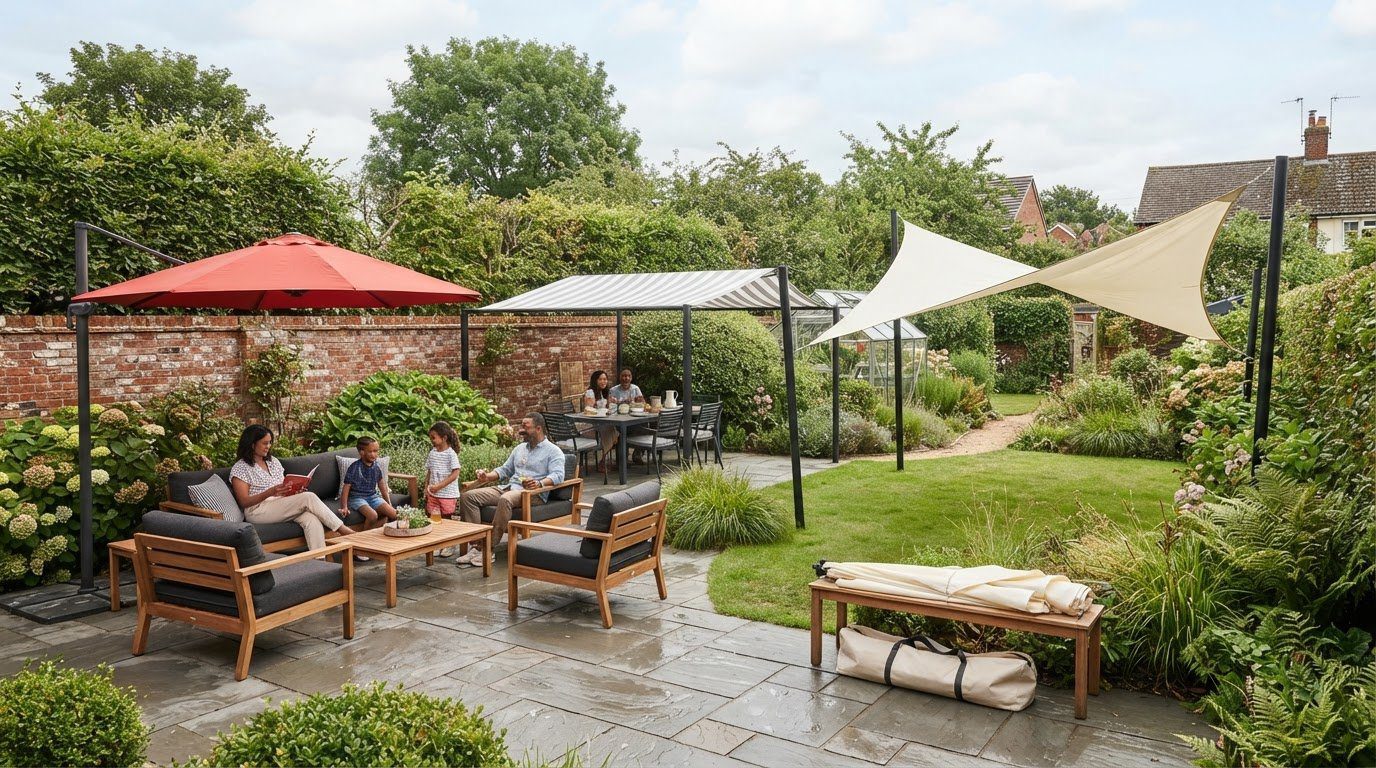
Non-permanent garden shade solutions: flexible ways to create a cooler outdoor space
The most flexible garden shade isn’t always the easiest to live with. A parasol can move with the sun, while a canopy may cover a larger area, but both raise practical questions about positioning, anchoring and storage. Choosing between non-permanent garden shade solutions means looking beyond how quickly they go up: will the option suit your layout, routine and exposure to changeable weather?
It’s understandable to want a cooler, more comfortable outdoor space without committing to a fixed installation. The right temporary choice can provide useful shade while keeping the garden adaptable. However, lightweight options have limits and may need attention when conditions change.
This guide compares removable choices, from portable umbrellas and canopies to shade sails. It explains what to consider before setting them up, storing them or leaving them outdoors. You’ll also learn when frequent adjustment or limited coverage makes a removable option less suitable, and when professionally designed shading, such as a bespoke sail shade, rolling sun sail, arm awning, giant umbrella or exterior blind, may be a better fit.
Key Takeaways
- Understand how portable, removable and retractable shade differ, including the setup and storage each may involve.
- Compare non-permanent garden shade solutions by setup, coverage and how easily they can be stored.
- Check wind exposure, anchoring and product instructions before deciding whether a temporary option suits your garden.
- Use a practical checklist to match your shade choice to the space, who uses it and how the sun moves.
- Recognise when repeated setup or awkward coverage may make professionally designed outdoor shading a better fit.
What counts as a non-permanent garden shade solution?
A non-permanent garden shade solution is a portable, removable or retractable way to create shade without relying on a fixed, permanent structure. These terms describe different types of flexibility. Some options move around the garden, some are taken down, and others adjust in place. Parasols, pop-up gazebos, removable shade cloth and retractable systems all offer flexibility, but differ in how they’re set up, secured and stored.
That flexibility comes with practical trade-offs. A portable option may need assembling and repositioning. Removable fabric needs suitable places to attach and somewhere to go when it’s taken down. Depending on the product and conditions, you may also need to check its instructions and monitor the weather. Consider the full routine, not just the amount of shade it provides.
Portable, removable and retractable shade: what is the difference?
Portable shade, such as a freestanding parasol or pop-up gazebo, can usually be moved to suit a different seating area or put away between uses. Its position and stability depend on the product and how it’s set up. Follow its instructions rather than assuming that a heavier-looking base or frame will suit every garden.
Removable shade includes fabric attached to suitable fixing points that can be taken down. A shade sail is one example, though installation varies. For an overview of what a shade sail is, see Wikipedia. Before choosing removable cloth, check whether your garden has appropriate fixing points and whether putting it up and taking it down will fit your routine.
Retractable shade adjusts rather than being moved as a whole. The mechanism, construction and operation vary by system. Retractable doesn’t automatically mean portable or easy to store. Some systems are professionally fitted, making them different from temporary products you assemble yourself.
Which garden situations benefit most from flexible shade?
For occasional entertaining, a parasol or pop-up gazebo may suit a space that only needs cover when guests are over. You can arrange the garden around the occasion, then put the product away afterwards if its instructions allow and you have room to store it.
Flexible shade can also appeal in a rented home or a garden whose layout changes. However, don’t assume that removable fabric can be attached without permission, or that a suitable fixing point is available. Check your property arrangements and the product’s installation requirements first.
If you use the same patio every day, convenience matters as much as portability. Consider how often you’ll set up or adjust the shade, who needs to use the space and where the equipment will go when it’s not in use. If those everyday tasks feel like a burden, compare options that provide more consistent coverage before deciding.
Compare non-permanent garden shade options by setup, coverage and storage
The best fit depends on how much of the garden you want shaded, how often you’ll set it up and where it can be stored. Use this comparison as a starting point. Actual coverage depends on placement, orientation, fabric and the sun’s movement through the day.
| Option | Setup and likely coverage | Portability and storage | Key limitation |
|---|---|---|---|
| Parasol | Usually straightforward to position beside a table or seating area. Coverage is local and depends on its position. | Can often be moved, but its base takes up space. Check how the canopy and base should be stored. | May need repositioning as the sun moves. Check the instructions for use in exposed conditions. |
| Pop-up gazebo | Creates a covered area for a gathering or temporary use, but needs to be set up before use. | Can be taken down, but the frame and cover need storage space. | Setup, packing away and product guidance all matter. Don’t assume it’s suitable for every location or condition. |
| Removable shade cloth | Can cover a chosen area if appropriate support points and secure fixings are available. | The cloth can be removed, but you’ll need somewhere to store it and time to put it up again. | Coverage and suitability depend on the layout, fixings and product instructions. |
| Retractable shade | Can be adjusted to change the shaded area, depending on the system. | Adjustable doesn’t necessarily mean portable. Construction and operation vary. | May involve a fitted system rather than a product you can move or store away. |
Parasols and pop-up gazebos for adaptable coverage
A parasol is a familiar choice for shading one seating spot. Allow room for its base and check that it won’t obstruct how you use the garden. A pop-up gazebo provides a temporary covered space for entertaining, though assembling it and storing its frame and cover take more effort. For both, check the manufacturer’s guidance before use, especially in exposed conditions. The Natural Learning Initiative at NC State University shares inexpensive ideas for instant, temporary shade, including sails and tarps.
Removable fabric and retractable options for tailored flexibility
Removable fabric is only a practical choice where suitable support and secure fixing points are available. Retractable systems offer a different kind of flexibility: they adjust in place but aren’t necessarily portable or removable. If you’re comparing a more tailored sail-shade design, explore this guide to bespoke sail shades. You can also explore outdoor shade options for professionally designed outdoor shading.
Are non-permanent garden shade solutions reliable in UK weather?
They can be useful, but lightweight or temporary doesn’t mean suitable in every condition. A parasol, gazebo or fabric covering may behave differently depending on its design, how it’s anchored and where it sits. A sheltered patio and an open, exposed part of a garden are different settings, so assess the location as well as the product.
Flexibility doesn’t remove the need for secure installation: wind exposure, suitable anchoring, the product’s instructions and the garden layout all affect whether a shade option can be used safely. Follow the manufacturer’s guidance for setup and use, including instructions about wind, rain, retraction and removal. Don’t assume one product’s advice applies to another.
How wind, rain and sun exposure affect temporary shade
Nearby buildings or planting may offer some protection in a sheltered position, but don’t treat this as a guarantee that a product is safe to leave in place. Open spaces can be more exposed, and the way a shade is supported and secured matters. Check the product instructions for its intended use and conditions rather than relying on a general rule or a neighbour’s experience.
Rain guidance also varies. Some products have specific instructions for wet weather, while others may need to be taken down or retracted. Check before use, and don’t assume a fabric covering is designed to withstand rain simply because it’s used outdoors.
Shade shifts as the sun moves. A parasol positioned over a table earlier in the day may no longer cover it later, and nearby buildings or fences can change where shadows fall. Consider when you need shade and check the area at those times. Its initial position may not provide useful coverage throughout the day.
When should you take temporary shade down?
Check the manufacturer’s instructions for conditions affecting setup, continued use, retraction and removal. If the guidance says to take a product down or retract it in particular weather, follow it. Don’t leave temporary shade in place simply because it appeared stable earlier.
Loose fixings, unexpected movement or visible damage are reasons to stop using the product and reassess it safely. Don’t approach or adjust an unstable structure in conditions that could put you at risk. Once conditions are safe, check the product and its supports, then follow the manufacturer’s advice before using it again.
These checks help you decide whether a flexible option suits your routine and garden exposure. If you need dependable coverage without repeated setup, compare the trade-offs with a professionally designed outdoor shading system rather than assuming every temporary product can remain in place.
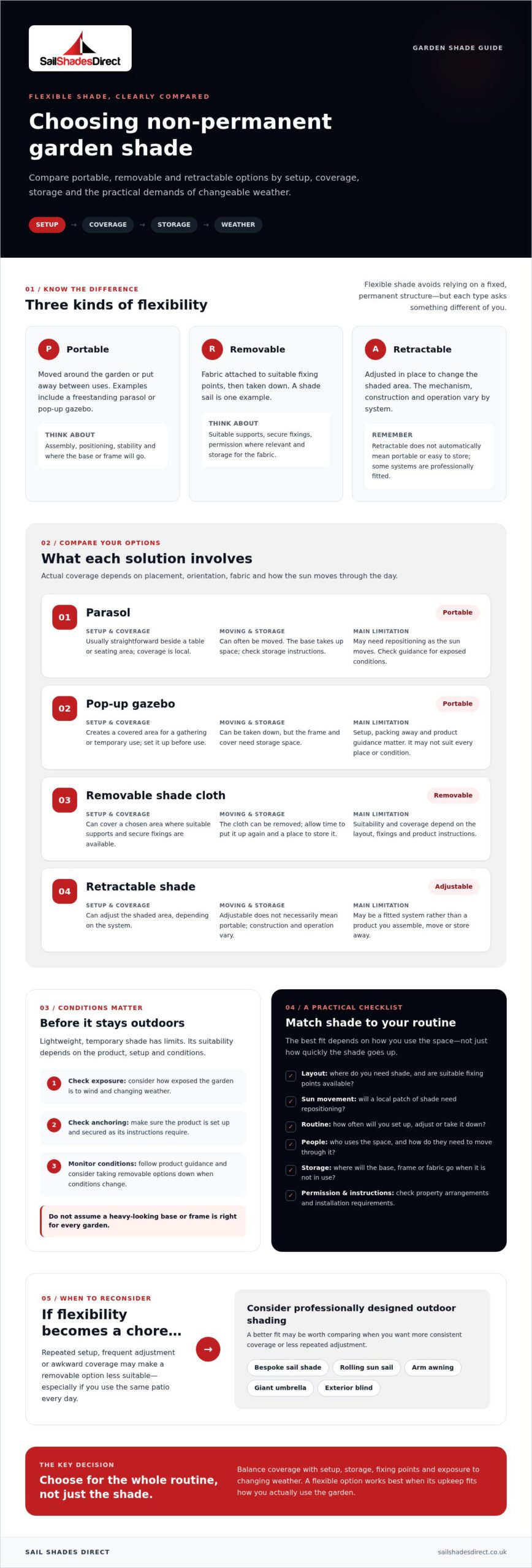
How to choose and set up flexible garden shade: a practical checklist
A little planning helps you choose shade that works with the garden rather than getting in the way. Measure the area, map its daily use, check access and fixing needs, plan storage, then read the product instructions before setting it up. Use the steps below to compare non-permanent garden shade solutions with your space and routine.
Assess the space, users and daily routine
- Measure the area you want shaded. Note the position of seating and tables, nearby doors, paths and garden boundaries. Allow space for people to move around, and consider whether a parasol base or gazebo frame would obstruct a route.
- Check when shade is needed. Observe the area at the times you’re most likely to use it. As the sun changes position, the useful shaded area can shift too. Consider whether you’re happy to reposition a portable option or want coverage that adjusts another way.
- Think about everyone using the space. Children, pets and regular foot traffic may affect where a product can sit and how people move around it. Keep entrances and walkways clear, and consider how often the shade will need to be moved or put away.
Check installation, storage and care before choosing
- Confirm what the setup requires. Does it need a base, suitable fixing points or additional room around it? For removable fabric, check that appropriate supports are available. Don’t assume you can attach it to a fence, wall or other feature.
- Plan where it will go between uses. Check whether you have enough room to store the item and its parts. A solution that’s easy to position but awkward to carry or put away may not suit frequent use.
- Read the instructions before assembly. Follow the manufacturer’s guidance on setup, anchoring, use and weather-related precautions. Check its cleaning and maintenance advice too, as this varies by product.
Finally, consider how often you’ll repeat the routine. If shade is only needed for occasional gatherings, a product you can set up and store may fit well. If it’s part of everyday outdoor use, weigh convenience and coverage alongside portability. The right choice should work not just on a sunny afternoon, but also with your garden’s access, storage and usual pattern of use.
If your measurements point towards a more tailored, consistent solution, explore bespoke outdoor shading options from Sail Shades Direct, including sail shades, rolling sun sails, arm awnings, giant umbrellas and exterior blinds.
When a bespoke garden shade system may suit you better
Portable shade is useful when you want to move it or put it away, but the routine can become a drawback if you’re setting it up and taking it down most days. Awkward coverage, limited storage or a layout that’s difficult to shade with a freestanding option may also be reasons to reconsider. These don’t mean your current product has failed. They’re signs to weigh flexibility against convenience and how well the shade fits your space.
Signs that portable shade no longer meets your needs
Think about how often you adjust the shade, whether it covers the area you actually use and whether there’s room to store it. A parasol that needs frequent repositioning or a gazebo that’s cumbersome to assemble may work for occasional use but feel less practical as part of your daily routine.
If the garden’s shape or layout makes suitable placement difficult, a tailored assessment may help you compare alternatives. Consider the coverage you want, how much adjustment you need and whether professionally designed and installed shading fits better than a product you move yourself. The aim isn’t to give up flexibility without reason, but to find an approach that suits how you use the space.
Explore a tailored option for regular outdoor use
Sail Shades Direct designs, manufactures and installs bespoke outdoor shading across the UK. Its options include bespoke sail shades, rolling sun sails, arm awnings, giant umbrellas and exterior blinds. These are professional offerings, distinct from portable garden products. Which, if any, suits your setting depends on the space and your requirements.
If adjustable coverage is part of your brief, read the rolling sun sails buying guide to explore that category. Then compare the benefits of a tailored system with the setup, storage and movement involved in non-permanent garden shade solutions.
To discuss your space and requirements, explore bespoke outdoor shading with Sail Shades Direct.
Choose shade that works with your garden
The right shade depends on how you use your outdoor space. Compare non-permanent garden shade solutions by setup, coverage, storage and the attention they need in changeable weather. Then consider how often you’ll use and reposition them.
If temporary options feel awkward to manage or don’t suit the area you want covered, professionally designed outdoor shading may be worth exploring. Sail Shades Direct designs, manufactures and installs bespoke shading across the UK, with options including sail shades, rolling sun sails, arm awnings, giant umbrellas and exterior blinds.
Explore bespoke outdoor shading with Sail Shades Direct and discuss an approach that fits your space and requirements. With the right match, you can make your garden more comfortable and enjoy using it your way.
Frequently Asked Questions
What is the best non-permanent garden shade solution?
The best option depends on how much area you need to shade, how often you’ll use it and whether you can store it. A parasol can suit a smaller seating area if there’s room for its base. A pop-up gazebo may suit occasional gatherings but needs assembly and storage. Removable fabric requires suitable fixing points. Compare the setup and product guidance with your garden before choosing.
Can I use a shade sail without permanent posts?
Possibly, if you already have suitable fixing points and the shade sail’s instructions allow the proposed arrangement. Don’t assume a fence, wall or tree can safely support it. Suitability depends on the structure, fixings and installation. If you rent, check permissions before attaching anything. If you can’t confirm that the supports are suitable, consider a freestanding option or seek advice about a professionally designed alternative.
Are pop-up gazebos suitable for windy weather?
Don’t assume a pop-up gazebo is suitable for windy conditions just because it’s designed for outdoor use. Safe use depends on the product, its setup and the exposure of your garden. Read the manufacturer’s instructions for anchoring and weather-related use, and follow any advice to take it down. An exposed position may be less suitable than a sheltered one, but shelter doesn’t guarantee safe use.
How do I shade a garden without drilling into walls?
Choose an option that doesn’t rely on wall fixings, such as a parasol with an appropriate base or a pop-up gazebo set up according to its instructions. These still need suitable positioning and may require storage space. Removable shade cloth needs secure, appropriate support points, so don’t attach it to a fence or other feature without checking suitability. Keep paths, doors and access to seating clear.
Can temporary garden shade stay up all summer?
Only leave it in place if the product instructions allow that use and you can follow any setup, care and weather precautions. Temporary shade isn’t automatically designed for continuous outdoor use. Check it regularly for movement, loose fixings or visible damage, and follow instructions about retracting or removing it. If the guidance calls for taking it down in particular conditions, do so rather than leaving it unattended.
How can I make a temporary garden shade more stable?
Follow the manufacturer’s setup and anchoring instructions, and use only the base, fixings or supports specified for the product. Place it where the guidance allows, taking account of the garden’s exposure and nearby paths or structures. Don’t improvise with extra weights or attach it to an unverified support. If it shifts, loosens or shows damage, stop using it and reassess safely before setting it up again.
Is a retractable shade system considered non-permanent?
Not necessarily. “Retractable” means the shade can be adjusted, while “non-permanent” may mean portable or removable, so the terms aren’t interchangeable. Some retractable systems are fitted in place and aren’t designed to be moved or stored like a parasol. Check how the system is installed and operated. If you need tailored, professionally fitted outdoor shading, compare the available options with your space and requirements.