
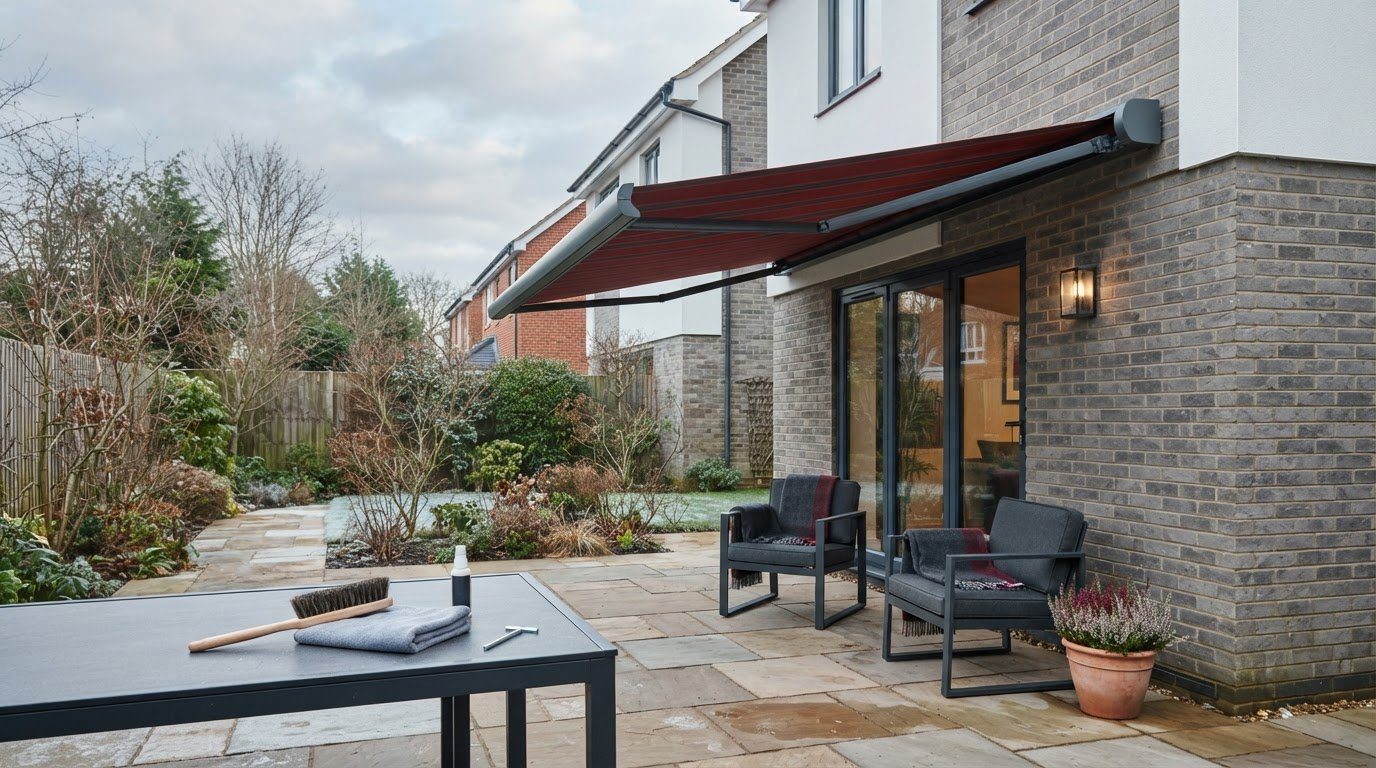
Winter Care for Retractable Awnings: A Practical UK Guide
Could leaving your awning retracted all winter be only part of the answer? Effective winter care for retractable awnings also depends on the fabric’s condition, the mechanism and how exposed the awning is to the weather.
It’s understandable to feel unsure when rain, frost and strong winds arrive. Retractable awnings are designed to provide shade, but heavy rain can lead to water pooling, while wind, snow and ice can strain fabric and moving parts. If a damp awning is rolled away before it dries, trapped moisture may encourage mildew or staining.
A simple seasonal routine can help you protect your awning. This guide explains when to retract it, how to clean and dry it safely, and what to look for during winter checks. You’ll also find practical steps for preparing the fabric and mechanism for colder months, plus advice on what to inspect before opening the awning again in spring. A little care and extra caution in severe weather can help you head into winter with more confidence.
Key Takeaways
- Start winter care for retractable awnings by checking the fabric, frame and operating mechanism before seasonal weather sets in.
- Follow the awning’s own instructions for cleaning and preparation, and make sure the fabric is completely dry before retracting it for an extended period.
- Choose whether to leave the awning open or closed according to its guidance, intended use and exposure to changing weather.
- Check visible parts safely during winter and before spring use, without climbing or opening enclosed mechanisms.
- Pause operation if you notice damage, loose components, unusual resistance or unexpected motor behaviour.
Why winter care for retractable awnings starts before bad weather
Winter preparation involves more than pressing a button when the forecast turns rough. Check the awning while conditions are manageable, remove ordinary dirt using the care method recommended for its fabric, let it dry fully and decide how to protect it when it won’t be in use. Starting early gives you time to notice changes before the awning is exposed to poor weather.
The right routine depends on the awning’s fabric, frame, installation and surroundings. A sheltered position may face different conditions from an exposed one, and products vary in how they’re designed to operate. General information about types of awnings can explain the broad category, but it can’t replace the instructions for your particular model.
Dry fabric and a retracted awning help limit winter exposure, but neither replaces the product’s care and operating guidance.
Keep routine care separate from repairs. A visual check and suitable cleaning are tasks you can do as an owner. Damaged fabric, a loose fixing, a suspected structural issue or an unusual mechanism calls for an assessment, not guesswork. Don’t open enclosed parts or adjust components unless the manufacturer’s instructions say it’s safe. This distinction makes winter care for retractable awnings practical without encouraging risky work.
Which winter conditions can affect an awning?
Persistent damp can leave marks or encourage mildew if fabric stays wet, particularly if it is rolled away before drying. Wind, frost and snow are reasons to be cautious, but they don’t mean every awning will be damaged. The effect depends on factors such as exposure, installation and product design. Check the forecast and your model’s instructions. Don’t assume an awning is suitable for severe weather simply because it can be extended or retracted.
What retractable does and does not mean
Retractable describes how the awning opens and closes. Retracting it when shade isn’t needed can reduce its exposure to weather, but the term alone doesn’t tell you its wind or snow rating or how it should be used in heavy rain. Consult the operating and care instructions for your model, including any stated limits and advice on retraction. If you don’t have the instructions to hand, don’t assume the mechanism makes the awning suitable for all weather.
How to prepare a retractable awning for winter, step by step
Set aside a suitable dry spell before prolonged winter weather arrives. Read the instructions for your particular awning first, then work through the checks below. If the fabric or mechanism is out of safe reach, or the weather makes access difficult, don’t climb or take risks to complete the job. The aim is a careful visual check and appropriate cleaning, not dismantling or repairing parts.
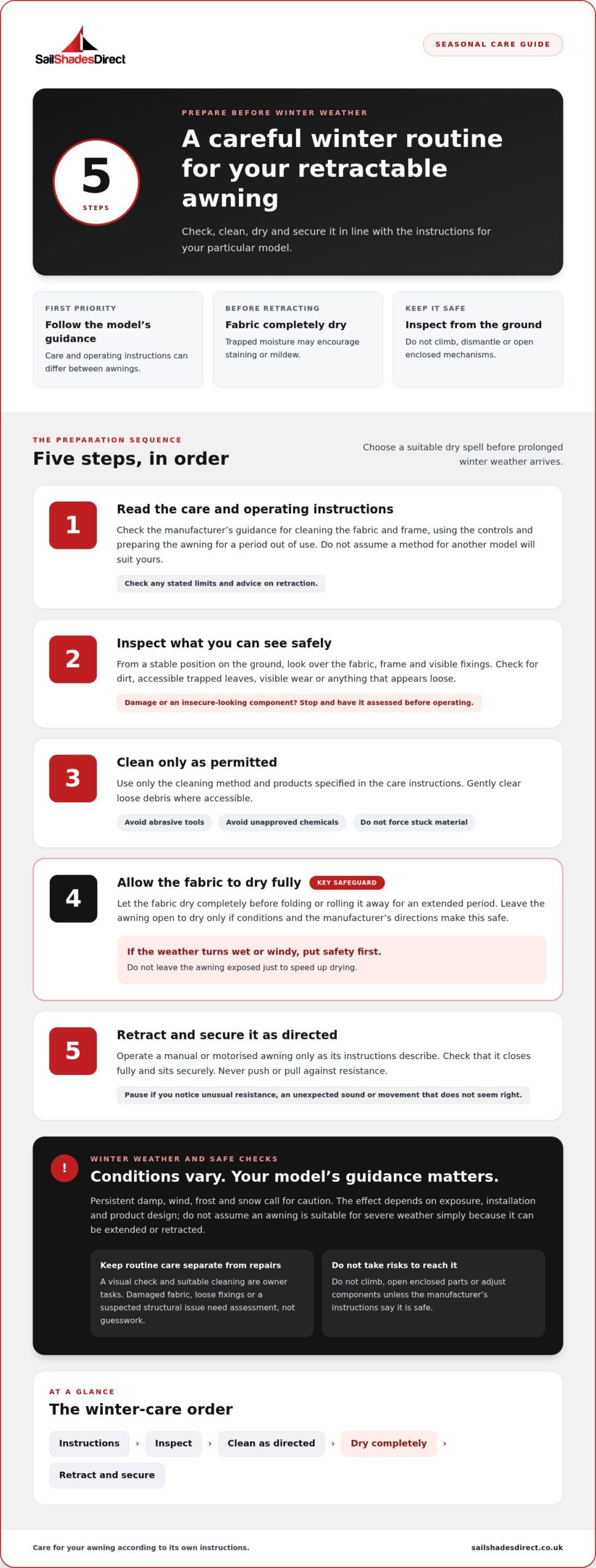
For reliable winter preparation, consult the instructions, inspect the awning, clean it as directed, let it dry completely, then retract and secure it.
- Read the care and operating instructions. Check the manufacturer’s guidance for cleaning the fabric and frame, using the controls and preparing the awning for a period out of use. Instructions can differ between models, so don’t assume a method that worked for another awning will suit yours.
- Inspect what you can see safely. Look over the fabric, frame and visible fixings for dirt, trapped leaves, signs of wear or anything that appears loose. Don’t dismantle the awning or reach into enclosed mechanisms. If you spot damage or a component seems insecure, stop and have it assessed before operating the awning.
- Clean only as permitted. Use the cleaning method and products specified in the care instructions. Avoid abrasive tools, unapproved chemicals, forceful scrubbing and washing, which may harm the fabric or finish. Gently clear loose debris, and don’t try to force stuck material from a moving part.
- Allow the fabric to dry fully. After cleaning, leave the awning open only if conditions and the manufacturer’s directions make this safe. Let the fabric dry completely before folding or rolling it away for an extended period. If the weather turns wet or windy, put safety first rather than leaving the awning exposed just to speed up drying.
- Retract and secure it as directed. Operate a manual or motorised awning only as its instructions describe. Make sure it closes fully and sits securely. Never force it if you feel unusual resistance, hear an unexpected sound or notice movement that doesn’t seem right.
Inspect and clean the fabric and frame
Choose a calm, dry day and inspect from a stable position on the ground. Look for surface dirt, leaves caught in accessible areas, visible wear or loose-looking parts. Clean gently using only approved methods. Don’t use a ladder to reach the awning, open its casing or attempt to adjust fixings. If safe access or cleaning isn’t possible, leave the task rather than risk a fall or damage.
Dry, retract and secure the awning
Drying matters because moisture trapped in folded fabric may contribute to staining or mildew. Once the fabric is completely dry, retract the awning according to its operating instructions and confirm it closes without pushing or pulling against resistance. If conditions deteriorate, don’t continue operating it outdoors. The UK Government’s winter preparedness information offers broader context on getting ready for winter weather, while your awning’s own guidance should direct its care.
This routine can help you approach winter care for retractable awnings with more confidence. If you’re planning a new outdoor-shading arrangement, explore bespoke arm awning solutions designed around your space and requirements.
Should you leave a retractable awning open or closed in winter?
There isn’t one position that suits every awning or every winter day. Leaving it extended may make sense for its intended use when conditions are suitable and the product guidance allows it. Retracting it when it’s not needed can reduce exposure to wind, rain and debris. For winter care for retractable awnings, base your decision on the forecast, the awning’s exposure and its operating instructions. Don’t assume that retractability means it can stay open in any weather.
Use this comparison as a prompt, not a substitute for model-specific advice. The practical response varies with the awning’s design, installation and surroundings.
| Condition | Practical response | Model-instruction caveat |
|---|---|---|
| Calm, dry weather | Extend it only if needed and permitted for normal use. | Follow operating guidance and stated limits. |
| Strong or gusty wind | Retract it if instructed, and avoid operating it in unsafe conditions. | Don’t assume a wind limit based on another awning. |
| Heavy rain | Consider retracting it, especially if water could collect on the fabric. | Check the product’s rain-use guidance. |
| Frost or snow | Use extra caution; retract if required by the instructions or conditions. | Don’t treat all frames and fabrics as having the same tolerance. |
When is it sensible to retract the awning?
If you won’t use the awning for a prolonged period, retracting it can limit its exposure to winter weather. Strong winds, snow, frost and severe weather warnings are reasons to consult the stated operating limits and take a cautious approach. Don’t rely on a universal wind speed or snowfall threshold, as one may not apply to a different model or installation. If it’s unsafe to reach or operate the awning, leave it alone until conditions improve.
Weather sensors, where fitted, can support operation, but they don’t remove the need to understand the awning’s limits. A sensor isn’t a reason to leave the awning extended when the forecast or manufacturer’s instructions call for caution. Follow any guidance on sensor settings, and remember the system may not account for every local exposure or changing condition.
Do manual and motorised awnings need different care?
The winter decision is broadly the same: follow the model’s weather limits and retract when its guidance or conditions call for it. The difference is how you operate it. Use a manual mechanism only as instructed, and don’t force it if movement feels unusual. For a motorised awning, follow the manufacturer’s directions before operating the motor or isolating its power. Don’t assume switching it off is required or safe in every case.
For broader context on how awning design can vary, explore this guide to heavy duty arm awnings. Whatever the design, the right winter position depends on its specific instructions and the conditions it faces.
Winter checks and spring restart for retractable awnings
A quick visual check can help you spot changes during winter without putting yourself or the awning at risk. Look from a safe position on the ground and keep clear of moving parts. You’re checking for visible signs that need attention, not testing fixings, opening a casing or diagnosing a mechanism. If part of the awning can’t be seen safely, don’t climb or reach to inspect it.
Safe visual checks help you spot concerns. Repairs, electrical faults and structural issues need appropriate professional attention.
What can you check safely during winter?
From a safe vantage point, look for leaves or other debris on accessible surfaces, visible fabric damage and signs that damp is persisting. Notice whether anything appears loose or out of position, but don’t touch or adjust it to find out. Keep children and pets away while the awning is in motion, and never reach into the mechanism or try to clear debris from a moving part.
Follow the manufacturer’s instructions before cleaning or operating the awning, even for a brief check. Don’t open enclosed mechanisms or attempt adjustments. If you see torn fabric, a loose-looking component or an unfamiliar change, stop there. Repeatedly operating the awning to investigate a concern could make matters worse.
How should you bring an awning back into use?
Before the first spring use, choose suitable conditions and check that the fabric is dry and the area beneath and around the awning is clear. Look for obstructions, such as garden furniture or branches, that could interfere with movement. Then refer to the operating instructions and open it as they specify. Don’t rush the first operation after a period out of use.
Pay attention as it moves. Stop if the fabric catches, the mechanism sticks, movement seems uneven, you hear an unexpected noise or a motor behaves unusually. Don’t force the awning through resistance or keep trying the controls in the hope that the problem will clear. Persistent sticking, visible damage, loose parts or electrical concerns are reasons to leave it retracted and arrange an appropriate assessment.
- Pause use if anything looks damaged or out of position.
- Don’t dismantle the casing or adjust concealed components.
- Follow the manual for cleaning, controls and safe operation.
- Get appropriate attention for faults that persist or involve electrical parts.
A cautious approach is a useful part of winter care for retractable awnings, and it gives you a clear point at which routine checks should stop. If you’re planning a new outdoor-shading arrangement, explore bespoke arm awning options designed around your property and how you use the space.
When winter care is not enough: choosing a well-suited awning solution
Routine seasonal care can help keep an awning in good condition, but it can’t resolve every fault. Surface dirt is different from fabric that stays damp, a frame that appears out of position or a mechanism that no longer moves as expected. Knowing when to stop using the awning protects both the equipment and anyone nearby.
When should you stop using an awning?
Pause operation if you notice visible damage, unusual movement, persistent moisture or components that seem loose. Don’t force a mechanism, dismantle the awning or attempt electrical repairs. Routine cleaning is appropriate only when it follows the care instructions; structural, mechanical or electrical concerns need suitable assessment. If you’re uncertain whether the awning is safe to operate, leave it closed until the concern has been assessed.
- Visible damage: Don’t operate the awning if fabric, frame parts or fixings appear damaged.
- Unusual movement: Stop if it sticks, moves unevenly or behaves differently from normal.
- Persistent damp: If the fabric doesn’t dry as expected, avoid repeatedly opening and closing it to investigate.
- Electrical concerns: Don’t handle wiring or attempt to repair a motor or controls yourself.
These signs don’t necessarily mean the whole awning needs replacing. They do mean that winter care for retractable awnings has reached its limit: cleaning and simple visual checks can’t establish whether a fault is safe to use. Keep the awning out of operation until the concern has been assessed.
How does the right awning fit your outdoor space?
If you’re choosing shading or reviewing whether your current arrangement suits your needs, consider the space, how you intend to use it, the mounting conditions and how you prefer to operate the awning. A patio used for occasional shade may call for a different approach from a commercial outdoor area used regularly. Exposure matters too, so think about how the awning will be used and cared for through changing seasons.
Bespoke design can respond to different residential and commercial requirements, including the dimensions and layout of the space. An arm awning is one option within a broader outdoor-shading plan; its suitability depends on the project, not an assumed winter capability. For more design context, explore bespoke arm awnings alongside other shading options.
Sail Shades Direct designs, manufactures and professionally fits bespoke outdoor shading, including arm awnings, for homes and commercial settings across the UK. Explore the company’s awning and shading solutions to find an approach tailored to your space and how you want to use it.
Plan outdoor shading that works for your space
Winter is a useful time to think beyond maintenance and consider how you want to use your outdoor space in the seasons ahead. The right shading should suit the setting, the way you use it and how it fits with your property. With a clear understanding of winter care for retractable awnings, you can make that choice with realistic expectations and include ongoing upkeep in your plans.
Sail Shades Direct provides bespoke design, fabrication and professional fitting for outdoor shading in residential and commercial settings across the UK. Whether you’re considering an arm awning or exploring other shading options, a solution shaped around your space can make your next decision more straightforward.
Explore bespoke awnings and outdoor shading solutions, and start planning a more considered outdoor space for the seasons ahead.
Frequently Asked Questions
Can I leave a retractable awning open during winter?
Only if the weather is suitable and your awning’s instructions allow it. An extended awning may catch wind or collect rain, so don’t leave it open simply because the mechanism is retractable. For example, if you’re using it during a calm spell, be ready to retract it as conditions change, following the model’s operating limits. There isn’t one safe weather threshold for every awning or installation.
Should I remove the fabric from my retractable awning for winter?
Usually, don’t remove the fabric unless the manufacturer’s instructions specifically say to. Taking it off can involve dismantling parts or disturbing the fabric tension, which may cause damage if done incorrectly. If you’re concerned about wear, damp or a tear, leave the awning in the position recommended by its instructions and have it assessed. Seasonal care doesn’t normally mean taking the awning apart.
Can I use a pressure washer to clean an awning?
Don’t use a pressure washer unless the care instructions for your specific awning explicitly permit it. Forceful water can affect fabric, seams or finishes, and may drive moisture into parts that are difficult to dry. Instead, use only the cleaning approach and products the manufacturer recommends. If you can’t remove a mark safely with the approved method, avoid scrubbing harder or trying a stronger cleaner.
Can damp fabric cause problems if an awning is retracted?
Yes. If damp fabric is folded or rolled away for a long period, trapped moisture may contribute to mildew, staining or an unpleasant smell. If rain catches the awning, follow its instructions and wait for a suitable opportunity to dry it before storing it retracted for an extended period. Don’t leave it open in unsafe weather just to dry; protecting the awning and keeping people safe come first.
Should I switch off the power to a motorised awning over winter?
Follow the instructions for your motorised model rather than assuming its power should be disconnected for winter. Some systems may rely on powered controls or sensors, and the correct procedure can vary. If the manual advises isolation, use its stated method and don’t handle wiring or electrical components yourself. If you’re unsure how to prepare the controls, leave them untouched and seek suitable technical advice.
What should I do if my awning is stuck after winter?
Stop operating it and don’t try to force it open or closed. Check from the ground for an obvious obstruction, but keep your hands away from moving parts and don’t open the casing. A stuck awning could involve the fabric, mechanism or motor, and repeated attempts may worsen the problem. Leave it in a safe position if possible, then have it assessed before using it again.
Does a retractable awning need lubricating before spring?
Not necessarily. Lubricate moving parts only if the manufacturer’s care instructions recommend it, and use the specified product and application method. The wrong lubricant can attract dirt or affect components, so don’t apply oil or spray simply as a precaution. If movement is noisy, stiff or uneven, stop rather than adding lubricant to mask the symptom; the mechanism may need assessment before operation resumes.