
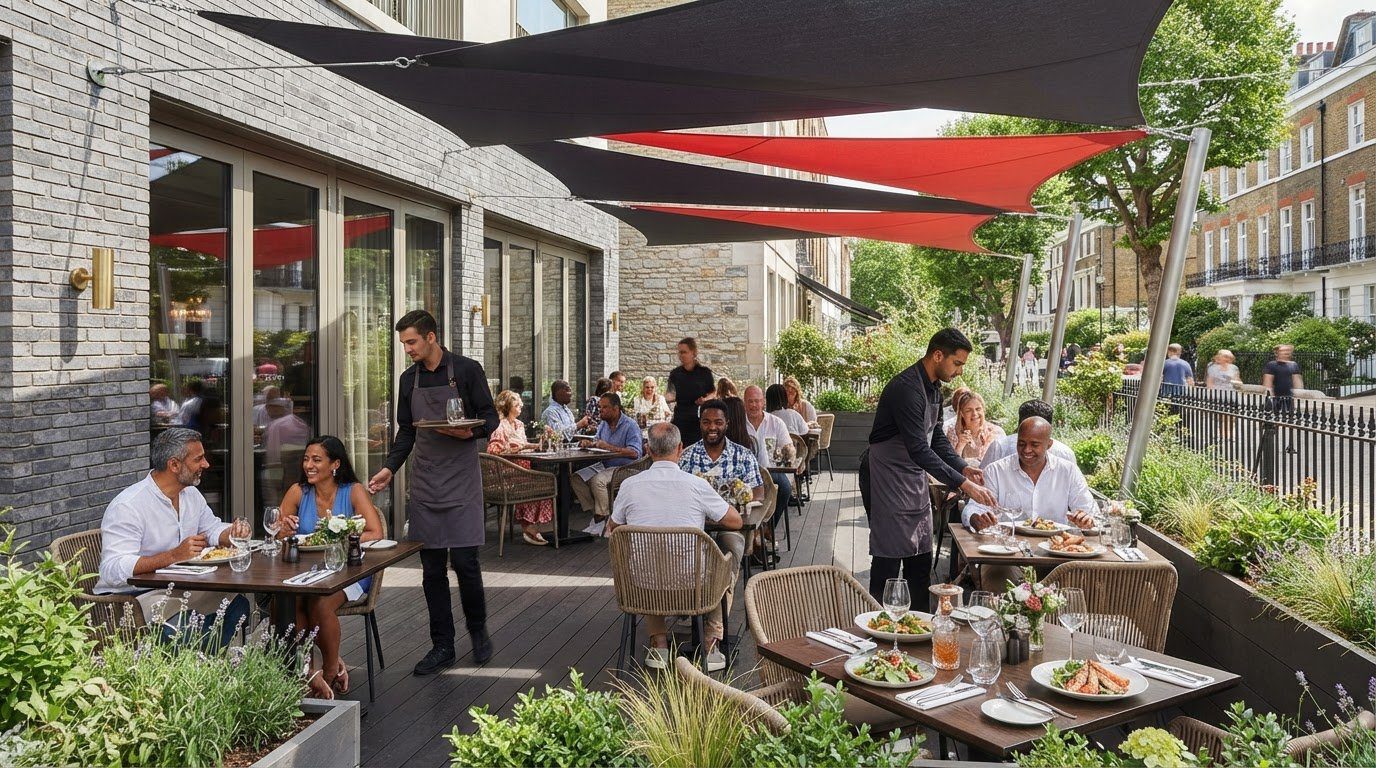
How Outdoor Shading Can Increase Restaurant Revenue
What if some of your restaurant’s most valuable seats are the ones guests avoid on a sunny afternoon or when the weather turns? Understanding how outdoor shading can increase restaurant revenue starts with making those tables more comfortable and usable, not simply adding more covers. The opportunity is real, but it needs to be weighed against the staff and service capacity required to serve guests outside.
Well-planned shade can help you use your outdoor area on more occasions, create a more inviting setting and make outdoor dining more comfortable. The right approach depends on your layout and priorities: bespoke sail shades, rolling sun sails, arm awnings, giant umbrellas and exterior blinds each offer different ways to shape a space.
This article looks at the practical ways shading may support revenue, from making existing seats more usable to improving the guest experience. It also explains how to assess whether a solution suits your venue, plan around daily operations and track measures such as outdoor covers, sales and days in use. Comparing results over time gives you a clearer basis for decisions than relying on assumptions.
Key Takeaways
- Outdoor seats create a commercial opportunity only when guests can use them comfortably and your team can serve them well.
- Learn how outdoor shading can increase restaurant revenue by potentially making more covers and service periods usable, while recognising that results depend on your venue and demand.
- Compare baseline and post-installation measures, such as outdoor covers, sales and days in use, to assess performance without relying on assumed benchmarks.
- Plan shading around your outdoor layout, seating arrangement and service priorities before selecting a suitable solution.
- Explore how bespoke design, fabrication and professional fitting can turn a venue-specific shading plan into a practical next step.
Why outdoor shading can make restaurant seating more commercially useful
Outdoor tables contribute to a restaurant only when guests can comfortably use them. Direct sun can make a table less appealing, while changing conditions may leave the space feeling exposed. Shading can help make existing outdoor seating more usable at suitable times. It does not, by itself, prove that revenue or profit will rise. To assess how outdoor shading can increase restaurant revenue, first identify the opportunity, then measure what happens at your venue.
How usable outdoor covers can create a revenue opportunity
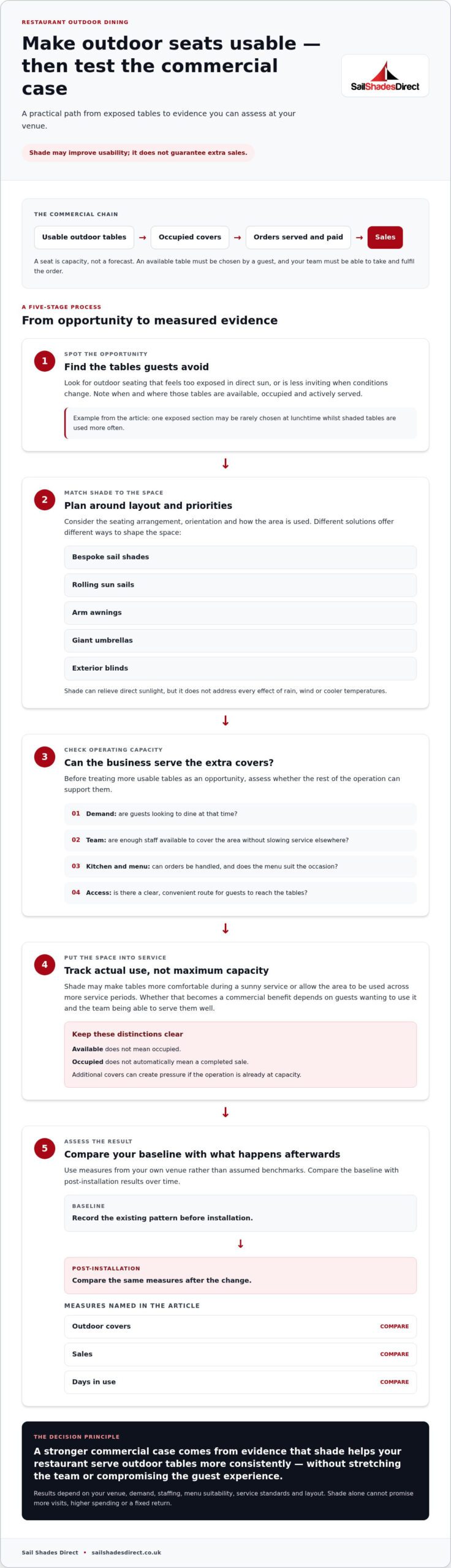
Start by distinguishing seats from sales. A patio may have capacity for a certain number of diners, but that capacity becomes occupied covers only when guests choose to sit there. Sales depend on those guests ordering, being served and paying. Shading may make existing tables more comfortable during a sunny lunch or help the area feel usable for more of a service. It does not create demand or guarantee that the seats will be filled.
For example, you might find that tables in one exposed section are rarely chosen at lunchtime, while shaded tables are used more often. That could point to an opportunity, but it needs to be weighed against the practical limits of the business. Can the kitchen handle additional orders? Are enough staff available to serve another area without slowing service elsewhere? Is there a clear, convenient route for guests to reach the tables? Demand, menu suitability and the site layout all affect whether more usable covers can translate into completed sales.
Capacity is a starting point, not a revenue forecast. Record when outdoor tables are available, occupied and actively served instead of treating the maximum number of seats as expected income.
Why guest comfort matters to outdoor dining
Guests choose between indoor and outdoor areas based on what each offers at that moment. Direct sun can make sitting outside less comfortable, and changing conditions can make an exposed table feel less inviting. Well-planned shading can provide relief from direct sunlight and help define the dining space. Outdoor dining, also known as al fresco dining, is a broad way of using a restaurant’s outdoor setting. Comfort in a particular space depends on its orientation, arrangement and conditions.
Shade is one measure, not an all-weather solution. It does not address every effect of rain, wind or cooler temperatures. The right coverage depends on where the seating sits and how the space is used. Consider bespoke sail shades, rolling sun sails, arm awnings, giant umbrellas or exterior blinds in relation to your venue’s layout and priorities.
Keep the commercial case grounded. Shading may improve the perceived usability of the space and give guests a more comfortable choice, but it cannot promise more visits, higher spending or a fixed return. The useful question is whether it helps your restaurant serve outdoor tables more consistently without stretching the team or compromising the experience.
How outdoor shading may support restaurant revenue
Shading can support restaurant revenue in several ways, but each depends on what your venue can serve. More tables may be usable during sunny periods, the outdoor area may work for more service windows, and a comfortable setting may contribute to a positive guest experience. None of these outcomes follows automatically from installing shade. Demand, staffing, menu suitability, service standards and the layout all matter.
Shading supports revenue only when it enables useful, bookable capacity. That means seating guests can access and want to use, which your team can serve without disrupting the rest of the operation. This distinction is central to understanding how outdoor shading can increase restaurant revenue: look for a practical link between the improved space and real service rather than assuming extra seats will become extra sales.
More opportunities to use existing outdoor tables
On a bright service, shade may make tables that feel too exposed more comfortable. If those tables are otherwise suitable and guests are looking to dine, they could create an opportunity to serve additional covers. But availability is not occupancy: an empty table generates no sale, and an occupied table only becomes a completed transaction when the restaurant can take and fulfil the order.
Consider when and where the opportunity might arise. Perhaps a sunny lunch leaves one part of the terrace unused, even while indoor tables are busy. Shading could make that section more inviting, but the value still depends on demand at that time, staff being able to cover the area and the kitchen being able to manage the orders. If service is already at capacity, adding covers could create pressure rather than improve the result.
Longer usable periods and a better guest experience
A shaded area may remain comfortable during more of a sunny day, creating the possibility of using outdoor tables across additional service periods. Whether that matters commercially depends on the venue: the space must be ready to serve, customers must want to book or walk in, and the menu and staffing must suit the occasion. Shade can address direct sunlight, but it does not resolve every changeable-weather challenge or ensure the area can operate in all conditions.
Comfort also shapes a guest’s experience. Thoughtful coverage can make outdoor dining feel more considered and help guests settle into their meal. A positive experience may encourage a future visit, but repeat custom depends on the whole visit, not shading alone. A report analysing the commercial effects of an outdoor dining programme offers wider context, not a forecast for an individual UK restaurant.
To explore what could suit your layout, consider commercial outdoor shading options such as bespoke sail shades, rolling sun sails, arm awnings, giant umbrellas or exterior blinds. Match the approach to the space and service you want it to support, then assess the results against your own trading patterns.
Does outdoor shading really increase restaurant revenue? Measure the evidence
Not necessarily. Shading can make an outdoor area more usable, but it cannot guarantee increased revenue or a positive return. Results depend on whether guests use the space, whether the team can serve them and what else changes at the restaurant. Claims such as QSR Web’s report that outdoor seating can increase revenue by up to 30 percent provide industry context, not a forecast for your venue or proof that shading alone caused an increase.
To assess how outdoor shading can increase restaurant revenue in your circumstances, set a baseline before installation and compare it with results afterwards. Choose measures you already record, then note conditions that could affect them. The aim is to find out whether the space is being used differently and whether any change is commercially meaningful for your operation, not to manufacture a positive result.
Which restaurant measures can reveal a change?
Track outdoor covers served and how often tables are occupied during service. Note which service periods use the space and whether it is open and staffed to serve guests. If your records allow a fair comparison, review outdoor sales or average transaction measures alongside usage figures. Keep operational context with the results, including staffing, opening hours, menu changes and promotions.
| Measure | Baseline | After installation |
|---|---|---|
| Outdoor covers served | Record covers by service period | Record the same measure and periods |
| Table use | Note occupied-table periods and unused times | Track the same occupancy pattern |
| Service utilisation | Log when the area is open and serving | Compare opening and service periods |
| Sales measures | Use available outdoor sales or transaction records | Compare like-for-like records |
| Operating context | Note weather, staffing, hours and promotions | Record the same factors and any changes |
How to make a fair before-and-after comparison
Choose comparable trading days or periods where practical. A weekday lunch is more useful to compare with a similar weekday lunch than with a busy weekend evening. Record weather and seasonal demand too: a run of warm, dry days could affect outdoor use independently of the shading. Note changes to staffing, opening hours, menu or promotions so you can interpret the figures rather than attribute every shift to one improvement.
Compare like-for-like periods and note weather, demand and operating changes. A short or inconsistent comparison may show a pattern, but it will not establish that shading caused it. Review results across a meaningful run of comparable services and treat any conclusion as specific to those conditions. If outdoor occupancy rises but covers or sales do not, that distinction matters: the space may be more comfortable without yet adding measurable commercial value.
How to plan restaurant shading around your space and service
A useful shading plan starts with how your restaurant operates, not with a product category. Identify the business objective first, then assess the outdoor area and how guests and staff move through it. This keeps the design focused on practical priorities, whether you want to make existing tables more comfortable at lunch or create a clearer, more inviting dining area.
Start with the outdoor dining objective
Be specific about what you want the space to do. Is the priority daytime comfort, better use of existing tables during sunny periods, or a more clearly defined outdoor area? Map the seating, entrances, circulation routes and service paths before planning coverage. Then consider your trading pattern: a space used mainly for lunch may need a different approach from one that matters most during evening service.
Use a straightforward sequence to shape the brief:
- Set the objective. Name the service period or guest experience you want to improve.
- Review the layout. Note table positions, access points, circulation and how staff reach each seat.
- Choose the shading category. Consider which form of coverage fits the space and intended use.
- Plan how to assess it. Decide which measures, such as outdoor covers and service periods in use, you’ll track afterwards.
This process connects the physical design to the commercial question of how outdoor shading can increase restaurant revenue. It also helps you avoid planning around theoretical capacity alone. The layout should work for guests and the team, with outdoor seating that can be accessed and served as part of normal operations.
Match the shading category to the space
Bespoke sail shades, rolling sun sails and arm awnings are possible overhead options. Giant umbrellas may suit outdoor dining layouts where individual or grouped coverage works with the seating arrangement. Exterior blinds can be considered where side shading fits the space and intended use. The right category depends on the site, the coverage you’re aiming for and how the area functions during service.
Think about the shape and arrangement of the tables, where coverage is needed and whether shading should relate to one seating zone or several. An open dining area with a defined group of tables may need a different layout from seating arranged alongside the building. Sail Shades Direct designs, manufactures and professionally fits bespoke outdoor shading for commercial environments, tailoring the design to the venue’s requirements.
For a broader view of commercial options, explore the commercial shading solutions guide. If umbrellas are relevant to your garden layout, see restaurant and pub garden umbrellas as one category to consider. Keep the choice connected to your objective, available space and service priorities, then track whether the finished area is being used as intended.
Ready to turn your venue’s priorities into a tailored plan? Explore bespoke outdoor shading for restaurants designed, manufactured and professionally fitted across the UK.
Turn a restaurant shading plan into a practical next step
A clear project starts with a specific opportunity, not an assumption that shade will automatically increase takings. Decide what you want the outdoor area to do, check that the goal fits your service and space, then choose how you’ll assess the outcome. Whether you’re addressing an exposed lunch area or making a garden more inviting, how outdoor shading can increase restaurant revenue depends on demand, daily operations and how well the finished space serves guests.
What to prepare for a tailored shading discussion
A useful brief doesn’t need to be complicated. Set out how the outdoor area is arranged and what you want it to support. A few practical details can help connect the proposed design to the way your restaurant works:
- Space and seating: Describe the area, table arrangement, entrances and the routes guests and staff use.
- Intended use: Note which service periods matter most and whether the priority is daytime comfort, using existing tables or defining a dining zone.
- Current challenges: Explain where direct sun or other conditions affect the usability of the space.
- Measures you can track: Identify existing records for outdoor covers, table use, service periods and relevant sales.
These details give the project a practical starting point and make it easier to discuss design choices in context. They also help keep the business case grounded: compare what the space was doing before with how it performs after the work, while noting changes in demand, staffing or service.
A tailored solution for your restaurant’s outdoor space
Sail Shades Direct designs, manufactures and professionally fits bespoke outdoor shading for commercial environments across the UK. A tailored design can respond to your venue’s layout, seating arrangement and project requirements. Depending on the space and intended use, options include bespoke sail shades, rolling sun sails, arm awnings, giant umbrellas and exterior blinds. The aim is to find an approach that suits the site, rather than assume one solution fits every restaurant.
To explore the choices in more detail, the commercial shading solutions guide provides a useful starting point. For garden layouts where umbrella coverage may be relevant, take a look at restaurant and pub garden umbrellas as one category within the wider planning discussion.
There’s no guaranteed revenue outcome: results depend on whether guests use the space, whether your team can serve them and whether the design works for the venue. Bring your layout, priorities and baseline measures together to start a focused conversation about a solution shaped around your restaurant. Explore bespoke outdoor shading for your restaurant.
Give your outdoor space a clear next step
Choose one part of your outdoor area where a change could make a practical difference. It might be a set of tables that feels exposed at lunchtime or a section guests rarely choose. Define what you’d like that space to do, then consider how its layout and your service routine could support the change.
This gives you a focused starting point for exploring how outdoor shading can increase restaurant revenue without treating extra seating as guaranteed income. A well-considered plan should suit the venue first; judge its commercial value against real use and trading conditions over time.
Bring your priorities and a simple outline of the space together to start planning a tailored design. Sail Shades Direct can shape a restaurant shading project around your requirements, with bespoke design, manufacture and professional fitting across the UK.
Explore bespoke outdoor shading for your restaurant and start planning a more usable space for your guests.
Frequently Asked Questions
Can outdoor shading increase restaurant revenue?
Yes, outdoor shading can potentially support higher restaurant revenue if it helps make seating usable when customers want it and the team can serve them. Treat how outdoor shading can increase restaurant revenue as a venue-specific business case: consider whether previously avoided tables become occupied and whether those covers lead to additional completed orders. Shade itself doesn’t create demand or guarantee a sales increase.
How much extra revenue can restaurant shading generate?
There’s no reliable figure that applies to every restaurant. The potential depends on factors such as outdoor demand, the number of tables guests use, menu choices and service capacity. To estimate the opportunity, use your own records: consider the additional covers you could realistically serve and the sales those covers might generate. Treat this as a working estimate, not a forecast, and compare it with actual trading results after installation.
Can shading help a restaurant use outdoor tables more often?
It may help if direct sun is one reason guests avoid particular tables. For instance, note whether a sunny section is regularly left empty during a service when nearby tables are in use. If that pattern changes after shading, it may indicate improved usability. Keep track of other reasons tables might be unavailable, such as a layout change or staffing limits, so you can understand what’s influencing outdoor use.
Which type of outdoor shading is suitable for a restaurant?
The suitable category depends on the space, the area you want to cover and how guests and staff use it. Options include bespoke sail shades, rolling sun sails, arm awnings, giant umbrellas and exterior blinds. For example, side shading may suit a particular layout, while an open dining area may call for overhead coverage. A tailored assessment of the venue can connect the intended use with an appropriate design.
Does restaurant outdoor shading guarantee a return on investment?
No. A return depends on whether the finished space is used enough to produce additional business, and whether that business outweighs the project’s overall outlay and operating impact. Consider the full picture, including whether more outdoor service puts pressure on kitchen or staff capacity. Set a realistic objective before proceeding, then review actual use and sales over comparable periods rather than relying on an assumed payback.
How can a restaurant measure whether outdoor shading is working?
Choose a clear measure linked to the reason for making the change. For example, calculate outdoor seat utilisation by comparing occupied seat-hours with the seat-hours available during the same service periods. You could also track reservation requests for outdoor seating, cancellations and covers served. Use consistent records before and after, and annotate unusual trading conditions so one busy spell doesn’t create a misleading impression.
Can outdoor shading help attract more diners?
It may make an outdoor area more noticeable and appealing to people choosing where to sit, but shading alone can’t guarantee extra diners. Check whether guests are specifically requesting outdoor tables, and note how often those requests can be accommodated. If the space is visible from outside, consider whether its appearance supports the restaurant’s overall presentation. Consider any change in bookings or walk-ins alongside other factors, such as events or promotions.