
How to Create Shade Without Trees: Expert Garden Solutions for 2026
Why are we still waiting decades for a silver birch to grow when the most sophisticated garden retreats don’t rely on nature’s timeline at all? If you’ve spent another summer retreating indoors because your patio feels like a furnace, you’re certainly not alone. Many homeowners struggle with how to create shade without trees, especially when flimsy umbrellas blow over in the breeze and overlooked new-build plots offer nowhere to hide. It’s exhausting to deal with the glare whilst worrying about UV damage to your favourite outdoor furniture.
The good news is that a sun-scorched garden is actually a blank canvas for high-end architectural shading. By moving away from off-the-shelf kits and embracing professionally engineered systems, you can transform your terrace into a cool, private sanctuary that adds genuine value to your property. In this guide, we’ll explore the latest 2026 trends in bespoke sail shades, motorised rolling sails, and robust arm awnings. You’ll discover how to achieve a tailored, wind-resistant look that provides year-round weather protection, regardless of your garden’s size or layout.
Key Takeaways
- Learn why architectural interventions are the most effective way for how to create shade without trees, helping to close the thermal comfort gap on exposed patios.
- Discover how bespoke sail shades and structural posts create a stylish “outdoor ceiling” using marine-grade stainless steel for maximum longevity.
- Compare the footprints of arm awnings, giant umbrellas, and rolling sails to find the ideal shading system for your garden’s specific circulation.
- Master the essentials of sun tracking and rainwater runoff angles to ensure your new shading structure remains functional throughout the British seasons.
- Understand the value of custom-engineered designs over standard kits, including the added luxury and ease of motorised rolling sun sails.
The Challenge of the Treeless Garden: Why Artificial Shade is Essential
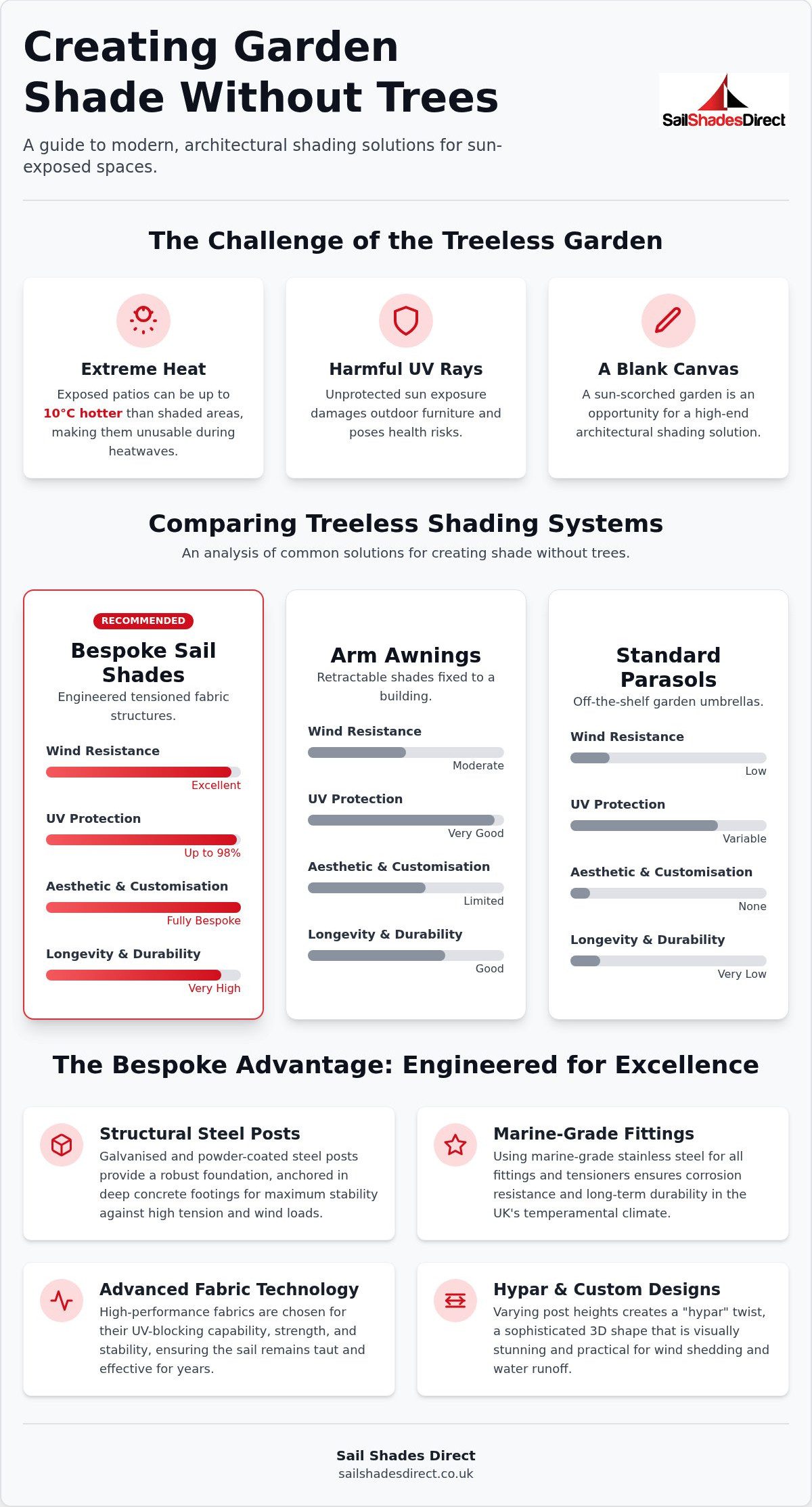
A treeless garden often feels like a missed opportunity during a heatwave. When we talk about how to create shade without trees, we aren’t just looking for a temporary fix. We’re talking about artificial shade: a deliberate, architectural intervention that replaces a missing natural canopy with a high-performance structure. This isn’t just about aesthetics. It’s about closing the thermal comfort gap. Exposed patios can reach temperatures up to 10 degrees higher than those protected by a professional shading system. That is the difference between a relaxing lunch and a desperate retreat indoors.
Beyond the immediate heat, there’s the invisible threat of UV rays. High-quality fabrics used in modern Shade sail technology can block up to 98% of harmful rays, but it’s vital to remember that not all materials are created equal. Investing in Architectural Shading means choosing a permanent asset for your home. It’s a bespoke addition that increases property value whilst providing a level of protection that off-the-shelf solutions simply can’t match. We view these installations as a necessary reprieve from the pressures of daily life, turning a sun-scorched patch of ground into a sophisticated living area.
The Limitations of “Living Shade”
Waiting for a sapling to provide a usable canopy is a twenty-year strategy. In 2026, homeowners need immediate results. Even when trees finally mature, they bring a host of maintenance headaches. You’ll deal with sticky sap on your paving, insects amongst the leaves, and the annual chore of clearing autumn debris. Whilst a tree offers a charming dapple, it’s unpredictable. A bespoke sail provides consistent, edge-to-edge protection exactly where you need it. It’s a clean, modern alternative that works from day one without the need for a pruning saw.
Why Traditional Parasols Often Fail in Treeless Spaces
Standard garden umbrellas are often the first thing people buy when wondering how to create shade without trees. Unfortunately, they rarely survive a typical British summer. In exposed, treeless gardens, even a light breeze can create a wind-sail effect, causing cheap parasols to topple or break. However, choosing high-quality engineering from specialist brands like Umbrellas.co.za can provide a much more reliable alternative, offering bespoke artist designs that elevate your garden’s aesthetic. Central-pole designs also limit your movement, forcing you to arrange furniture around a heavy, obstructive base. To truly reclaim your outdoor space, you need tensioned, structural solutions that stay put. Our engineered systems are designed to withstand the elements whilst looking effortlessly elegant on your terrace.
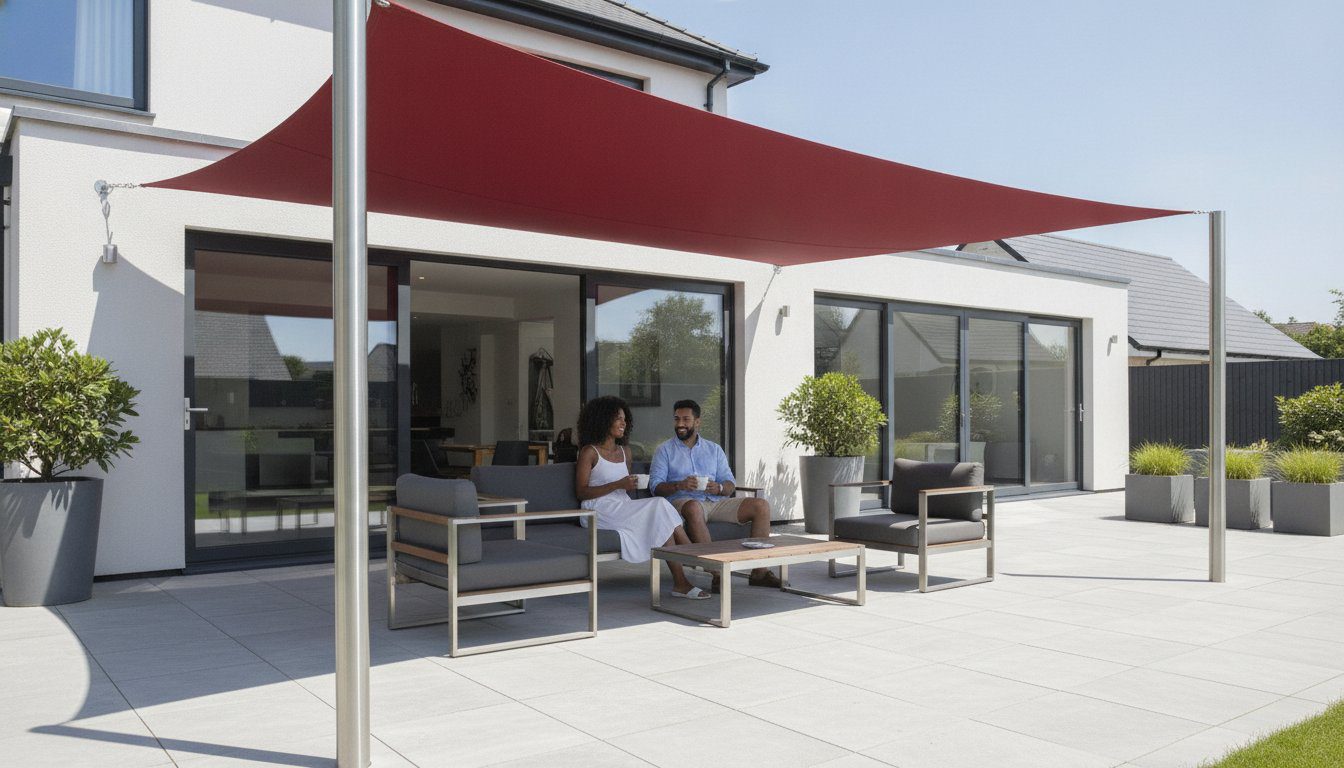
Many homeowners wonder how to create shade without trees whilst maintaining a modern, clean aesthetic. The answer lies in tensioned sail shades. These structures effectively act as a “ceiling” for your outdoor room, providing a sleek, architectural finish that doesn’t rely on a single branch for support. By using marine-grade stainless steel fittings, these systems are built for longevity in the temperamental UK climate. They resist corrosion and maintain their tension over time, unlike budget alternatives that often sag after the first heavy rain shower.
For those seeking a striking visual impact, “hypar” (hyperbolic paraboloid) designs are a favourite choice in 2026. By varying the height of the attachment points, we create a dramatic three-dimensional twist in the fabric. This doesn’t just look sophisticated; it helps significantly with wind shedding and water runoff. Custom-made sun sails always outperform standard-sized DIY kits because they are laser-cut to the exact millimetre to fit your specific garden dimensions, ensuring a taut, professional finish every time.
The Secret to Stability: Structural Steel Posts
Standard garden fences are rarely strong enough to withstand the high tension required for a professional sail. This is why galvanised and powder-coated steel posts are the foundation of any successful treeless installation. Depending on your site, we typically use deep concrete footings to anchor these posts, though surface mounting on reinforced terraces is possible for specific designs. It’s essential to organise post placement carefully; by positioning them at the perimeter, you can maximise your shaded area without cluttering the centre of your patio or obstructing the flow of your garden.
Advanced Fabric Technology
Modern shading relies heavily on high-density polyethylene (HDPE) fabrics. These materials are engineered for superior UV filtration, which is vital given the importance of shade for sun safety and skin protection. When selecting your system, you’ll need to choose between waterproof sail shades for year-round protection or breathable meshes that allow rising heat to escape upwards. Tensile strength refers to the maximum load a fabric can withstand whilst being stretched without breaking or permanently deforming. If you’re ready to see how these engineered elements could work in your space, you can view our bespoke range of shading solutions to find your perfect fit.
Comparing Treeless Shading Systems: Sail Shades, Awnings, and Giant Umbrellas
Choosing the right system for how to create shade without trees depends largely on your garden’s layout and how you intend to move through the space. Every solution has a different “footprint”. A fixed sail shade requires perimeter posts, whilst an awning clears the floor entirely by mounting to your house. Understanding these spatial dynamics is the first step in creating a bespoke retreat that feels open and inviting rather than cluttered. Whether you are designing a domestic patio or a large commercial terrace, the versatility of modern shading means there is always a configuration to suit your specific site.
Bespoke Arm Awnings for Wall-Adjacent Shade
If your primary seating area sits directly against the house, heavy duty arm awnings are an exceptional choice. These systems extend your indoor living space outward, creating a seamless transition between the kitchen and the garden. One of the greatest benefits of modern arm awnings is the integration of automatic sensors. These clever devices monitor the British weather in real-time, automatically retracting the fabric if the wind exceeds safe limits or extending it when the sun hits a certain intensity. It’s a “set and forget” solution that protects your furniture from UV damage without any manual effort.
Giant Umbrellas: The Flexible Commercial-Grade Choice
For large open spaces where wall mounting isn’t an option, giant umbrellas offer a robust and flexible alternative. These aren’t your standard garden parasols; they are commercial-grade structures designed for stability and scale. They are particularly useful in the centre of a lawn or on an expansive terrace where you need a significant “pool” of shade. For those looking for inspiration on high-quality manufacturing, specialist suppliers like The Umbrella Man showcase how robust materials can transform a simple umbrella into a durable outdoor asset. Many of our premium models feature 360-degree rotation, allowing you to track the sun’s path throughout the day with a simple adjustment. This ensures your guests stay cool from breakfast through to a late afternoon gin and tonic.
If you love the architectural look of a sail but want the flexibility of a retractable system, motorised rolling sun sails represent the pinnacle of 2026 garden design. These systems provide a sophisticated hybrid solution, allowing you to deploy the sail at the touch of a button and retract it into a sleek, protective housing when not in use. This is perfect for the unpredictable UK climate, where a clear sky can turn to a drizzle in minutes. When retracted, the system disappears into its minimalist housing, preserving your garden’s view whilst keeping the high-performance fabric clean and ready for the next sunny spell.
Essential Planning: Aspect, Wind Loading, and UK Weather Considerations
Planning how to create shade without trees requires more than just picking a spot on the patio. You must identify your garden’s “hot zone” by tracking the sun’s path from midday through to the evening. Whilst the midday sun is highest, it’s often the late afternoon glare that makes a space unusable. When installing bespoke sail shades, a steep angle is essential. We always recommend a minimum 20-degree pitch to ensure rainwater runoff doesn’t pool in the centre of the fabric. Pooling can stretch the material and compromise the structural integrity of your posts, leading to long-term damage.
Professional wind loading calculations are the backbone of a safe, permanent installation. We calculate the potential force exerted on your structural posts during a gale to ensure they remain safely anchored. Regarding legalities, most shading systems in the UK are considered permitted development. However, if your structure is within 2 metres of a property boundary, it must generally stay under 2.5 metres in height to comply with standard rules. For absolute peace of mind, many clients choose to obtain a Lawful Development Certificate (LDC) for around £103 to prove compliance, which is particularly useful during future property sales.
The “Low Sun” Challenge
In the UK, horizontal shade often fails when the sun dips low in the sky during peak BBQ hours. This is where the specific angle of your bespoke sail becomes critical. By lowering one corner of the sail or integrating exterior blinds, you can block that piercing low-angle glare that a high canopy might miss. These vertical additions provide a secondary barrier that keeps your seating area cool even as the sun sets. It transforms a standard patio into a truly functional outdoor room that overcomes the limitations of a treeless plot.
Winter Management and Durability
Whether you leave your sails up year-round depends on the fabric type and your specific location. Coastal gardens amongst the salt spray require more frequent rinsing of stainless steel fittings than inland sites to prevent tea-staining. Many of our clients utilise quick-release toggles to take their sails down during the harshest winter months, though our high-tension fabrics are designed for significant durability. Professional installation ensures that every bolt and footing is engineered to survive the British winter. If you’re ready to start your project, contact our expert team today for a bespoke consultation on your garden’s unique requirements.
The Bespoke Advantage: Designing Your Perfect Treeless Retreat
When you’re researching how to create shade without trees, it’s tempting to opt for a standard kit from a local garden centre. However, a one-size-fits-all approach often leads to disappointment. Every garden has unique angles, wind patterns, and architectural features that a pre-packaged rectangular kit simply cannot account for. By choosing a bespoke design service, you ensure that your shading system is an intentional extension of your home’s architecture rather than an awkward afterthought. Custom manufacturing allows us to create unique, multi-point shapes that follow the lines of your property, providing a seamless look that off-the-shelf options can’t replicate.
Aesthetics are just as vital as function. Our extensive colour palette options allow you to coordinate your new shade with existing outdoor furniture, window frames, or even your garden’s floral scheme. Whether you prefer a bold, contemporary anthracite or a soft, neutral sand tone, the right choice can tie the entire outdoor space together. Beyond the look, the professional fitting process provides total peace of mind. We handle the complex engineering and high-tension requirements, ensuring that every bracket is secure and every post is perfectly aligned for a lifetime of use.
Why Custom Measurement is Non-Negotiable
The secret to a professional-looking installation lies in the physics of tension. To remain taut and resist flapping in the wind, a sail must be cut with a “catenary curve” along its edges. This inward curve allows the tension to be distributed evenly across the entire fabric surface. Without this precise tailoring, sails often develop saggy “dead zones” where sun peeks through the edges and rainwater can pool. Our bespoke design process ensures every millimetre is accounted for, providing edge-to-edge protection. For more technical details on how we tailor these structures, explore our guide to bespoke sail shades UK.
Investing in Quality with Sail Shades Direct
As national experts in how to create shade without trees, we’ve built our reputation on handling the projects that others find too complex. We pride ourselves on a versatile “can-do” attitude, viewing every treeless terrace as an engineering opportunity to create something spectacular. From the initial design to the final professional installation, we function as your dedicated partner in transforming your garden. We understand the emotional value of a well-designed environment and aim to reduce your stress by projecting competence at every stage. If you’re ready to reclaim your garden from the summer heat, book a consultation with our design team to start your project today.
Reclaim Your Garden for 2026 and Beyond
A treeless garden isn’t a limitation; it’s an opportunity to build a sophisticated, architectural retreat that works on your schedule. We’ve explored how to create shade without trees by utilising high-tension sail shades, motorised rolling sails, and heavy-duty arm awnings. These systems provide immediate thermal comfort and UV protection whilst adding genuine value to your property. By prioritising professional wind-loading calculations and bespoke manufacturing, you avoid the pitfalls of “one-size-fits-all” kits that often fail in the British wind.
At Sail Shades Direct, we bring over 10 years of UK craftsmanship to every project. Our team provides professional nationwide installation using high-wind resistant architectural fabrics, ensuring your investment stands the test of time. Don’t let another summer pass whilst you hide indoors from the glare. You can request a bespoke quote for your treeless garden today and start the journey toward your perfect outdoor sanctuary. We’re ready to help you transform your space into a cool, private haven you’ll love to use every single day.
Frequently Asked Questions
Can I install a shade sail without any trees?
You can absolutely install a shade sail without any trees by using structural steel posts anchored in concrete. In fact, most of our professional installations are designed for open, treeless spaces like new-build gardens or large patios. These posts provide a stable, permanent foundation that allows for much higher tension than a tree branch could ever sustain, ensuring your sail remains taut and wind-resistant throughout the British summer.
What are the best alternatives to trees for garden shade in the UK?
The most effective alternatives to trees include bespoke sail shades, motorised rolling sun sails, and heavy-duty arm awnings. These engineered solutions provide immediate relief from the heat without the decades-long wait for a natural canopy to grow. For those wondering how to create shade without trees whilst maintaining a modern look, these structures offer superior UV protection and can be tailored to fit the exact dimensions of your terrace area.
Do I need planning permission for permanent shade structures?
Most garden shading structures fall under permitted development and don’t require planning permission. However, specific rules apply if the structure is within 2 metres of a boundary, where the height should generally not exceed 2.5 metres. For larger installations or listed buildings, it is always wise to consult your local planning authority. Obtaining a Lawful Development Certificate (LDC) can also provide legal proof of compliance for future property sales.
How do I anchor a shade sail in a garden with no natural supports?
Anchoring a sail in an open space requires a combination of wall-mounted brackets and independent structural posts. We typically use galvanised and powder-coated steel posts set into deep concrete footings to handle the significant tension loads. This engineered approach ensures the fabric stays perfectly flat and doesn’t sag. It’s a far more robust method than using wooden fence posts, which lack the necessary strength to support professional-grade architectural fabrics.
Are bespoke sail shades better than off-the-shelf parasols?
Bespoke sail shades offer significant advantages over standard parasols, particularly regarding wind resistance and coverage. Whilst a cheap umbrella might topple in a gust, a tensioned sail is designed to stay up in typical UK weather. They also clear the floor of heavy bases and central poles, allowing for better garden circulation. Because they are custom-made, they eliminate “dead zones” where sun might peek through the edges of a smaller, standard-sized parasol.
How do I choose the right fabric colour for maximum UV protection?
Whilst darker colours like anthracite or navy often provide slightly higher UV blockage, modern high-density polyethylene (HDPE) fabrics are engineered for high performance across the entire colour spectrum. Many of our lighter tones still block up to 98% of harmful rays. When choosing a colour, consider the architectural style of your home and your existing furniture. A lighter shade can make a small patio feel more open, whilst darker fabrics offer a bold, contemporary statement.
Can shade sails stay up in the wind?
Professionally installed shade sails are specifically designed to withstand the British wind through high-tension engineering and robust steel supports. Unlike flimsy gazebos, these structures shed wind efficiently due to their curved edges and stable anchoring. However, in extreme gale conditions or during the winter months, we recommend using quick-release toggles to temporarily take the sail down. This protects the fabric’s longevity and ensures the structural integrity of your wall fixings and posts.
How much does a professional shade sail installation cost?
The cost of a professional installation depends on several factors, including the size of the area, the type of fabric chosen, and the number of structural posts required. A bespoke solution involves custom laser-cutting and precision engineering tailored to your specific garden. Whilst it represents a higher initial investment than a basic DIY kit, the durability and increased property value make it a cost-effective choice for those looking at how to create shade without trees permanently.