
Planning Permission for Commercial Umbrellas UK: What Businesses Need to Know
The umbrella you choose may not decide whether permission is needed. For businesses considering planning permission for commercial umbrellas UK, the site, installation method and effect on nearby buildings or streets can all matter. A movable umbrella and a fixed canopy may raise different questions, so assuming the same rule applies to every shade solution could lead to delays or design changes.
The checks depend on where your business is in the UK and on details such as whether the structure is permanent, whether the property is listed or in a conservation area, and whether it affects public space. Planning permission is also separate from permissions that may apply to pavement use or advertising.
This guide explains what to check before installation, who to contact for site-specific guidance and how to compare options without treating product type as a planning decision. Careful project planning helps you weigh practical needs alongside site requirements, whether you are considering giant umbrellas or another outdoor shading option.
Key Takeaways
- Planning permission for commercial umbrellas UK depends on the proposal and site, not simply whether you choose an umbrella or canopy.
- Review permanence, size, fixing method, position and potential effects on the building or surroundings before settling on a design.
- Check whether planning permission is separate from other permissions that may apply to advertising or use of public space.
- Compare freestanding giant umbrellas, attached awnings and canopy-style structures by how they suit your site and shading needs, not by assumed planning outcomes.
- Prepare photographs, dimensions, fixing details and the intended installation period before asking the relevant planning authority for written, site-specific guidance.
Planning permission for commercial umbrellas in the UK: what determines the answer?
There isn’t a single yes-or-no rule for planning permission for commercial umbrellas UK. The answer depends on the proposed installation, the property and its setting, and the effects it could have. A small movable umbrella on private business land is different from a large structure fixed beside a building or extending over public space. Neither its product name nor its apparent portability settles the planning question.
Planning permission is consent from the relevant planning authority for development where consent is required. It is not the same as other approvals, such as listed building consent, advertisement consent or permission to use public space. Which approvals may apply depends on the site and proposal, so check them separately.
In England and Wales, the Town and Country Planning Act 1990 is part of the statutory framework for planning and development. It isn’t a UK-wide permission test: Scotland and Northern Ireland have distinct planning systems, and each nation’s legislation, policy and procedures must be considered separately.
Does a commercial umbrella count as development?
It may, depending on the arrangement. A freestanding umbrella that can be moved and stored may raise different planning questions from one fixed into the ground or attached to a building for long-term use. But mobility, seasonal use or a “temporary” label doesn’t automatically establish an exemption. The authority may need to consider how it is secured, how long it will remain, its scale and its position.
For example, an umbrella within a private outdoor seating area may be assessed differently from one positioned at a frontage that affects a public pavement. Share the exact proposal with the relevant planning authority and ask whether planning permission or another consent is needed before installation.
Why UK planning rules depend on where the site is
England, Wales, Scotland and Northern Ireland each have their own planning system. National guidance and responsible decision-making bodies differ, and local planning authorities assess proposals in their area. Site circumstances can also matter, including whether a building is listed or lies within a conservation area.
Start with current official planning guidance for the nation where the business is located, then contact the local planning authority with the site and installation details. For a legal interpretation, verify it against current official material or seek suitable professional advice. This early check helps you compare shading options against actual site constraints rather than assuming that a particular product determines the outcome.
Commercial canopy planning permission: which site and design factors matter?
The proposal and its site context matter more than the product name. To assess commercial canopy planning permission, an authority may need to understand the structure’s scale, position, fixing method and relationship to the building and surroundings. Calling a product an umbrella or canopy doesn’t determine the planning outcome.
Make the design specific enough to discuss. Note the proposed height, width and projection, where supports or fixings would go, and how long the structure is intended to remain in place. The official government guidance on planning permission explains the principles behind deciding whether work amounts to development. Check the guidance for the relevant UK nation too, as systems and procedures aren’t identical across the UK.
How permanence, size and attachment can affect the assessment
Think beyond the open fabric. A freestanding structure, a ground-fixed base and an awning attached to a façade can have different physical effects on a site. Record whether installation involves fixings or other work, and include a plan or sketch showing the footprint, height and distance from the building or boundary.
Scale and placement matter in practical terms. A structure beside a narrow frontage may affect access, while a larger canopy may change how the building looks from the street. Include the proposed period of use, including any seasonal plan. Temporary arrangements and fixed installations still need case-specific checking. Don’t assume a short installation period or particular dimension automatically qualifies for an exception. Ask the planning authority to verify whether permitted-development criteria apply to your proposal.
When a listed building or protected setting needs extra care
Check whether the property is listed, within a conservation area or covered by another local or heritage designation. These details can affect what changes are acceptable and which consents need consideration. Planning permission and listed building consent are separate checks, so one shouldn’t be taken as confirmation that the other is unnecessary. Requirements depend on the building, proposed work and applicable rules.
Share photographs of the building and its surroundings, alongside dimensions and fixing details, with the relevant planning authority. Ask whether the location has a designation, which permissions or consents the design may need, and whether changes to the proposal would affect the advice. Clarifying constraints early helps you compare options before finalising a design. For example, commercial outdoor shading options can be considered alongside site requirements, without assuming that any product category guarantees a particular planning result.
Commercial umbrellas vs canopies: compare the proposal, not just the product
Start by considering how the shade will work on your premises, not what it’s called. A freestanding giant umbrella, an awning fixed to a building and a canopy-style structure can differ in footprint, attachment and intended duration. Those details help you describe the proposal, but they can’t determine planning permission by themselves.
For planning permission for commercial umbrellas UK, compare the practical arrangements and use them to frame questions for the relevant planning authority. Will the shade stand in a private seating area, sit close to a boundary or affect space used by the public? Is it designed to move, or will it remain in place? Give the authority those specifics rather than relying on a product label.
What to compare between an umbrella, awning and canopy
| Format | Practical points to compare | Questions to prepare |
|---|---|---|
| Freestanding giant umbrella | Position of the base and supports, covered footprint, and whether it is intended to move or remain set up. | Where will it sit? How will it be secured, and for how long will it be in place? |
| Attached awning | Fixing to the building, projection from the façade and relationship to doors, windows or neighbouring features. | What work is involved in attaching it, and how will its position affect the building’s appearance? |
| Canopy-style structure | Overall footprint, supports, connection to the ground or building, and how the area beneath it will be used. | What does the structure cover, where are its supports, and is it temporary or intended to stay? |
This is a planning-enquiry checklist, not a permission test. Similar-looking products may be installed differently, and the same format may raise different questions in different settings. If the site is constrained by a narrow frontage or limited fixing options, include that context in your enquiry.
When a different shading format may suit the site better
Match the format to the space you need to shade, available attachment points and how the business will use the area. A freestanding option may suit a site where façade fixings aren’t appropriate; an attached awning may fit a different layout. Neither should be treated as a planning-permission workaround.
Sail Shades Direct offers giant umbrellas alongside awnings and sail shades. Explore the commercial shading solutions guide to compare formats, then review the commercial giant umbrella guide as you consider what may suit the site. Confirm the planning position for the specific design and location before settling on an installation.
How to check planning permission before installing commercial shading
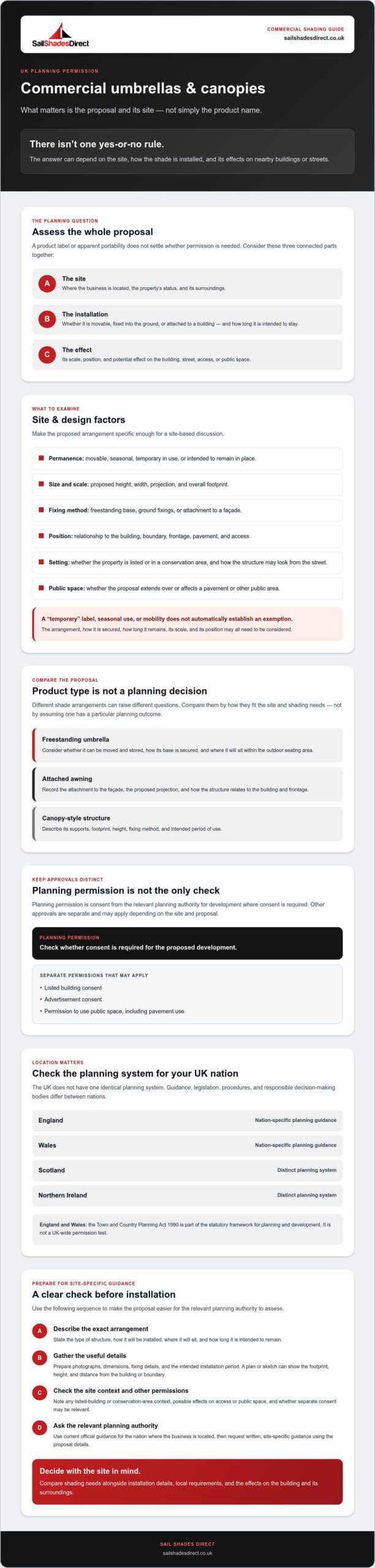
A clear enquiry is easier to answer when it describes the actual site and proposed installation. Before ordering or arranging work, use this checklist to establish what needs checking and keep the replies with your project records. This is particularly useful for planning permission for commercial umbrellas UK, where the rules depend on the site and proposal.
- Review the site. Confirm the property address, who owns or manages it, and whether the proposed shade would sit on private land or affect a public pavement or other public space. Note any known listed status, conservation-area location or other designation, then ask the planning authority to verify it.
- Document the proposal. Take clear photographs of the building, frontage and intended installation area. Add a simple location plan and proposed dimensions, including height, width and footprint.
- Describe how it will be installed and used. Explain whether the structure will be freestanding or attached, identify proposed fixing points and materials, and state whether it is intended to move or remain in place. Include the planned installation period and how the area beneath it will be used.
- Ask the relevant planning authority. Contact the local planning authority responsible for the site, using current official guidance for the relevant UK nation. Ask whether the proposal needs planning permission, whether another consent may apply, and what information the authority needs to assess it. Request written guidance and keep a copy with the plans and correspondence.
- Check permissions and requirements separately. Don’t assume a planning response covers every approval. Ask the relevant bodies about building regulations, where applicable, and whether listed building consent may be needed. If the structure or associated seating would use public space, check requirements with the responsible council or authority. Confirm any landlord or site-manager approval, and check whether licensing requirements apply to your proposed use.
Separate checks help prevent surprises
These checks serve different purposes, and which ones apply depends on the project and location. Planning permission concerns the planning assessment; it doesn’t automatically confirm compliance with building regulations, authorise work to a listed building or grant permission to use public space. Terminology and procedures can vary across England, Wales, Scotland and Northern Ireland, so confirm requirements with the appropriate authority rather than relying on a general rule.
For another project-planning perspective, see the professional commercial shading planning guide. Once you’ve identified site constraints and questions to resolve, you can discuss commercial shading options with Sail Shades Direct as part of shaping a suitable proposal.
Choose commercial shading with planning checks built into the project
Good project planning brings the site, shading requirements and permission checks together before the design is finalised. This doesn’t guarantee consent, but it can help you identify constraints early and avoid committing to an installation before key questions are answered. Treat the planning enquiry and product choice as connected steps, not decisions made in isolation.
Questions to ask a commercial shading supplier
Share what you know about the site and ask how different options could suit its layout and intended use. Useful questions include:
- How might the proposed design fit the area we need to shade and the way the space is used?
- What attachment points or ground positions would the design require?
- What drawings, dimensions or fixing details could be provided to support a planning enquiry?
- Which details of the proposal should we confirm with the local planning authority before proceeding?
A supplier can help develop and explain the shading proposal, but isn’t a substitute for formal confirmation from the relevant authority. The business installing or commissioning the work should verify which permissions and other approvals apply to its site and proposal.
Plan a suitable next step for your business
Before discussing a project, bring together the essentials: the site address, photographs, the area to be shaded, known property constraints and questions still awaiting an answer. If you’ve spoken with the authority, keep its written guidance alongside your plans. This gives a supplier a clearer picture of what the design needs to accommodate, without assuming that a particular format will secure approval.
Then consider what suits the space and how your business operates. Bespoke giant umbrellas may work for some layouts; awnings, sail shades or exterior blinds may suit others. Compare practical fit, attachment and use alongside the planning position for that specific site.
Sail Shades Direct designs, manufactures and professionally installs bespoke outdoor shading for commercial clients across the UK. Bring your site details and shading goals to a project discussion so the design can take account of your requirements.
Move from planning checks to a shading design that fits
For planning permission for commercial umbrellas UK, assess the full proposal in its setting rather than relying on the product name for a yes-or-no answer. Check the site, installation details and any separate approvals with the relevant authority before finalising the design or arranging installation.
With those questions in hand, you can compare shading options against your business’s layout and practical needs. Sail Shades Direct offers commercial giant umbrellas and provides UK-wide design, fabrication and professional installation for bespoke outdoor shading. A considered project discussion can bring the site requirements and shading brief together without treating a product choice as a guarantee of planning consent.
Discuss your bespoke commercial shading project with Sail Shades Direct and take the next step with the design and site requirements in view.
Frequently Asked Questions
Do commercial umbrellas need planning permission in the UK?
There’s no single answer for every site or umbrella. For planning permission for commercial umbrellas UK, the relevant planning system, installation method, permanence, location and possible effects can all matter. Before ordering or installing, describe the proposal to the planning authority responsible for the site and ask whether planning permission or another consent may be needed. Request written guidance, and don’t rely on the product label alone.
Do I need planning permission for a commercial canopy attached to a building?
An attached canopy may raise different planning questions from a freestanding umbrella, but attachment alone doesn’t determine the answer. The building, dimensions, design, intended duration and relevant site controls may also be considered. Ask the responsible planning authority to assess the proposal before installation. Check separately whether building regulations or listed building consent may apply, and verify current requirements for the UK nation where the business is located.
Are temporary commercial umbrellas exempt from planning permission?
Temporary use doesn’t automatically mean planning permission is unnecessary. Duration and frequency, location, design, effects and local controls may all be relevant. Explain to the planning authority when and how the umbrella will be used, and request guidance for that proposal. Treat claims of automatic exemption cautiously. If you believe permitted-development rules may apply, check the current official criteria with the relevant authority before proceeding.
Does a listed building need consent for a commercial umbrella or canopy?
A listed building may need additional checks, but whether consent is required depends on the building, proposed structure and its effect on the listed asset. Listed building consent is separate from planning permission, so check both rather than assuming one covers the other. Before attaching or installing anything, contact the relevant authority with photographs and drawings, and ask which process applies. Don’t assume a freestanding or temporary structure is automatically exempt.
Do planning rules for commercial umbrellas differ across the UK?
Yes. England, Wales, Scotland and Northern Ireland have separate planning systems, and their terminology and guidance can differ. Identify which nation the site is in, then check its current national planning guidance and contact the authority responsible for the property. Ask about local designations or controls that could affect the proposal. An answer based on one part of the UK shouldn’t be assumed to apply elsewhere.
Can a business put a commercial umbrella on a pavement or public space?
Using a pavement or other public space may require permission beyond planning, depending on who controls the land and how it will be used. Before placing an umbrella or related equipment there, contact the relevant local authority or landowner and ask whether a licence or highway approval applies. Confirm any conditions, including the permitted area and operating arrangements. Planning permission alone shouldn’t be taken as authorisation to use public space.
Should I contact the council before installing a commercial canopy?
Yes. Contacting the planning authority before installation is a practical way to clarify requirements for your site. Provide photographs, dimensions, fixing details, materials and the intended installation period, then ask whether planning permission or another approval may be needed. Request written guidance and keep it with your project records. If the site has a designation or the proposal is complex, consider qualified planning advice before committing to a design or installation.