
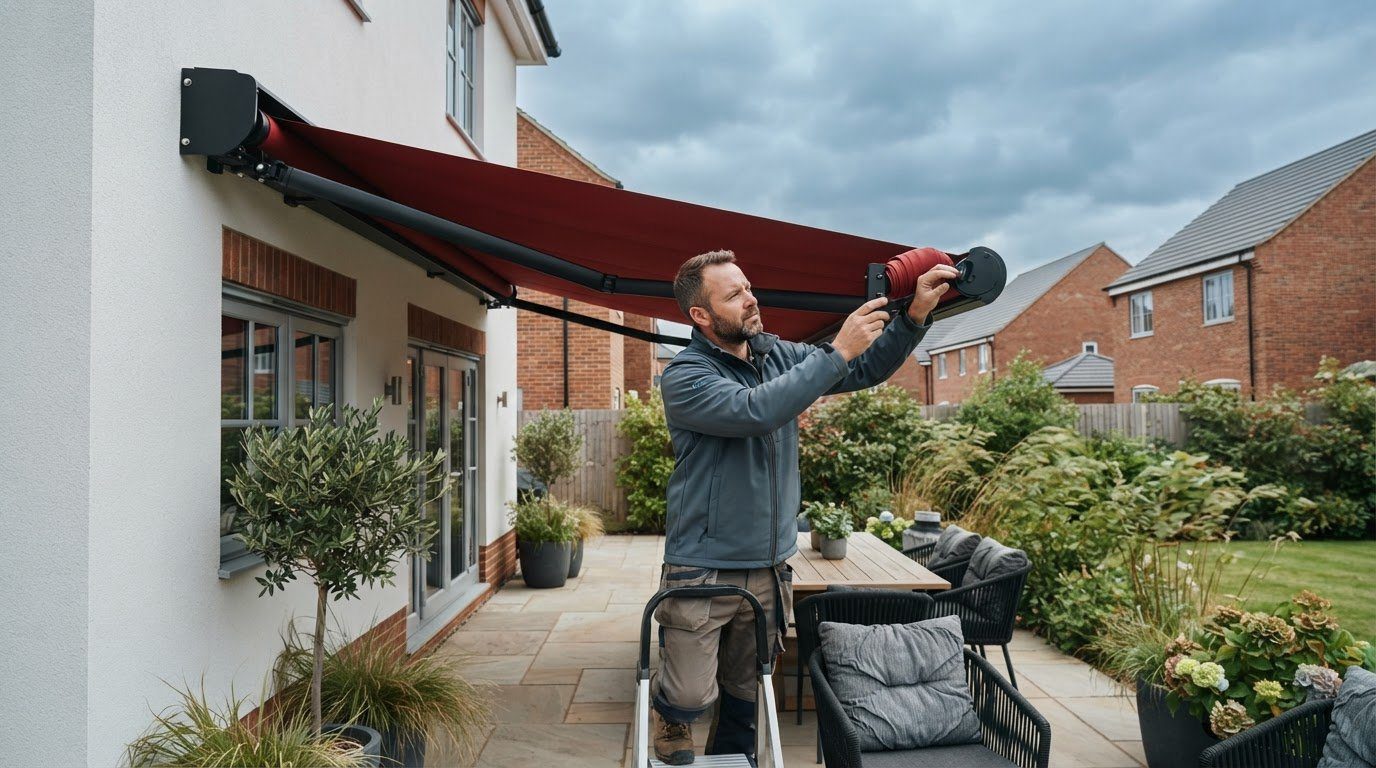
Preventing Awning Wind Damage: A Practical UK Guide
A sudden gust, rather than a weather warning, can be the first sign that an awning is under strain. Knowing how to avoid wind damage to awnings starts with acting early: an extended canopy can catch the wind, putting force on its fabric, arms and wall fixings. Even a well-made system can be vulnerable if conditions change or its installation does not suit the setting.
When is it safe to leave an awning open, and do the same precautions apply to every type? Retractable awnings can be closed before the wind strengthens; fixed awnings need a different approach, with attention to their condition, fixings and exposure. This guide explains how wind affects different systems, what to do as the forecast changes and which warning signs need attention. You’ll also learn when damage or movement calls for a professional assessment, and why design and fitting matter when planning or replacing an awning. A simple routine helps you make clearer decisions and protect your outdoor space.
Key Takeaways
- Learn how to avoid wind damage to awnings by responding to changing conditions and following the guidance for your specific system.
- Understand how awning type, installation and site exposure affect the forces on fabric, moving parts and fixings.
- Use the Met Office forecast alongside the manufacturer’s instructions to decide when to secure or retract a movable awning.
- Check fabric, seams, arms, joints, brackets and nearby mounting surfaces routinely, especially after notably windy weather.
- When planning or replacing an awning, discuss the site’s exposure, intended use and how you’ll operate it with a professional designer.
How wind damages awnings and why prevention matters
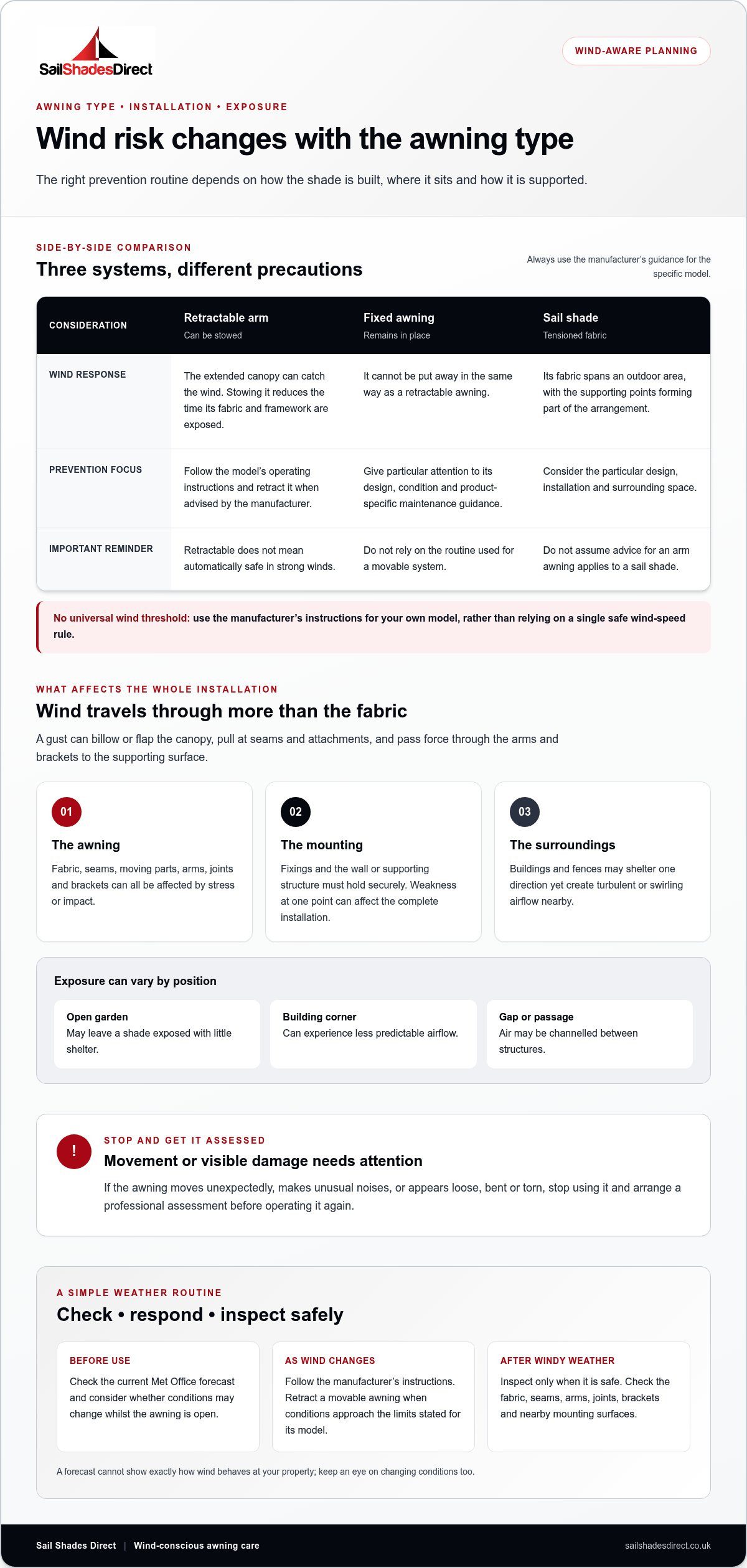
Wind damage is not limited to a torn canopy. It includes stress or impact that harms the fabric, moving parts, fixings or the surface supporting the awning. A gust can make fabric billow or flap, then pull sharply against its seams and attachments. That force travels through the arms and brackets to the wall or supporting structure, so the whole installation matters.
Wind can rise and ease quickly, and a change in direction can catch a canopy differently. Buildings, fences and neighbouring structures may shelter an awning from one direction but create turbulent or swirling airflow nearby. A spot that feels calm at ground level may still expose an extended awning to sudden movement.
For a general introduction to awning types and construction, remember that awnings vary in form and operation. Their ability to cope with wind depends on the particular design, its condition, how it was installed and the manufacturer’s instructions.
Wind resistance describes how an awning performs under specified conditions; it is not permission to leave it extended in every kind of weather. Treat the guidance for your own model as the key reference. A sturdy appearance alone does not mean it can stay open as conditions change.
Which parts of an awning are most exposed to wind?
The fabric is directly exposed and may billow, flap or pull against seams and attachment points. On an arm awning, repeated movement can strain the arms, joints and brackets. The wall or supporting surface must also hold the fixings securely. Weakness or damage at any point can affect the complete installation.
Why an awning can be vulnerable even when it looks sturdy
Calm conditions can change quickly, so a brief glance outside is not a reliable guide to what an awning may face moments later. Wear, loose fittings or previous damage can also affect how it behaves under load, even if the frame looks solid from a distance. To avoid wind damage to awnings, follow the manufacturer’s model-specific operating guidance rather than relying on a universal wind-speed rule. If anything appears loose, bent or torn, stop using the awning until it has been assessed.
How awning type, installation and exposure affect wind risk
Wind risk depends on more than the awning itself. Installation, surroundings and operation all influence how wind affects an outdoor shade. A retractable arm awning, fixed canopy and tensioned sail shade have different forms and respond differently to conditions. Prevention should suit the particular system and its setting.
Retractable and fixed awnings: different prevention routines
A retractable arm awning can be stowed when conditions call for it, reducing the time its fabric and framework are exposed. That flexibility does not make it automatically safe in strong winds: follow the manufacturer’s instructions for your model and retract it as advised. A fixed awning cannot be put away in the same way, so its design, condition and product-specific maintenance guidance are especially important.
Sail shades also need to be considered according to their particular design and installation. Their fabric spans an outdoor area, and the supporting points and surrounding space form part of the overall arrangement. Do not assume that advice for an arm awning applies equally to a fixed system or sail shade.
How position and installation influence exposure
An open garden may leave a shade exposed to wind with little shelter. Nearby buildings can channel air through gaps or create less predictable conditions around corners. An awning mounted on an open elevation, at a building corner or beside a passage between structures may therefore experience different airflow from one in a more sheltered position.
Secure mounting depends on both the awning’s fixings and the supporting structure. Suitable design and professional fitting take the installation setting into account, rather than treating the product in isolation. If an awning moves unexpectedly, or you notice cracking or unusual noises, stop using it and arrange a professional assessment before operating it again.
When planning maintenance in a commercial outdoor area, consider the safety of people nearby as well as the shade. Consult general UK Health and Safety Executive (HSE) guidance when planning work around staff or customers.
To account for how to avoid wind damage to awnings from the start, describe the site, its exposure and how you intend to use the shade during a professional awning design discussion. This brings the installation and operating routine into the same conversation.
What to do before, during and after windy weather
A straightforward routine makes how to avoid wind damage to awnings easier to put into practice: check conditions before use, respond cautiously if the wind increases, then inspect only when it is safe. Use the current Met Office forecast alongside the manufacturer’s instructions for your specific awning. A forecast cannot show exactly how wind behaves at your property, so keep an eye on changing conditions too.
Before the wind picks up: prepare and reduce exposure
- Check before extending. Look at the forecast and consider whether conditions are likely to change while the awning is in use. A calm moment does not guarantee that the wind will stay light.
- Follow the model’s operating guidance. Retract a movable awning when conditions approach the limits stated by its manufacturer. There is no single safe wind threshold for every design and installation.
- Clear nearby hazards. Secure or move loose garden furniture, parasols and other items that could blow into, catch on or strike the fabric and frame.
These are general precautions, not a substitute for model-specific instructions. For broader UK information on product safety, consult the UK Office for Product Safety and Standards (OPSS). Follow the awning manufacturer’s guidance for operation and care.
During windy weather: put safety first
If conditions worsen, take them seriously before visible damage appears. Retract an awning only if it is safe to do so and you can follow its normal operating instructions. Do not operate it in unsafe conditions, and do not climb a ladder or reach out from a window or balcony to secure or inspect it. If it cannot be handled safely, keep people clear and wait for conditions to ease.
After windy weather: inspect without taking unnecessary risks
Once the wind has eased, look from ground level before using the awning again. Check for torn or displaced fabric, bent components, loose-looking brackets, unusual sagging or signs that the awning has shifted. Do not tug at the fabric or try to straighten parts yourself.
If you spot damage, movement or anything that looks out of place, stop using the awning and arrange a professional assessment. A careful visual check can flag a problem, but it cannot establish whether hidden fixings or supporting surfaces remain secure.
How regular checks help prevent wind damage to awnings
A quick visual check can reveal wear or changes before they become harder to address. Make it part of your routine before regular seasonal use, and repeat it after notably windy weather. These checks cannot prove that an awning is safe in every condition, but they can help you spot signs that it needs attention.
Follow the manufacturer’s instructions for cleaning and maintenance, including advice specific to the fabric and operating mechanism. Avoid improvised treatments or adjustments: the wrong cleaning method can harm materials, while altering a loaded component can create additional risk.
A simple awning inspection checklist
From a safe position, look over the visible parts without dismantling the awning or reaching at height. Note anything that has changed since your last check.
- Fabric and seams: Look for fraying, holes, stretched areas, loose stitching or fabric that sits under persistently uneven tension.
- Arms and joints: Watch for visible corrosion, looseness, bending or other deformation. Do not tighten or adjust loaded components yourself.
- Brackets and mounting area: Look for apparent looseness, cracking or fresh movement around the fixings and supporting surface.
- Operation: Notice new creaking, unexpected movement or a change in how smoothly the awning opens and closes. Do not keep operating it to test a suspected fault.
Keep a note of concerns and, if useful, take a photograph from ground level to track changes over time. A visual check is not a structural assessment, so do not rely on it to confirm that hidden fixings are secure.
When to stop using an awning and seek an assessment
Stop operating the awning if an arm, joint or bracket appears bent, loose or damaged. Do the same if the awning has shifted or the mounting surface shows cracking or movement. Do not attempt structural repairs or climb to investigate; arrange a professional assessment so the issue can be examined safely.
Regular checks are a practical part of how to avoid wind damage to awnings, alongside following the manufacturer’s guidance and responding to changing weather. If you are planning to replace an awning or want a new system designed and fitted with its setting in mind, explore bespoke awning design and fitting.
Choosing a wind-conscious awning design and planning next steps
A sensible awning plan starts with how you will use the space, not just the area you want to shade. Consider the position’s exposure, whether the system needs to retract, how often it might remain extended and what routine checks it will need. These details help shape a design and operating plan suited to your setting, without promising that any awning is wind-proof.
Questions to consider when planning an awning
Before a professional design discussion, think through the practical details of the site. Is the awning going on an open elevation, near a corner or in a position sheltered by other buildings? Could gaps between structures channel wind towards it? Describe what you have noticed in different weather, as conditions can vary across a garden or outdoor area.
It is also useful to consider how you will operate the shade day to day. Would a retractable option suit your routine, and might it be left extended when the space is not in use? Discuss access for operation and inspection, nearby structures, and how you will follow the manufacturer’s maintenance guidance. Clear answers make it easier to choose a suitable awning form and plan how it will be cared for.
How bespoke design and professional fitting support prevention
Design can be tailored to the site, intended use and chosen type of outdoor shading. Professional fitting takes the mounting points and supporting surfaces into account too, rather than treating the canopy or frame as a standalone item. Together, these choices help establish a suitable design and practical routine, but they cannot remove the need to respond to weather or follow product-specific instructions.
If you are considering an arm awning, explore the factors that shape bespoke outdoor shading solutions and share details of the site’s exposure and how you plan to use it. A considered design and fitting process is a practical next step in working out how to avoid wind damage to awnings, while keeping the needs of your particular installation in view.
Make awning care part of your outdoor plans
Knowing how to avoid wind damage to awnings comes down to three habits: follow the guidance for your particular system, retract movable awnings when conditions call for it, and check for signs of wear or movement once it is safe. The awning’s design, installation and exposure all matter, so a sturdy appearance alone is no reason to leave it extended in changing weather.
If you are planning a new awning or replacing an existing one, consider how you will use it, how exposed the position is and what routine care it will need. Sail Shades Direct designs, fabricates and professionally fits bespoke outdoor shading for residential and commercial settings across the UK, taking the installation setting into account.
Explore bespoke outdoor shading solutions and take the next step towards a shade designed for your space and how you use it. Pair a considered design with a simple weather routine to help protect your outdoor area.
Frequently Asked Questions
Can I leave my awning open in windy weather?
Not necessarily. There is no universal safe wind limit for every awning, and the right action depends on its design, condition and manufacturer’s guidance. If you have a retractable awning, follow its operating instructions and retract it when conditions exceed its stated limits. Do not take a calm moment as proof that the weather will stay settled; wind can strengthen or change direction quickly, so check the forecast and stay alert.
At what wind speed should I retract an awning?
Use the operating limit given in your awning’s manufacturer instructions, as there is no single wind-speed figure that applies to every model. Check the forecast before extending it, then act early if conditions are expected to approach that limit. Do not wait until the wind feels strong. If you cannot find the guidance or it is unclear, avoid guessing and arrange a suitable professional assessment before relying on the awning in windy conditions.
Can wind damage an awning when it is retracted?
Retracting a movable awning can reduce its exposure, but it does not make every system immune to damage. Wind-driven debris may still strike it, while existing wear or installation issues can affect its condition. Follow the product instructions, and once conditions are safe, look for visible signs of movement or damage. If anything appears loose, bent or out of place, do not operate the awning until it has been assessed.
How can I tell if wind has damaged my awning?
Look for torn or stretched fabric, bent components, loose-looking brackets, new sagging or uneven movement. If the awning makes unfamiliar noises or no longer opens and closes as it did before, pause and inspect it from a safe position. Do not operate an awning that appears damaged, and never climb to inspect it during unsafe weather. Suspected structural or mounting problems need a professional assessment before it is used again.
Should I retract a motorised awning before a storm?
Yes, if forecast conditions may exceed the operating limits stated in the instructions for your model. Check the forecast and retract the awning in good time, following its normal operating guidance. Do not assume a motor or automatic feature guarantees protection, and use any stated safety features only as directed. If conditions are already unsafe, do not attempt to operate the awning; wait until it is safe to do so.
Can I repair wind damage to an awning myself?
Limit DIY care to cleaning or maintenance described in the manufacturer’s instructions. Do not improvise repairs to structural damage, loose fixings or bent arms, as the cause and extent of the problem may not be obvious. Avoid operating a damaged awning, and do not work at height in unsafe conditions. Arrange a professional assessment to identify what is affected and determine whether an appropriate repair or replacement is needed.
Do sail shades and patio awnings need the same wind precautions?
Both can be affected by wind, but their designs, fixings and operation differ, so their precautions may differ too. A retractable patio awning can be stowed according to its instructions, while a fixed sail shade needs guidance suited to its particular design and installation. Follow the relevant product guidance rather than applying one system’s limits or routine to another. Consider the shade’s condition and mounting points during safe visual checks.