
UV Protection from Sail Shades: What the Fabric and Coverage Really Mean
A sail shade can create a welcome patch of cool shade without blocking every ray of sunlight. If you’re comparing uv protection sail shades, a fabric claim alone won’t tell you how much protection people will get beneath or around the finished design.
That uncertainty is understandable. The fabric matters, but so do its construction, the sail’s position and how much of your outdoor area it covers. Sunlight can still reach people from the sides, and the shade moves as the sun changes position.
This guide explains what to look for when comparing UV-protection claims, why test evidence for the specific fabric matters and how coverage and positioning affect shade in everyday use. You’ll also find practical questions to consider before requesting a bespoke design, from where people sit or play to the times of day the space needs shade. A clear picture of your needs and site conditions makes it easier to discuss a design for your outdoor space.
Key Takeaways
- Think of shade as reducing direct UV exposure in a covered area, not eliminating every source of exposure outdoors.
- When comparing uv protection sail shades, look for fabric-specific test evidence rather than judging performance by appearance alone.
- Check how the sail’s footprint and open sides relate to where people sit, play or dine.
- Observe your outdoor space at the times you use it most, then note which areas need better shade coverage.
- Before discussing a bespoke design, prepare questions about fabric evidence, intended use and conditions at your site.
How do UV-protection sail shades reduce your exposure outdoors?
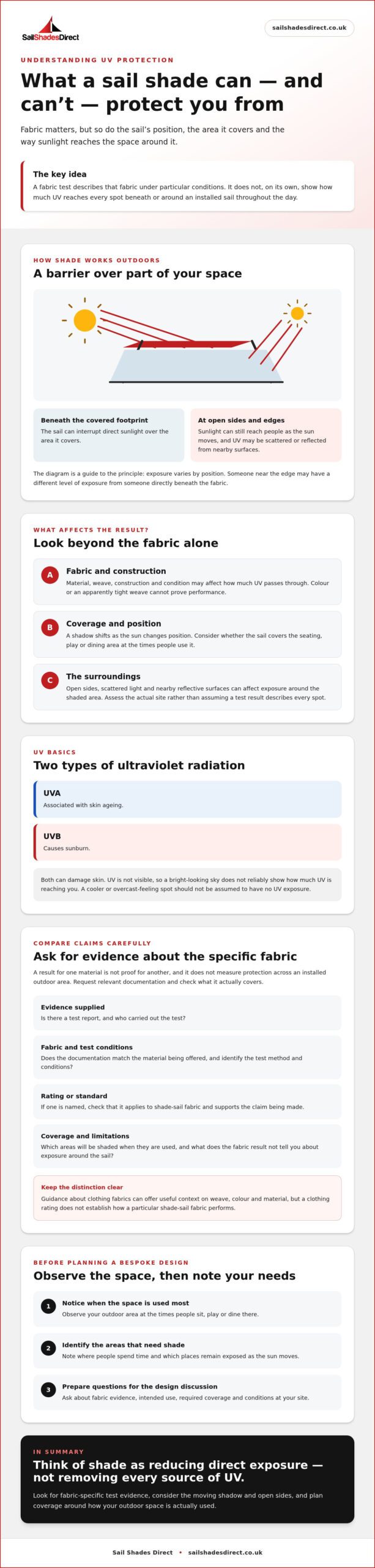
A sail shade reduces direct ultraviolet (UV) exposure by placing a fabric barrier over part of an outdoor space. The protection you experience depends on more than the presence of a sail. Fabric and construction affect how much UV passes through, while coverage, the sun’s position and light reflected from nearby surfaces also matter.
That distinction helps make sense of claims about uv protection sail shades. A test result describes the performance of a piece of fabric under particular conditions. It doesn’t automatically show how much UV reaches every spot beneath an installed shade throughout the day. The sail’s position and the area it covers affect the real-world outcome.
What are UVA and UVB rays?
UVA and UVB are types of ultraviolet radiation from the sun. NHS guidance explains that UVA is associated with skin ageing, whilst UVB causes sunburn; both can damage skin. UV isn’t visible, so a bright-looking sky isn’t a reliable guide to how much UV is reaching you. Equally, a cooler or overcast-feeling spot shouldn’t be assumed to have no UV exposure.
What does a sail shade protect you from?
A correctly positioned sail can interrupt direct sunlight across the area beneath its covered footprint. This can make a seating or play area more comfortable and reduce direct exposure while people are in the shade. The benefit depends on the fabric’s UV performance and whether the sail covers the space at the times it’s used.
A shade sail doesn’t create a sealed, UV-free space. Sunlight can enter from open sides as the sun moves, and UV can reach people through light scattered in the atmosphere or reflected by surrounding surfaces. Someone sitting near the edge may have a different level of exposure from someone directly beneath the fabric.
Think of the sail as one part of a broader approach to sun protection, not a guarantee that all UV is blocked. Consider where people spend time, how the sun crosses the area and which spaces remain exposed. These observations are a more useful starting point for planning coverage than the shade’s appearance alone.
How fabric, weave and shade coverage affect UV protection
Fabric is important, but a sail’s colour or the apparent tightness of its weave can’t prove its UV performance. Material, weave, construction and condition may all affect how much UV passes through. Wear or damage can also change the fabric over time, so ask for evidence relating to the specific fabric being considered rather than relying on appearance.
Guidance on sun-protective clothing helps explain why fabric properties matter. The Skin Cancer Foundation on sun-protective fabrics discusses factors such as weave, colour and material in relation to UV protection. This is useful context, but a clothing rating doesn’t establish how a particular shade-sail fabric performs. Ask for evidence that applies to the actual fabric and intended use.
How should you interpret a fabric UV-protection claim?
Ask whether the stated result is backed by test evidence, and request the relevant documentation. Check that it identifies the fabric tested, the test method and the conditions. If a rating or standard is named, verify that it applies to shade-sail fabric and supports the claim being made. A result for one material isn’t proof for another, or a measure of protection across an installed outdoor area.
A simple comparison can keep the details clear. For each option, note:
- Evidence supplied: Is there a test report, and who carried out the test?
- Fabric and test conditions: Does the documentation match the material being offered?
- Coverage: Which part of the area will the sail shade at the times it’s used?
- Limitations: What does the result not tell you about exposure around the sail?
Why does the size and position of the sail matter?
A sail’s dimensions don’t tell the whole story. As the sun changes position, its shadow shifts too, potentially moving away from a table, play area or seating spot. Consider the shaded footprint at the times people are most likely to use the space, rather than judging coverage only from a plan or the sail’s outline.
Nearby buildings and surfaces can also affect light around the shaded area. The effect depends on the site, so assess the actual surroundings rather than assuming a fabric test result describes every position beneath or beside the sail.
For broader material-selection considerations, explore this bespoke sail shade fabric guide. If you’re weighing up uv protection sail shades for a particular space, discuss its intended use, coverage needs and site conditions as part of planning a bespoke design. Discuss your bespoke sail shade requirements.
Does a UV-protective sail shade block all sunlight?
No. A UV-protection claim doesn’t mean every ray is blocked everywhere around the shade. It relates to the fabric or the covered area under particular conditions. In practice, protection also depends on whether the sail covers the places people use and how sunlight reaches them throughout the day.
Overhead shade can reduce direct sunlight beneath its footprint, but it can’t close off open sides. As the sun moves, the shadow shifts; light may also reach people through gaps or reflect from nearby surfaces. Consider the fabric claim alongside the coverage at your site.
Can UV reach you around the edges of a shade sail?
Yes. For example, a sail might shade a patio table earlier in the day, then cast its shadow towards the garden as the sun changes position. Later, someone at the table may be partly in direct sun, even though the sail hasn’t moved. Seats or walkways near the perimeter may also sit outside the shaded area.
Think about when the space is typically used and where people spend that time. Observe the patio or garden at those hours, noting which areas are shaded and which remain exposed. This gives a more realistic picture than considering the sail’s dimensions alone.
Does cloudy weather mean there is no UV exposure?
No. Cloudy conditions don’t automatically mean there’s no UV exposure. Visible brightness and warmth aren’t dependable measures of UV, so don’t use the appearance of the sky alone to decide whether sun protection is needed. A shade sail can help in its covered area, but it doesn’t remove the need to consider exposure beyond it.
For day-to-day decisions, check current guidance from the NHS or the Met Office, including the UV forecast where available. Their advice can help you judge conditions; a fabric claim can’t do that on its own.
Clothing guidance shouldn’t be treated as proof of how a shade sail performs. The Skin Cancer Foundation’s information on sun-safe fabric factors explains how fabric properties relate to sun protection. Use it as background, then ask for evidence specific to the shade fabric being considered.
Key takeaway: Judge UV protection by combining relevant fabric evidence with the shade your particular site receives, where people sit and how the sun changes across the day. If you’re planning a bespoke shade, include the intended use and site conditions in the design conversation. Discuss your bespoke sail shade requirements.
How to assess UV protection when planning a sail shade
A little preparation makes it easier to compare claims and discuss a design that suits your space. Use this checklist to organise what you know and what you still need to ask.
- 1. Map the area you use. Mark where people sit, dine or play, including the spots where shade matters most. Note nearby buildings, boundaries and other features that could affect possible positions for the sail.
- 2. Observe the sun at typical use times. Check the area when you’re most likely to be outside, rather than relying on a single midday view. Note where direct sun falls and how the shaded area changes as the day progresses.
- 3. Ask for fabric details. Request the specification and supporting evidence for any UV-protection claim. Check which fabric was tested, what method was used and whether the evidence describes the material alone or the complete installed shade.
- 4. Ask about care and condition. Find out what cleaning is recommended and whether weathering, wear or other changes may affect the fabric’s performance. Ask how to identify when it needs attention.
- 5. Discuss the proposed design. Ask how the shape, position and coverage relate to your intended use and the sun’s movement across the site. Consider where people will be at different times, not just the area covered in a plan.
- 6. Check current sun-safety guidance. Consult up-to-date NHS or Met Office advice for day-to-day decisions. Treat the sail as a way to create shade, not as medical protection or a substitute for wider sun-safety guidance.
Bring your notes to a design discussion. For example, explain that the table is used in the afternoon and describe where the sun reaches it. This helps a professional consider whether the proposed position and footprint address the actual need. Bespoke design can take the shape and intended use of an outdoor area into account, alongside relevant site conditions.
If you want to understand more about the structural considerations involved, see this architectural sail shades guide. Preparing these questions is a practical first step in assessing uv protection sail shades for your space.
Ready to discuss your area and coverage requirements? Talk through your bespoke sail shade design.
Choosing bespoke UV-protection sail shades for your outdoor space
A suitable design brings together three things: credible evidence for the fabric, useful shade coverage and the practical needs of your space. A fabric claim alone can’t show how well a proposed sail will cover the places you use, while a carefully planned layout can’t verify a fabric’s UV performance. Consider both before deciding.
Bespoke design may be worth discussing if your outdoor area has an unusual shape, several areas with different uses, or mounting positions that make standard dimensions or fixed shade positions difficult to work with. A tailored design conversation can explore the area’s shape, intended use, possible mounting points and the coverage you need. These design choices don’t replace independent evidence for a fabric-specific UV claim, so ask for that evidence separately.
When is a bespoke sail shade worth discussing?
Think about the space as people use it. You might want shade over a dining table but need to keep a route through the garden clear, or have seating where the sun reaches at particular times. Sharing these priorities helps a designer consider the sail’s shape and position in relation to your site. Sail Shades Direct designs, manufactures and professionally fits bespoke sail shades across the UK. Ask for evidence to support any specific fabric UV-protection claim.
What information should you prepare before an enquiry?
A few practical details can make an initial discussion more focused. You don’t need a finished design, just a clear picture of the space and what you want it to do.
- Approximate dimensions: Note the length and width of the area you’d like to shade.
- Photos: Include views of the space and any potential mounting points, if available.
- Intended use: Explain whether the area is used for dining, sitting, play or another purpose.
- Timing: Note when you most want shade and where the sun falls at those times.
- Site constraints: Mention known obstacles or limitations around possible mounting positions.
During the conversation, ask which fabric is proposed and what evidence supports any UV-protection claim. Clarify whether that evidence describes the fabric itself or the installed shade, and ask how the proposed shape and position relate to your priorities. This keeps design decisions distinct from verified fabric performance.
If you’re ready to talk through the shape, use and shade requirements of your outdoor space, discuss a bespoke sail shade with the team.
Plan shade that fits your space
Choosing uv protection sail shades means looking beyond a fabric claim. Ask for evidence relating to the fabric being considered, then think about where the shade will fall as the sun moves and whether it covers the areas you use. Your space, mounting points and intended use all help shape a practical design.
Sail Shades Direct designs and manufactures bespoke sail shades, then professionally fits them across the UK. A tailored discussion can help you explore coverage and site requirements for your outdoor area, while keeping fabric evidence distinct from design choices. Ask for supporting documentation for any fabric claim.
Ready to take the next step? Discuss a bespoke sail shade for your outdoor space and share what you’d like the area to do. Your requirements are a useful starting point for planning an outdoor space that feels more comfortable to use.
Frequently Asked Questions
Do UV-protection sail shades block 100% of UV rays?
No, you shouldn’t assume a sail shade blocks every UV ray. It can reduce direct exposure beneath the area it covers, but fabric performance, installation, sun angle, open sides and reflected light all affect outdoor conditions. If you’re comparing uv protection sail shades, check the evidence for the exact fabric claim and consider how coverage works for your space. For wider sun-safety advice, consult current NHS guidance.
How do I know if a sail shade fabric offers UV protection?
Ask the supplier for the fabric specification and supporting test evidence for the specific UV-protection claim. Check which material was tested, the test method and conditions, and whether the result describes the fabric alone or the complete installed shade. Colour, thickness and marketing language aren’t proof of a particular protection level. If a rating or standard is cited, verify that it applies to shade-sail fabric and the claim being made.
Can UV rays get around the sides of a sail shade?
Yes. A sail provides overhead coverage, but open sides and the sun’s changing position can leave part of a seating or play area exposed. Reflected light may also affect conditions around the shade. Think about where people spend time and when they use the space, then discuss the proposed position and footprint with a designer. A shade sail can reduce exposure in its covered area, but shouldn’t be treated as eliminating all outdoor UV exposure.
Does a darker sail shade provide more UV protection?
Not necessarily. Colour alone can’t establish how well a fabric performs, and appearance isn’t a substitute for evidence. Material and construction matter, while the installed sail’s position affects the coverage people experience. Ask for documentation relating to the specific fabric on offer, and check the source, scope and relevance of any stated rating before comparing it with another option. This helps separate verified performance information from assumptions based on colour.
Are sail shades effective on cloudy days?
A cloudy sky doesn’t automatically mean there’s no UV exposure. A sail’s coverage still depends on its fabric, position and design, and visible brightness isn’t a reliable guide to exposure. For day-to-day sun-protection decisions, check current NHS or Met Office guidance rather than judging by the weather’s appearance alone. A sail shade can contribute to a more comfortable outdoor space, but it’s only one part of a broader approach to sun protection.
How should I choose the right size sail shade for UV protection?
Start with the places people use and the times they’re usually outdoors. Observe where the sun falls then, and consider how its movement may shift the shaded area. Discuss the proposed sail’s dimensions, position and mounting points with a professional. The measurements of the fabric alone won’t show how much useful shade the design provides throughout the day, so ask how the proposed coverage relates to your intended use.
Can a bespoke sail shade be designed around my garden or patio?
Yes. A bespoke design discussion can take account of your space’s dimensions, intended use and possible mounting positions. Sharing approximate measurements, photos and the times you most want shade can help explain your priorities. Ask how the proposed shape and coverage relate to the site, and request fabric evidence separately, since custom sizing doesn’t establish a UV rating. Sail Shades Direct designs, manufactures and professionally fits bespoke outdoor shading across the UK.