
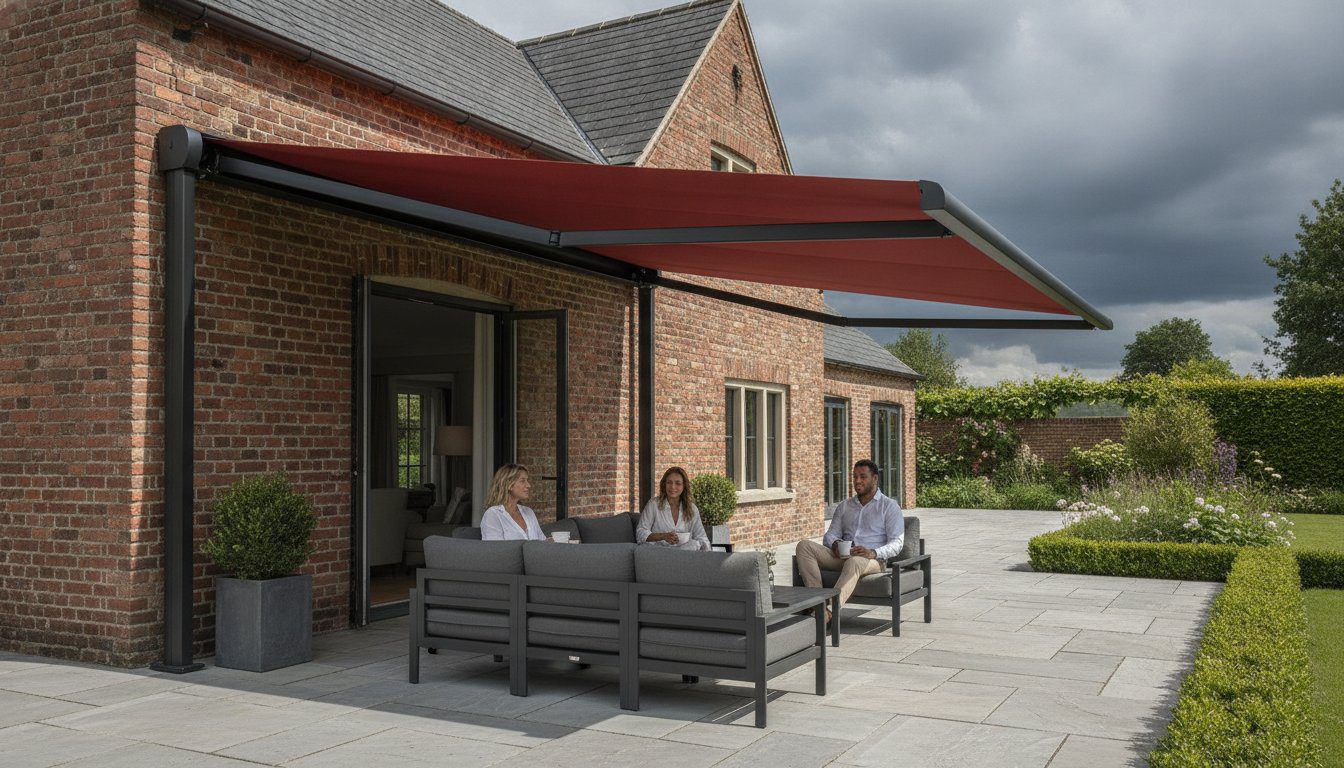
Heavy Duty Arm Awnings: The Ultimate Guide to Durable Patio Shading in 2026
If your patio shade isn’t engineered to handle a sudden British squall, is it really a home improvement, or just an expensive liability? We’ve all felt that familiar spike of anxiety when a calm afternoon turns gusty and the retractable arms start to flex under the pressure. It’s exhausting to navigate the confusing jargon of “water-resistant” claims whilst secretly fearing your fabric will sag or fade before the season is even out.
You deserve a garden space that feels like a reliable extension of your home, regardless of our unpredictable weather. This guide will help you master the technical essentials of selecting heavy duty arm awnings that are built to the rigorous BS EN 13561:2015 safety standards. We’ll demystify the engineering behind industrial-grade frames and show you how to choose high-performance fabrics that maintain their vibrant colour for up to twenty years. From smart automation sensors to bespoke structural mounting, you’ll gain the confidence to create a durable, year-round sanctuary that perfectly matches your property’s unique character.
Key Takeaways
- Understand why high wind class ratings and drop-forged aluminium components are essential for heavy duty arm awnings to survive the unpredictable British weather.
- Discover the longevity of solution-dyed acrylics and how nano-technological coatings create a self-cleaning effect that keeps your patio looking pristine.
- Learn how smart sensors and automated motorisation can protect your investment by reacting to wind and rain even when you aren’t home.
- See why professional installation using chemical resin anchors and spreader plates is vital for the structural integrity of large-scale shading systems.
- Master the technical specifications required to transform your outdoor space into a bespoke, weather-resilient retreat that adds lasting value to your home.
Defining Heavy Duty Arm Awnings for the UK Climate
A heavy duty arm awning isn’t just a larger version of a standard sunshade; it’s a piece of precision engineering designed to survive where others buckle. Whilst a budget model might look identical on a sunny afternoon, the real difference lies in the internal mechanics and the grade of materials used. For a comprehensive Awning overview, it’s clear that the category has evolved from simple canvas covers to complex, motorised structures. In the United Kingdom, we don’t just deal with sun; we face sudden gusts and persistent damp that can quickly turn a flimsy installation into a safety hazard.
Commercial-grade heavy duty arm awnings are built to withstand significantly higher wind loads than their domestic counterparts. This is vital because the British climate demands a higher wind class rating (typically Class 2 or 3) compared to the lighter models popular in Mediterranean climates. When we talk about “bespoke” measurements, we aren’t just talking about aesthetics. Every millimetre matters for structural load distribution. A custom fit ensures the weight is anchored precisely into your property’s structural points, preventing the leverage of a 5-metre projection from damaging your brickwork. If you want to understand the full spectrum of what separates a flimsy kit from a professional-grade installation, our guide to high quality patio awnings covers the critical differences in depth.
If you are concerned about the structural load on your walls, a free-standing aluminium pergola offers an excellent alternative; you can visit Pergola2Go to view their range of high-quality outdoor structures.
Why Standard Retractable Awnings Often Fail
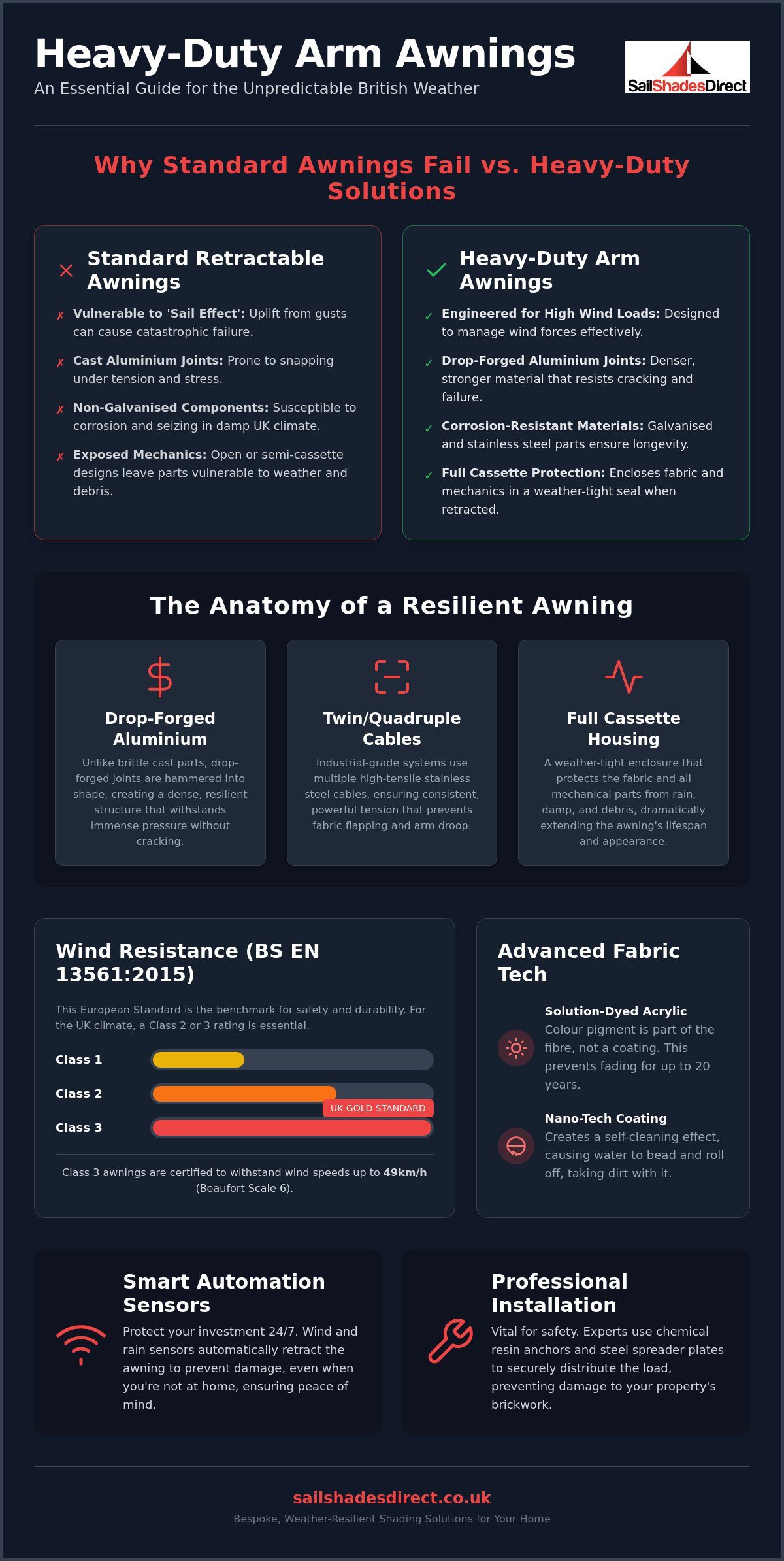
Most failures occur because of the “sail effect.” When a gust of wind gets trapped under the fabric, it creates an enormous amount of uplift. Budget “box” awnings from DIY stores often use cast aluminium joints that are prone to snapping under this tension. Couple this with the high moisture levels in the UK, and non-galvanised components will begin to seize or corrode within just a few seasons. These failures aren’t just inconvenient; they can be dangerous if the arm snaps whilst fully extended.
The Cassette System: Protecting Your Investment
The housing of your awning is your first line of defence against the elements. Open systems leave the fabric and mechanics exposed to rain and nesting birds, whilst semi-cassettes offer a partial hood. For true longevity, a full cassette is the gold standard. This design completely encloses the heavy duty arm awnings when retracted. It creates a weather-tight seal that prevents damp from soaking into the fabric roll and keeps debris away from the precision-tensioned cables. It’s the best way to ensure your investment looks as good in five years as it does on the day of installation.
Engineering Resilience: The Anatomy of a Heavy Duty Arm
The strength of any retractable system lives and breathes within the arms. Whilst the fabric provides the shade, the arms bear the brunt of every breeze and the weight of the entire structure. Most homeowners don’t realise that the “heavy duty” label often refers to the density of the metal and the method of manufacture rather than just the size. High-end heavy duty arm awnings rely on drop-forged aluminium joints. Unlike cheaper cast components, which are made by pouring molten metal into a mould, drop-forged parts are hammered into shape under immense pressure. This process creates a much denser, more resilient grain structure that won’t snap or crack when the wind catches the fabric like a sail.
Inside these arms, the tensioning system is what keeps the cover from flapping. Standard models might use a single chain or a light spring, but industrial-grade versions employ twin-cable or even quadruple-cable systems. These high-tensile stainless steel cables are coated in plastic to prevent corrosion and noise. They work in tandem with heavy duty internal springs to ensure the elbow joints remain rigid. For large-projection awnings extending beyond 3 metres, elbow joint reinforcement is critical; it prevents the “arm droop” that often plagues lower-quality installations after just a few months of use.
The Projection-to-Width Ratio is the specific mathematical balance between the awning’s extension length and its total mounting width, which directly dictates the amount of leverage and stress placed upon the wall brackets. If you’re unsure which configuration suits your property’s exposure level, you can explore our range of bespoke arm awnings to see how precision engineering makes a difference.
Wind Class Ratings and the Beaufort Scale
Every professional installation should be measured against the European Standard BS EN 13561:2015. This standard categorises awnings into Wind Classes. A Class 1 rating is only suitable for light breezes, whilst Class 3 is the gold standard for the UK, capable of withstanding wind speeds up to 49km/h (Beaufort Scale 6). Heavy duty arms maintain consistent fabric tension even in gusty conditions, but we always recommend integrating vibration sensors. These smart sensors detect when the arms are oscillating too violently and automatically retract the system to prevent structural damage.
Spring Tension and Fabric Tautness
Precision-engineered internal springs are the unsung heroes of patio protection. Their primary job is to keep the fabric taut enough to prevent “pooling,” where rainwater collects in the centre of the material and stretches it out of shape. High-quality spring tension doesn’t just protect the fabric; it also reduces the strain on the motor system. When the fabric is kept perfectly flat, the motor doesn’t have to work as hard to roll the system back into its cassette, significantly extending the lifespan of the electronics.
While the engineering of the arms provides the structural skeleton, the fabric is what ultimately defines your comfort and the longevity of your outdoor space. For heavy duty arm awnings, selecting a high-performance material is about far more than matching your masonry. Most budget options found in DIY stores use basic polyester, which is essentially a plastic-based weave that degrades rapidly under intense UV exposure. Professional-grade systems instead utilise solution-dyed acrylic. This process infuses the pigment into the liquid polymer before the fibre is even spun, ensuring the colour is consistent all the way through the thread. It’s the difference between a radish, which is only red on the outside, and a carrot, which is orange all the way through.
This depth of colour is vital for maintaining a bespoke aesthetic in high-exposure areas. Beyond aesthetics, modern fabrics often feature nano-technological coatings like Cleangard or Teflon. These treatments create a "self-cleaning" effect where water beads and rolls off, taking surface dust and environmental pollutants with it. These materials also offer high UPF (Ultraviolet Protection Factor) ratings, often reaching UPF 50+. This doesn’t just protect your family’s skin from 98% of harmful rays; it also prevents your expensive patio furniture and flooring from bleaching in the sun. For a detailed comparison of fabric grades and what to look for when specifying a premium system, see our professional guide to high quality patio awnings and the engineering standards that separate lasting investments from short-term solutions.
The Pitch Factor: Ensuring Effective Drainage
One of the biggest misconceptions in the industry is the idea that an awning is "waterproof." In reality, most high-end fabrics are highly water-repellent. To prevent water from penetrating the weave or causing damage, a minimum pitch is absolutely essential for effective run-off.
Automatic vs Manual: Managing Large Scale Shading
Deciding between a manual crank and an electric motor isn’t just a matter of luxury; it’s often a mechanical necessity for larger installations. When you invest in heavy duty arm awnings with projections exceeding 3 metres, the physical force required to retract the high-tension springs becomes significant. Whilst a manual handle is a reliable, entry-level option for smaller systems, it can feel cumbersome and slow on industrial-grade models. Modern tubular motors are specifically engineered to handle these high-torque requirements, providing a smooth and consistent operation that a manual crank simply cannot replicate. In our damp UK climate, these motors are housed in weather-sealed casings to prevent moisture ingress, ensuring they remain responsive through frosty winters and humid summers alike. If you’re also considering automated shade solutions for open garden areas, our guide to motorized rolling sun sails explores how button-operated retractable systems can complement your patio awning setup.
To further protect your investment, we recommend systems equipped with “soft-close” technology. This intelligent feature ensures the motor slows down just before the awning fully retracts into its housing. It prevents the front profile from slamming against the cassette, which preserves the internal gears and maintains the integrity of the weather seal over thousands of cycles. If you’re looking for a system that combines this level of precision with effortless use, explore our motorised arm awnings to see how automation can transform your patio experience.
Smart Sensors and Safety Fail-safes
The British weather is notoriously fickle, often shifting from calm to gusty in a matter of minutes. 3D vibration sensors are the most effective way to protect heavy duty arm awnings because they monitor the actual oscillation of the arms rather than just wind speed. If the sensor detects the arms moving beyond a safe threshold, it triggers an autonomous retraction to prevent structural damage. Sun sensors add another layer of utility by automatically extending the awning to manage internal room temperatures, which can significantly reduce your home’s cooling costs. Despite these smart features, we always advise opting for a manual override motor. This ensures that if a power cut occurs during a summer storm, you still have the peace of mind that you can stow the system safely by hand.
Remote Operation and Home Automation
Modern shading solutions now integrate seamlessly with smart home hubs like Somfy, allowing you to control your environment with a single touch. You can use multi-channel remotes to synchronise your awning with exterior blinds and integrated LED lighting, creating the perfect evening atmosphere instantly. App-based control allows for pre-cooling a patio before use, ensuring your outdoor furniture remains at a comfortable temperature even on the hottest July afternoons. This level of connectivity turns a simple sunshade into a proactive climate management tool for your entire property.
The Bespoke Advantage: Professional Installation and Design
When you invest in heavy duty arm awnings, you aren’t just buying a product; you’re commissioning a structural addition to your property. Many of these industrial-grade systems weigh well over 50kg, and when fully extended, they exert significant leverage on your building’s facade. This is why professional awning installation is absolutely non-negotiable. At Sail Shades Direct, we ensure that every installation is engineered to last, using specialised hardware like spreader plates to distribute the load across a wider surface area of your brickwork. For maximum security, we utilise chemical resin anchors rather than standard mechanical bolts. These anchors create a stress-free bond with the masonry, which is vital for the older or more varied architectural styles often found across the UK.
Our national service combines technical mastery with a deep understanding of local building regulations. Whether you’re a homeowner looking for a private retreat or a business owner needing a commercial-grade solution, we tailor the installation to suit the specific structural requirements of your site. This precision ensures that your shading remains stable and safe, even when the British weather decides to be less than cooperative.
Bespoke Fabrication vs. Off-the-Shelf Models
The difference between a mass-produced import and a bespoke system is evident from the first glance. Custom manufacturing allows for millimetre-perfect sizing, ensuring your awning provides maximum coverage without looking like an afterthought. You have the freedom to choose RAL-matched frame colours that complement your existing window frames or exterior blinds perfectly. This level of customisation doesn’t just improve the aesthetic; it ensures higher quality control. Every component is checked against rigorous engineering standards before it ever reaches your property, avoiding the common pitfalls of “one-size-fits-all” budget models.
Integrating Awnings into a Holistic Shading Plan
We believe that effective patio protection works best as part of a total shading concept. Whilst heavy duty arm awnings provide immediate, retractable shade over your doors and windows, you can combine them with bespoke sail shades UK homeowners rely on to cover larger, open garden areas. For those seeking effortless weather protection across a wider terrace, exploring motorised rolling sun sails for UK homeowners reveals how automated retractable systems can handle awkward layouts and integrate with smart home controls. This layered approach allows you to manage light and heat across different zones of your outdoor space simultaneously. You might also consider adding exterior blinds to the sides of your patio for lateral wind protection and enhanced privacy. This holistic design strategy ensures your garden remains a versatile, usable sanctuary throughout the year. Ready to upgrade your outdoor space? Book a bespoke design consultation with Sail Shades Direct.
Secure Your Outdoor Sanctuary for the Years Ahead
Investing in a patio upgrade should bring peace of mind, not a list of maintenance worries. By prioritising precision engineering like drop-forged aluminium joints and high-performance, solution-dyed fabrics, you ensure your garden remains a functional reprieve from the daily grind. We’ve explored how smart sensors and professional mounting techniques transform heavy duty arm awnings from simple sunshades into resilient, architectural assets that withstand the unique challenges of the British climate.
With over 10 years of bespoke manufacturing experience, our team understands that every property requires a unique approach, especially in high-wind or coastal environments. Our national UK installation service provides the expert fitting teams needed to handle complex structural requirements safely. You can explore our range of bespoke heavy duty arm awnings and discover how a tailored solution can elevate your outdoor living experience. It’s time to stop worrying about the weather forecast and start enjoying your patio with total confidence!
Frequently Asked Questions
How much wind can a heavy duty arm awning actually handle?
Heavy duty models are typically rated to Wind Class 2 or 3 under the BS EN 13561:2015 standard. A Class 3 system is engineered to withstand wind speeds up to 49km/h, which is equivalent to a Force 6 on the Beaufort Scale. Whilst these units are incredibly resilient, we always recommend retracting them during severe gales to protect the structural integrity of your property’s masonry.
Do I need planning permission for a large retractable arm awning in the UK?
Most residential installations fall under permitted development rights and don’t require formal planning permission. However, you’ll likely need consent if your property is a listed building or situated within a conservation area. Commercial installations that project over public pavements usually require council approval, a process that typically takes four to five weeks to complete.
Can I leave my heavy duty awning out in the rain?
You can safely use your awning in light rain as long as it has a minimum pitch of 14 degrees to allow for effective drainage. Without this angle, water can pool on the fabric and cause it to stretch or put undue strain on the arms. It is best to retract the system during heavy downpours or snow to prevent weight-loading issues that could damage the internal springs.
What is the difference between a folding arm awning and a drop arm awning?
Folding arm systems extend horizontally to provide a large shaded area for patios and seating. Drop arm awnings pivot downwards from a higher mounting point, making them ideal for window shading where you want to block low-lying sun whilst maintaining an outward view. Heavy duty arm awnings are usually the folding variety, specifically engineered for larger spans and higher wind resistance.
How long does a bespoke heavy duty awning typically last?
A professionally installed system can easily last 20 years or more with the correct care and maintenance. Whilst the mechanical frame is designed for decades of service, the fabric usually has a lifespan of 10 to 15 years before it might benefit from a professional replacement. Choosing solution-dyed acrylics over cheaper polyester significantly extends the vibrant appearance and structural strength of the cover.
Are motorised awnings more reliable than manual ones for commercial use?
Motorised systems are generally more reliable for commercial settings because they ensure consistent tension and smooth operation every time. Manual handles can be prone to user error or rough handling, which puts unnecessary strain on the internal gears over time. Electric motors also allow for the integration of automatic wind sensors, which act as a vital safety fail-safe for your business premises.
How do I clean and maintain the fabric on a retractable awning?
Modern fabrics with nano-technological coatings are largely self-cleaning, but occasional maintenance helps preserve the finish. Use a soft brush to remove loose dust and debris before it becomes embedded in the weave. For deeper cleaning, lukewarm water and a mild, non-detergent soap are sufficient. Avoid using power washers or harsh chemicals, as these can strip away the protective water-repellent layer.
Can heavy duty awnings be fixed to a bungalow or timber-framed house?
Yes, these systems can be safely installed on bungalows or timber-framed properties using specialist brackets and spreader plates. These components distribute the weight across a larger area or tie into the structural timber frame rather than relying solely on the outer cladding. Our professional fitting teams assess the substrate of your home to ensure the mounting for heavy duty arm awnings is structurally sound and secure. For a full breakdown of what this process involves, our professional awning installation guide explains how expert fitters handle complex substrates and structural requirements safely.