
Professional vs DIY Sail Shade Installation: The Ultimate 2026 Comparison
A weekend DIY project might seem like the quickest route to a shaded garden, but that “bargain” kit often becomes the most expensive mistake you’ll make this summer. We all want that perfect, stylish retreat where we can relax whilst the sun is at its peak; however, the reality of the British climate can quickly turn a simple fabric sheet into a liability. When weighing up professional vs DIY sail shade installation, it’s easy to focus on the initial price tag and overlook the heavy-duty engineering required to keep a structure standing during a sudden gale.
You’ve likely seen the common pitfalls: unattractive sagging, rusted fixings, or the constant worry that a gust of wind might rip the brackets right out of your masonry. This ultimate 2026 comparison will show you how to avoid the cycle of repeat purchases and failed attempts. We’ll dive into the technical differences between off-the-shelf hardware and bespoke, architectural-grade solutions that are built to last. By the end, you’ll know exactly how to achieve a permanent, wind-resistant outdoor centrepiece that adds genuine value and safety to your home.
Key Takeaways
- Learn how the unpredictable UK climate affects fabric tension and why a poorly installed sail can act like a giant wing in high winds.
- Discover the importance of kilonewton (kN) ratings in hardware to ensure your shading solution remains a permanent architectural feature.
- Evaluate the true cost of professional vs DIY sail shade installation by comparing initial kit prices against the ten-year lifespan of a bespoke system.
- Identify whether your specific site requires specialist tools or heavy-duty wall fixings through our practical decision framework.
- See how architectural-grade fabrics and professional tensioning create a safe, stylish outdoor centrepiece that resists sagging and weather damage.
The Great British Summer: Why Installation Method Matters
The British summer is famously unpredictable. A Shade sail should be a reliable retreat from the heat, but many homeowners mistakenly view them as mere seasonal accessories rather than permanent architectural features. This distinction is the core of the professional vs DIY sail shade installation debate. Whilst a temporary shade might suffice for a single calm afternoon, the UK’s sudden gusts and heavy downpours test the limits of fabric tension in ways a standard kit simply cannot handle. Without the correct engineering, a sail becomes a giant wing that can exert hundreds of kilograms of force on your wall fixings.
Choosing a professional installation represents a significant psychological shift. You’re no longer just buying garden furniture; you’re investing in a genuine home improvement. Most UK gardens are irregular shapes with specific wind tunnels created by neighbouring buildings or natural topography. Standard retail sizes often fail to provide the required coverage. This leaves awkward, hot gaps where the sun peeks through at the most inconvenient times, rendering the shade ineffective for large parts of the day.
The Problem with Off-the-Shelf DIY Kits
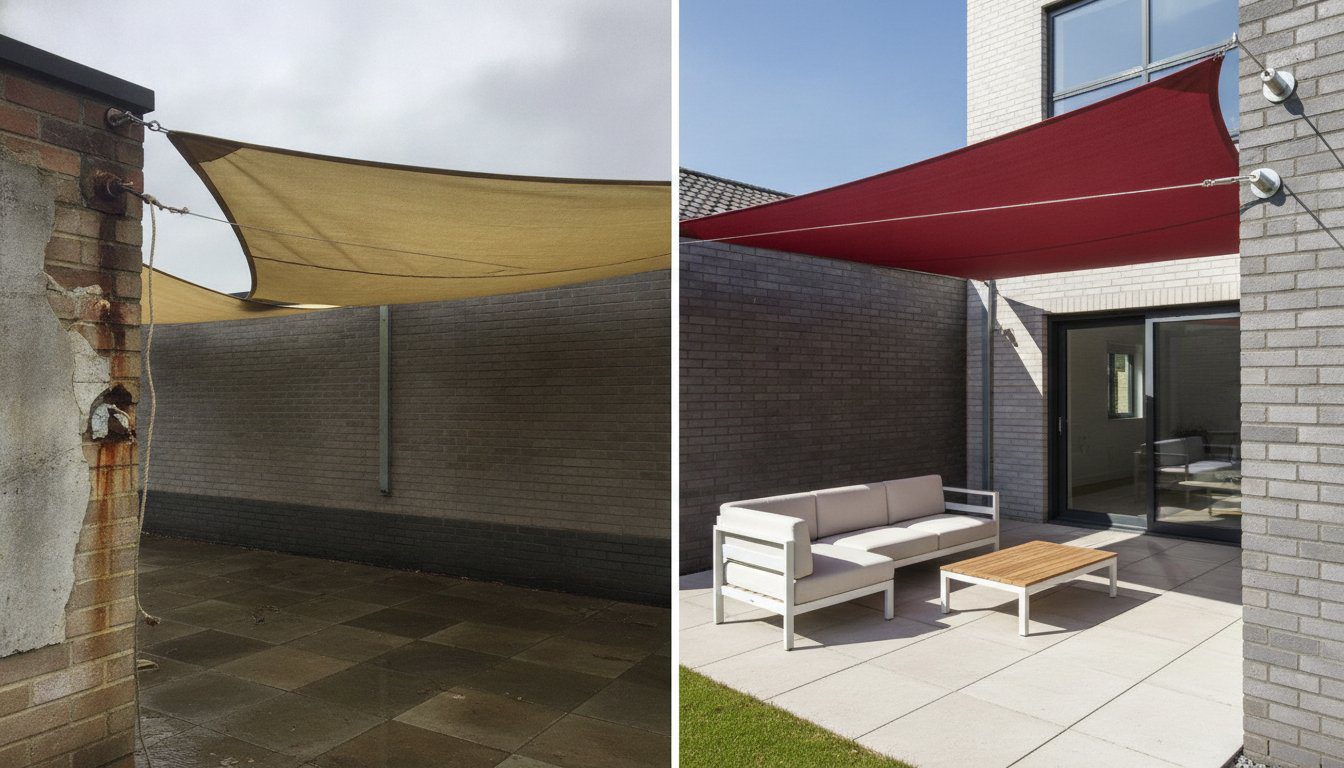
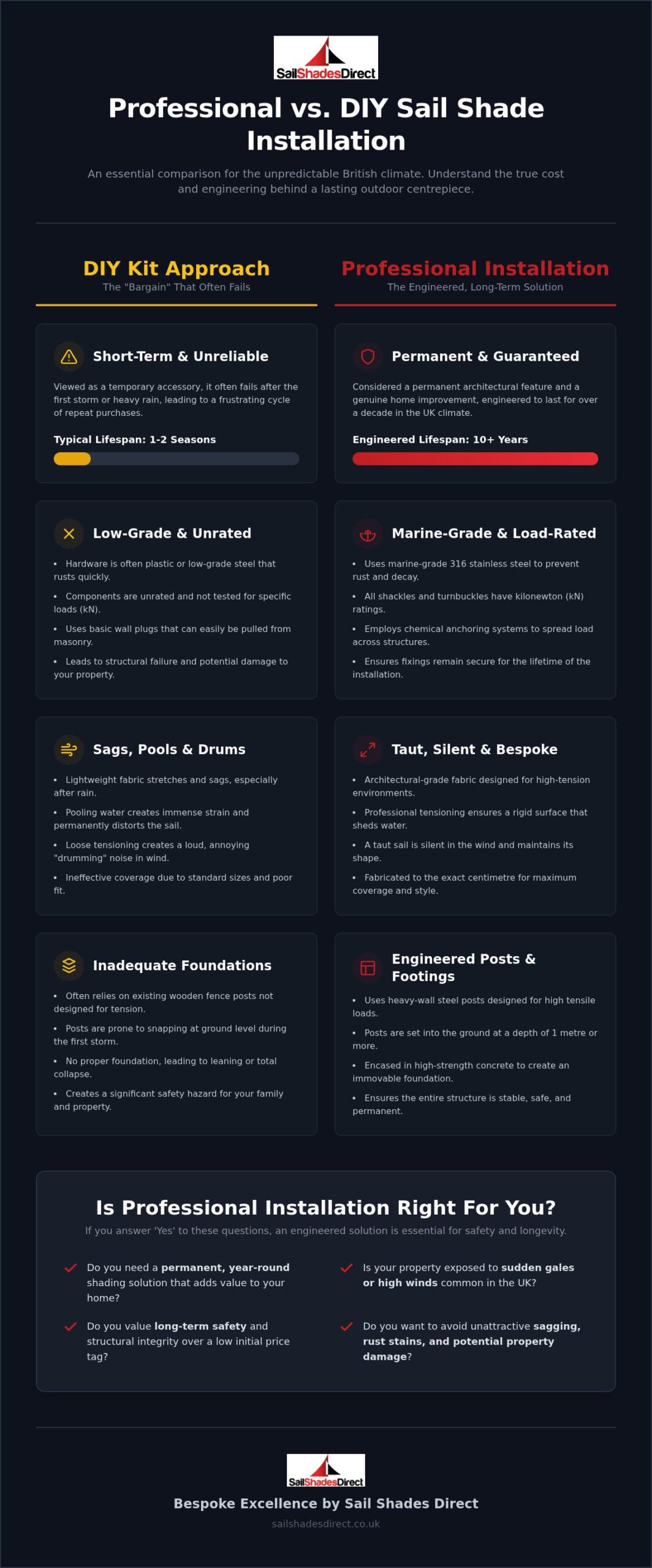
Most DIY kits rely on lightweight fabrics that are prone to stretching almost immediately. After the first significant rainfall, these sails often begin to sag. This creates a reservoir for water that further strains the attachment points and distorts the fabric permanently. The hardware included in these kits is frequently plastic or low-grade steel. These materials rust quickly in damp British conditions; this leads to unsightly streaks on your masonry or, in the worst cases, total structural failure during a summer storm. You often end up spending more on replacements than you would on a single, high-quality installation.
The Bespoke Professional Alternative
A professional approach prioritises engineering over simple assembly. We use architectural-grade fabrics designed for year-round exposure and high-tension environments. Every sail is fabricated to the exact centimetre to maximise your usable outdoor area, ensuring the fabric remains taut and vibrant. We don’t guess where to put the fixings. Instead, we use load-calculated points that integrate seamlessly with your property’s existing structure. This creates a stress-reducing, “can-do” solution that remains a stylish and safe centrepiece of your garden for over a decade. It’s about building something that lasts, not just something that fits in a box.
Engineering vs Assembly: The Structural Reality of Tension
A sail shade is far more than a decorative cloth; it’s a high-tension membrane that behaves like a giant wing. When wind passes over the curved surface, it creates significant lift and lateral pressure. This is precisely why international building codes for tensile structures emphasise the importance of lateral load calculations. When comparing professional vs DIY sail shade installation, the hardware is usually the first point of failure. Professional-grade shackles and turnbuckles carry kilonewton (kN) ratings, proving they can withstand the massive forces generated during a British gale. DIY kits often provide thin, unrated components that are simply not fit for purpose.
The forces involved aren’t just vertical; they are “pull-out” forces. Standard residential brickwork or timber cladding isn’t naturally designed to be pulled sideways with hundreds of kilograms of tension. A DIY bracket fixed with basic wall plugs will likely fail, potentially damaging your home’s structural integrity. Professional installers use marine-grade 316 stainless steel and chemical anchoring systems. These spread the load across multiple brick courses or internal structural beams, ensuring your property remains as safe as it is stylish.
Foundation and Post Requirements
DIY projects frequently rely on existing wooden fence posts. This is a mistake. These posts are designed for privacy, not the constant tension of a sail, and they usually snap at the ground level during the first storm. A professional installation involves heavy-wall steel posts. These are typically set into the ground at a depth of 1 metre or more, encased in high-strength concrete. This creates a permanent, immovable foundation that won’t lean or buckle under pressure.
The Art of Tensioning
Achieving the correct tension is what separates a professional finish from a sagging DIY attempt. If you can only tighten the sail “by hand,” it’s not tight enough. Loose fabric creates a loud “drumming” noise in the wind, which is both annoying for neighbours and destructive to the fabric fibres. Professional tensioning ensures the sail is rigid. This prevents water from pooling in the centre, a common issue that leads to fabric stretching and eventual failure. Our bespoke sail shades are engineered to stay taut, ensuring rain runs off efficiently and the structure remains silent even in breezy conditions.
Analysing the True Cost of Ownership: DIY vs Professional
The upfront cost of a project often dictates the path a homeowner takes, but when comparing professional vs DIY sail shade installation, the initial price tag is only half the story. A standard DIY kit might cost under £200, appearing as a bargain compared to an engineered professional system. However, the lifespan of these budget options is notoriously short, often lasting only one or two seasons before the fabric degrades or the hardware fails. In contrast, a professionally installed sail is designed to last ten years or more, providing a much lower cost per year of use.
Effective shading is also a health priority. High-quality sails help you reduce your risk of sun damage by blocking up to 95% of harmful UV rays. A sagging, cheap sail that you’ve stopped using because it looks unsightly offers zero protection. A professional installation ensures the sail remains taut and effective, adding genuine aesthetic and functional value to your property.
Initial Price vs Value Over Time
DIY kits come with “invisible” costs that many forget to budget for. You might need to hire a heavy-duty SDS drill to penetrate masonry or purchase high-grade stainless steel fixings when the kit’s components inevitably rust. There is also the significant investment of your own time. When you factor in the inevitable replacement of a stretched sail, the DIY route often becomes more expensive within three years. Choosing bespoke sail shades UK homeowners trust means paying once for a solution that remains a beautiful, durable part of your home for a decade or more.
Commercial Implications for Businesses
For pubs, restaurants, and schools, the stakes are even higher. A DIY installation in a public space carries immense public liability risks; if a bracket fails in a gust of wind, the legal consequences far outweigh any initial savings. Investing in commercial shading solutions UK businesses rely on ensures your outdoor area remains a safe, revenue-generating asset. Professional aesthetics also play a massive role in customer perception. A taut, vibrant sail suggests a high-quality establishment, whilst a sagging, stained DIY kit can actively drive customers away. It’s about creating an inviting environment that encourages guests to stay longer and enjoy the space safely.
Decision Framework: When to DIY or Call the Experts
Deciding on the right path requires an honest assessment of your site’s unique challenges. Whilst many retailers suggest that anyone can hang a fabric sheet, the reality of a permanent installation is far more demanding. If you’re considering rolling sun sails installation, the technical requirements for motorisation and track alignment make professional fitting essential. DIY becomes a structural risk the moment you move beyond small, decorative panels into large-scale shading that must withstand the elements. You need to evaluate whether you have the heavy-duty drilling equipment and technical knowledge to handle chemical anchors and high-tension hardware.
The 5-Point Environmental Audit
Before picking up a drill, look at your surroundings. Are you situated in a coastal area or a high-altitude spot? These environments require a specific wind resistant sun sail engineered for higher kilonewton loads. Check your attachment points; fixing to a single-skin garden wall is vastly different from anchoring into a structural house beam. High-velocity wind funnels between buildings can double the pressure on your fixings, turning a minor oversight into a major failure. If your site audit reveals any of the following, it’s time to call in the professionals:
- High Wind Exposure: Your garden sits on a hill or near the coast.
- Complex Heights: Fixings are required above three metres.
- Structural Uncertainty: You’re unsure if your masonry can handle lateral “pull-out” forces.
- Large Span: The sail is larger than 20 square metres.
- Permanent Intent: You want a structure that stays up for the entire season.
When DIY is Acceptable
There are certainly scenarios where a DIY approach works perfectly well. If you only need a lightweight shade for a single afternoon garden party, a temporary kit is a cost-effective choice. Small, highly sheltered courtyard gardens with minimal wind exposure also allow for simpler setups. These projects are usually budget-constrained and involve sails that you plan to take down daily or at the first sign of a breeze. However, for anything intended to stay up through a British summer, the expertise of a professional ensures peace of mind. If your project involves complex heights or high-wind exposure, contact our expert team today to discuss a fully engineered solution.
Bespoke Excellence: The Sail Shades Direct Professional Approach
Choosing a professional partner for your project means moving beyond the limitations of standard retail kits. At Sail Shades Direct, we manage every stage of the process to ensure your outdoor space becomes a functional masterpiece. Our approach to professional vs DIY sail shade installation focuses on longevity and precision engineering. From the initial design phase to the final tensioning on-site, our team delivers a solution that retail kits simply cannot match. We take pride in our craftsmanship, using architectural-grade fabrics that are designed to remain vibrant and structurally sound for over a decade.
We understand that a “one size fits all” approach rarely works in UK gardens. Our versatility allows us to offer a wide range of engineered structures. Whether your site requires a bespoke tensioned sail, heavy duty arm awnings, or commercial-grade giant umbrellas, we tailor the hardware to your specific environment. This fully managed nationwide installation service removes the stress of technical calculations, leaving you with a safe, stylish, and durable retreat.
Tailored Design for Unique Spaces
We don’t just hang fabric; we create stable architectural structures. A key part of our design process involves calculating the perfect “hypar” twist. This hyperbolic paraboloid shape is essential for structural stability, as it prevents the fabric from flapping and ensures rainwater runs off efficiently. You can customise your installation with an extensive choice of colours and finishes to perfectly match your home’s aesthetic. We’ve spent more than 10 years transforming ordinary UK gardens into premium outdoor retreats, ensuring every centimetre of fabric is tensioned to perfection.
Taking the Next Step
Ready to upgrade your outdoor living area? Getting a bespoke quote is straightforward and transparent. We begin by understanding your vision and the functional needs of your space. During a professional site survey, we’ll assess your masonry, potential post depths, and wind exposure to guarantee a permanent fit. This level of detail is what separates a professional installation from a weekend DIY attempt. Contact Jamie and the team today for expert advice. We are ready to help you create an outdoor centrepiece that will stand the test of time and weather alike.
Invest in a Durable Outdoor Sanctuary
Choosing between professional vs DIY sail shade installation is ultimately a decision between a seasonal quick-fix and a long-term architectural asset. We’ve explored how the British climate demands more than just a basic kit; it requires precise engineering, kilonewton-rated hardware, and foundations that can withstand high winds. A bespoke system doesn’t just protect you from the sun; it transforms your garden into a safe, stylish retreat that lasts for a decade rather than a single summer.
Our team brings over 10 years of professional installation experience to every project, offering nationwide UK coverage with a personal, local touch. We take pride in delivering bespoke systems engineered specifically for our unique weather conditions, ensuring your peace of mind even when the winds pick up. Ready to turn your outdoor vision into a permanent reality? Request your bespoke sail shade consultation with our expert UK team today. Let’s create an environment where you can truly relax, knowing your shade is built to last.
Frequently Asked Questions
Do I need planning permission for a professionally installed sail shade in the UK?
Planning permission is usually not required for standard residential shade sails in the UK, provided they are considered temporary structures. However, if the installation exceeds 2.5 metres in height or covers a very large area, you should check with your local council. Commercial properties almost always require permission, particularly if the structure projects over a public pavement. Our team can offer guidance on these regulations during the design phase to ensure your project remains compliant.
Can I leave a professionally installed bespoke sail shade up all year round?
Whilst our architectural-grade fabrics are designed for extreme durability, we generally recommend taking bespoke sail shades down during the winter months to protect them from heavy snow loads and prolonged frost. If you require a year-round solution, our rolling sun sails are an excellent alternative. These allow you to retract the fabric quickly when severe weather is forecast, preserving the material’s lifespan whilst keeping the structural hardware and posts permanently in place.
What is the maximum wind speed a professional sail shade can withstand?
The maximum wind speed depends on the specific engineering of your installation, but professionally fitted bespoke sails are designed to withstand significantly higher loads than DIY kits. Whilst a standard kit might fail in a moderate breeze, our fully engineered structures are calculated to remain stable in typical UK gale conditions. We use high-tension hardware and deep-set steel posts to ensure the structure doesn’t become a hazard during unpredictable summer storms.
How much more does professional installation cost compared to a DIY kit?
When analysing professional vs DIY sail shade installation, the initial investment for a professional system is higher due to the bespoke manufacturing and heavy-duty hardware. DIY kits are inexpensive upfront but often require replacement every one or two seasons. A professional installation provides better value over time because it’s a permanent home improvement designed to last over a decade. You’re paying for structural safety, architectural-grade fabric, and expert fitting that prevents costly masonry damage.
Will a DIY sail shade damage my house walls if not tensioned correctly?
Yes, a poorly installed DIY sail shade can cause significant damage to your property. Because these sails act like wings, they exert massive lateral “pull-out” forces on fixings. If you use standard wall plugs or attach to weak masonry without chemical anchors, the brackets can rip out, taking chunks of brickwork with them. Professional installers use load-calculated anchoring systems to distribute this tension safely across the structural elements of your building, preventing any risk of collapse.
Can professional installers fit sail shades to any type of wall?
Professional installers can fit sail shades to most sound structures, but we must first assess the wall’s structural integrity. Single-skin garden walls or decorative timber cladding are often unsuitable for high-tension loads without additional reinforcement. In these cases, we might recommend using independent steel posts set in deep concrete foundations instead. Our site survey identifies these challenges early, ensuring we only attach to points that can safely handle the required kilonewton forces.
What maintenance is required for a bespoke, professionally fitted shade sail?
Maintenance for a bespoke, professionally fitted shade sail is relatively minimal. We recommend a gentle clean with warm soapy water once a year to remove environmental debris and prevent mould growth. It’s also wise to periodically check the tensioning hardware to ensure the fabric remains taut. Unlike DIY kits that sag and trap water, our high-tension systems are designed to be self-cleaning to an extent, as rainwater runs off the steep angles we incorporate during design.
Is it possible to automate a professionally installed sail shade system?
Automation is absolutely possible with our professionally installed rolling sun sails. These systems can be fitted with integrated motors and wind sensors that automatically retract the sail when wind speeds exceed a safe threshold. This provides a high level of convenience and protection for your investment. Whilst standard fixed sails cannot be automated, these rolling systems offer a versatile, “can-do” solution for homeowners who want effortless control over their outdoor environment at the touch of a button.