
The Hidden Costs of Cheap Awnings: Why Budget Patio Covers Fail
That bargain patio cover you bought to save cash might actually become the most expensive fixture attached to your home. We all want a comfortable outdoor sanctuary without overspending, and grabbing an off-the-shelf kit often feels like a practical weekend win. Yet the hidden costs of cheap awnings quickly surface once the reality of British weather sets in, turning a seemingly thrifty upgrade into a frustrating cycle of repairs.
You shouldn’t have to endure torn seams after a single gusty afternoon or stress over cracked brickwork caused by inadequate DIY fixings. You’ll discover the real structural, fabric, and safety expenses lurking behind bargain patio awnings before you commit your hard-earned funds. We will examine the critical failure points of mass-market systems, explore how maritime winds and damp degrade budget fabrics, and help you evaluate genuine lifecycle value so your outdoor space stays protected for years to come.
Key Takeaways
- Uncover how the true hidden costs of cheap awnings stem from rapid material degradation, premature failure, and regular replacement cycles.
- Identify the primary structural weak spots in budget patio kits, from lightweight arm joints to non-UV-stabilised fabrics prone to mould and water pooling.
- Understand the serious masonry risks created by off-the-shelf expansion fixings under heavy wind torque, and why bespoke engineering protects external walls.
- Learn the essential evaluation criteria, including fabric resilience, cassette protection, and wind ratings, needed to match shading systems to British weather conditions.
- Discover how investing in a purpose-built arm awning or outdoor shading structure turns your garden into a durable, multi-season living space.
The False Economy of Budget Patio Awnings
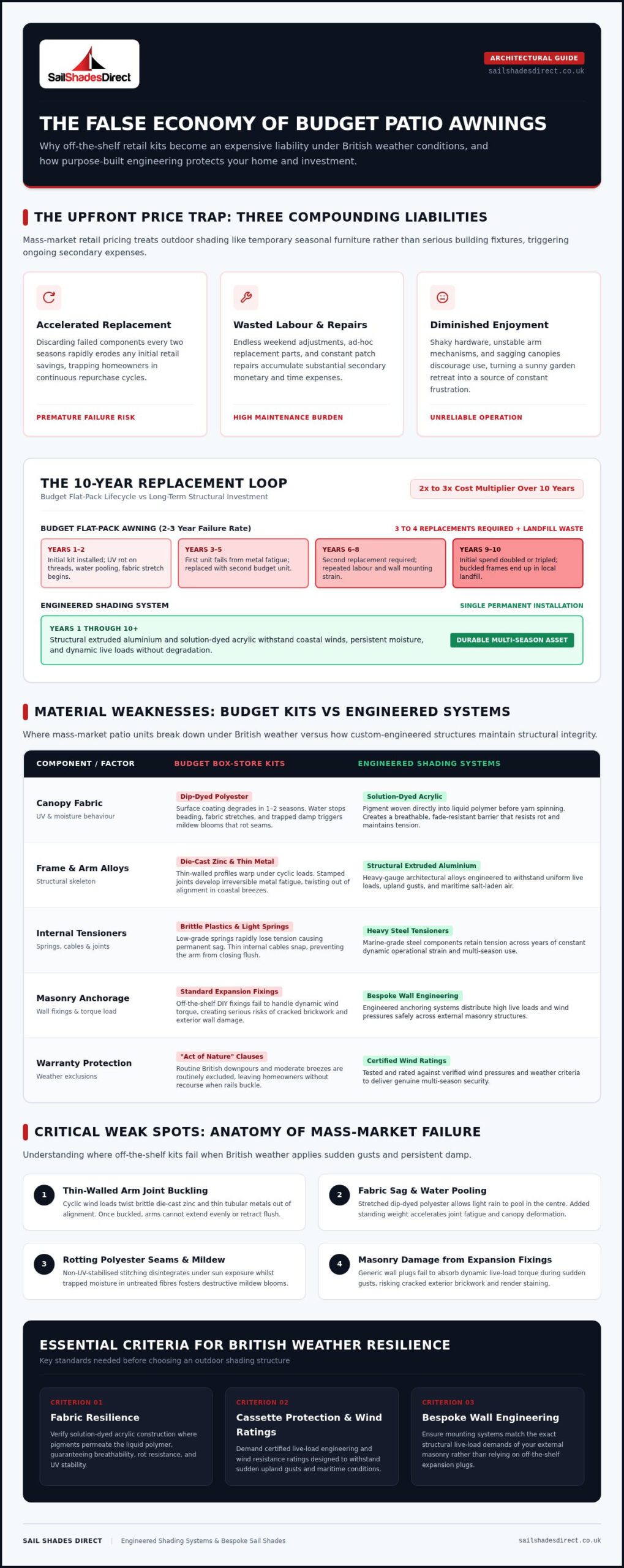
Box-store patio kits look remarkably tempting sitting on a retail shelf. Wrapped in glossy packaging, an off-the-shelf system promises an instant garden transformation for a fraction of what an architecturally engineered installation costs. This retail pricing illusion relies on a disposable consumer mindset, treating garden fixtures like temporary seasonal furniture rather than serious building additions. The hidden costs of cheap awnings quickly reveal themselves once wind, damp, and constant operational strain take their toll.
Instead of securing a permanent home asset, homeowners often discover three compounding liabilities:
- Accelerated replacement schedules: Discarding failed components every two seasons erodes initial savings.
- Wasted labour and patch repairs: Endless weekend adjustments and ad-hoc parts run up substantial secondary expenses.
- Diminished outdoor enjoyment: Shaky hardware and sagging canopies discourage actual use, turning a sunny retreat into a source of constant irritation.
The Upfront Price Trap
Mass-market manufacturers achieve bargain pricing by thinning aluminium profiles and relying on low-density alloys. While a traditional awning or overhang requires structural rigidity to withstand sudden gusts, budget builds substitute heavy internal steel tensioners with lightweight, brittle plastics. These components warp under cyclic loads. Adding to the problem, entry-level warranties routinely categorise regular British downpours and moderate breezes as “acts of nature”, leaving you without recourse when an unexpected gust buckles the front rail.
The Rapid Replacement Cycle
Most budget flat-pack patio covers fail within two to three years. Polyester threads rot under UV exposure, and stamped joints develop irreversible metal fatigue. Buying consecutive bargain units creates an expensive loop, effectively doubling or tripling your initial spend over a decade. Beyond personal expense, this churn carries a heavy environmental toll. Buckled, lightweight aluminium frames and non-recyclable coated textiles routinely end up in local landfills, proving that the true hidden costs of cheap awnings extend far beyond your bank account.
Material Weaknesses: Where Cheap Outdoor Awnings Fail First
British weather presents a punishing mix of persistent moisture, salt-laden maritime air, and sudden upland gusts. Off-the-shelf patio covers simply aren’t engineered for these conditions. When manufacturers cut corners on raw alloy grades and weather-resistant finishes, the hidden costs of cheap awnings manifest as seized joints, stained render, and torn fabrics long before their time. Understanding where mass-market units break down helps you protect your patio and avoid expensive mid-season headaches.
Polyester vs Solution-Dyed Acrylic Fabrics
Budget awnings typically ship with dip-dyed polyester canopies. While polyester looks crisp out of the box, thin surface treatments break down under damp conditions and UV exposure within a season or two. Water stops beading, the material stretches under the weight of light rain, and trapped moisture triggers mildew blooms that rot the seams. High-performance solution-dyed acrylic weaves pigment directly into the liquid polymer before spinning the yarn, delivering a fade-resistant, breathable barrier that resists rot and keeps its shape across years of damp weather.
Inferior Metals and Flimsy Arm Mechanisms
The mechanical skeleton of an awning bears constant dynamic stress. Architectural shading systems rely on structural extruded aluminium, but budget options lean on brittle die-cast zinc and wafer-thin tubular metal. Building codes specify that exterior structures should be designed for uniform live loads and wind pressures. Flimsy retail arm assemblies lack the mechanical integrity to meet these demands.
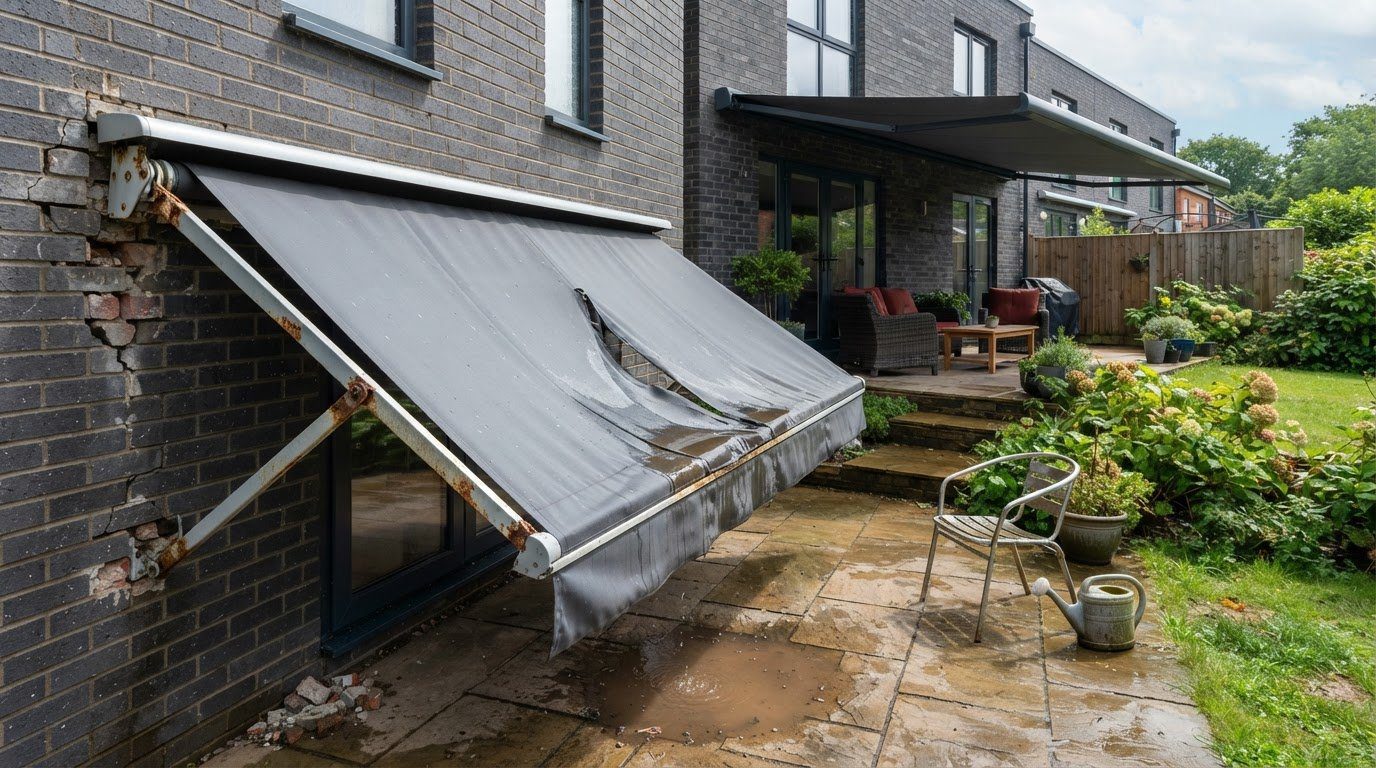
A moderate coastal breeze is often enough to twist thin-walled extension arms out of alignment. Inside these arms, low-grade steel springs lose tension rapidly, causing permanent fabric sag, or thin internal cables snap entirely. Once an articulated arm buckles, the awning will neither extend evenly nor close flush against its frame. Rather than risking seasonal failures with fragile hardware, investing in custom-engineered, marine-grade arm awnings ensures your outdoor space remains structurally sound through unpredictable weather.
Comparing Budget Box-Store Awnings vs Engineered Shading Systems
Choosing between an off-the-shelf retail kit and a custom outdoor fixture comes down to how you view your home. Mass-produced retail kits treat shading as a disposable accessory, whereas bespoke systems treat it as a permanent architectural improvement. When you calculate the hidden costs of cheap awnings, the gap in long-term value becomes strikingly apparent across core engineering metrics:
| Engineering Metric | Budget Box-Store Kits | Engineered Shading Systems |
|---|---|---|
| Frame Metallurgy | Thin-gauge rolled steel or cast zinc | Extruded, structural marine-grade aluminium |
| Canopy Material | Dip-dyed non-UV-rated polyester | High-density solution-dyed acrylic |
| Wind Resistance | Class 0 or unverified ratings | EN 13561 certified up to Class 2 or higher |
| Dimensional Fit | Fixed incremental widths (e.g. 3m, 4m) | Millimetre-precise custom manufacture |
| Expected Lifespan | 2 to 3 years before severe wear | 10 to 15+ years of daily functionality |
Selecting durable patio additions forms an essential part of environmentally sustainable home design, regulating indoor temperatures without wasting raw building resources on disposable kits.
Engineering Standards and Wind Resistance
European standard EN 13561 governs external blinds and awnings, testing structural resistance to wind pressure on the Beaufort scale. Most mass-market units lack independent verification, meaning a sudden Force 4 breeze can rip them from their fixings. Purpose-built heavy duty arm awnings integrate robust internal tension systems alongside automated vibration and wind sensors. When gusts exceed safe limits, integrated smart motors retract the arms automatically, shielding the assembly from damage even when you are away from home.
Precision Custom Fabrication
Fixed retail widths rarely match UK patio door arrangements. An off-the-shelf awning that ends midway across a set of bi-fold doors channels rainwater directly onto your entertaining area. Custom fabrication ensures millimetre-exact coverage, directing runoff away from brickwork, walkways, and seating. If an articulated arm design doesn’t suit your property’s architectural lines, custom configurations like bespoke sail shades UK deliver tailored geometry that withstands strong winds while complementing complex building facades.
The Hidden Structural and Masonry Risks of DIY Installations
Mounting an awning is not like hanging a decorative garden mirror. When a three-metre canopy extends over your terrace, it turns into a massive mechanical lever. Every passing gust creates intense torque and continuous pull-out force concentrated on just a handful of wall fixings. When tackling a self-install using basic flat-pack hardware, homeowners often discover that the hidden costs of cheap awnings involve structural masonry repairs that dwarf any money saved on retail shelving.
Budget kits typically include standard steel expansion bolts. As these mechanical anchors tighten, they exert outward radial pressure inside the brick. Combine that internal expansion with dynamic uplift forces from an unexpected breeze, and traditional domestic brickwork splits or blows out completely. Repairing blown bricks, re-pointing cracked mortar courses, and restoring structural stability to external walls can prove disastrously disruptive. Where wall mounting isn’t architecturally viable, exploring exterior blinds for patios offers an effective alternative to enclose existing veranda posts or pergolas without transferring heavy leverage to residential brickwork.
Cavity Wall and Substrate Vulnerabilities
Modern British homes present specific installation challenges due to thermal cavity designs. External brick leaves are decorative, non-load-bearing skins that sit isolated from internal breeze blocks. Bolting heavy awnings directly into outer brick without engineered spreader plates risks crushing the leaf inward or pulling masonry away from wall ties. Unsealed drill holes also breach the cavity barrier, allowing driving rain to soak thermal insulation and spark severe internal damp issues.
Professional Surveying and Installation Standards
Securing heavy-duty shading safely requires precision engineering. Experienced installation specialists survey the substrate first, checking mortar condition, cavity depth, and masonry density before mounting hardware touches the property. Rather than relying on destructive mechanical expansion anchors, professional installations utilise structural spreader brackets and marine-grade chemical resin anchors. The injection resin fuses threaded stainless rods into the brickwork without expanding, distributing load forces evenly across entire masonry courses.
Specialists also calibrate awning pitch precisely. A slight calculation error creates an awning that collects pooled rainwater, which adds excessive dead weight and risks catastrophic pull-out collapse during overnight downpours. Protect your home and eliminate the hidden costs of cheap awnings by letting our specialists manage the installation. Contact our nationwide team today to schedule a structural survey for your property.
How to Choose a Durable Shading Solution That Protects Your Investment
Upgrading your garden terrace should bring years of relaxed outdoor living, not an ongoing maintenance headache. To steer clear of the hidden costs of cheap awnings, approach the purchase with an eye for structural resilience and material longevity. Looking beyond initial price tags allows you to select a shading system tailored to your property’s precise layout and weather exposure.
Keep these fundamental criteria in mind while evaluating your options:
- Cassette engineering: A full-cassette casing completely seals the fabric canopy, motor, and folding arms inside an aluminium shell when retracted, preventing winter rot, bird fouling, and dirt buildup.
- Microclimate resilience: Properties on exposed hillsides or open coastal settings require heavy-duty wind ratings and automatic safety retractors, while sheltered urban courtyards can focus more on low-angle sun management.
- Professional structural surveying: Never guess when it comes to masonry strength or fixing types. A qualified specialist checks your wall construction first to ensure absolute safety.
Assessing Your Site and Architectural Requirements
Start by mapping how sun and wind move across your patio throughout the day. South-facing gardens demand high UV resistance to prevent heat build-up against patio glazing, while west-facing spaces need adjustable pitch angles to block blinding late-afternoon glare. Evaluate where physical forces will land. If your property features extensive bi-fold doors or lightweight timber frame extensions, wall-mounted arms may not provide sufficient anchoring depth. In open layouts with multiple boundary posts, motorised rolling sun sails offer expansive coverage that retracts smoothly along tensioned architectural cables without overloading your exterior walls.
Partnering with Sail Shades Direct for Enduring Quality
Sail Shades Direct brings over a decade of bespoke engineering experience to homeowners nationwide across the UK. Instead of forcing flat-pack kits onto incompatible structures, we provide a complete service encompassing nationwide site surveys, custom design, precision fabrication, and professional installation. Every arm awning, sail shade, and exterior blind features marine-grade stainless steel hardware, heavy-gauge extruded aluminium, and durable, weather-tested textiles crafted to withstand harsh British winters. Choosing bespoke craftsmanship eliminates the hidden costs of cheap awnings, giving you an enduring, architecturally sound outdoor room that enhances your lifestyle and adds lasting value to your home.
Build an Outdoor Space That Lasts for Seasons to Come
Investing in your garden should bring peace of mind, not seasonal headaches. As we have examined, the hidden costs of cheap awnings quickly add up through snapped brackets, rotted polyester seams, and expensive masonry damage from improper fixings. Cutting corners on structural sun protection almost always leads to replacement churn and wasted weekends.
Choosing an engineered system turns your patio into a reliable extension of your living space. With over 10 years of bespoke outdoor engineering across the UK, Sail Shades Direct delivers the protection your home deserves. We combine marine-grade corrosion-resistant fixings, reinforced frames, and high-performance textiles with a comprehensive nationwide service covering design, custom fabrication, and professional fitting. Explore our bespoke, engineered shading solutions today and create an outdoor setting that stands strong against the elements for years to come.
Frequently Asked Questions
How long does a cheap patio awning usually last in the UK?
A budget off-the-shelf patio awning typically lasts between two and three years before showing critical failure. Untreated polyester fabrics degrade rapidly under British rain and UV radiation, whilst unsealed metal joints begin seizing after a single damp winter. Facing premature replacement cycles and continuous part repairs is one of the primary hidden costs of cheap awnings that homeowners encounter.
Can a cheap retractable awning withstand heavy British rain and wind?
No, standard retail awnings cannot cope with typical British squalls or prolonged rainfall. Low-cost systems rarely carry certified EN 13561 wind ratings, leaving their thin-gauge aluminium arms vulnerable to bending in light breezes. In heavy downpours, inadequate pitch causes rainwater to pool on non-tensioned polyester cloth, quickly buckling the roller bar under the sudden accumulation of dead weight.
What happens if an awning is installed with incorrect wall fixings?
Using incorrect anchors risks pulling external bricks away from your property’s framing structure. Cheap expansion sleeves exert strong radial force that can shatter older bricks or fracture mortar lines. Over time, the leverage generated by extended arms yanks these bolts loose, causing dangerous structural facade fractures, cavity moisture ingress, and potentially catastrophic collapse onto the patio below.
Is it possible to replace the torn fabric on a budget awning frame?
While replacement textiles exist, replacing fabric on a budget frame is rarely practical or economical. Mass-market frames are glued or riveted together using non-standard components, making manual dismantling exceptionally difficult. The labour and sourcing fees often rival the original price of the entire flat-pack kit, reinforcing the reality of the hidden costs of cheap awnings.
Why do budget awnings squeak, shudder, and jam when retracting?
Squeaking and jamming happen because budget units rely on lightweight internal springs, plastic end caps, and unmachined cast-iron gears. Without corrosion-resistant coatings, grit and damp cause the roller bar mechanism to stick. As the thin folding arms twist out of alignment from routine breeze exposure, the entire tension system binds unevenly during retraction.
What is the main difference between water-resistant and waterproof awning fabric?
Water-resistant fabrics shed light mist through temporary topical coatings that degrade within months of UV and moisture exposure. Waterproof outdoor textiles feature solution-dyed acrylic yarns treated at a molecular level alongside high-density weaves. This engineering prevents liquid penetration entirely, resisting heavy rainwater pooling and internal seam rot across years of damp weather without leaking.
Can cheap DIY awnings be upgraded with automated wind sensors later?
Most DIY retail awnings cannot be retrofitted with intelligent wind or vibration sensors. Entry-level units use sealed manual gearboxes or basic tubular motors that lack compatible digital receivers or open circuitry. Adding automation generally requires custom wiring, high-grade universal motor adaptors, and external control units that cost considerably more than the original fixture itself.