
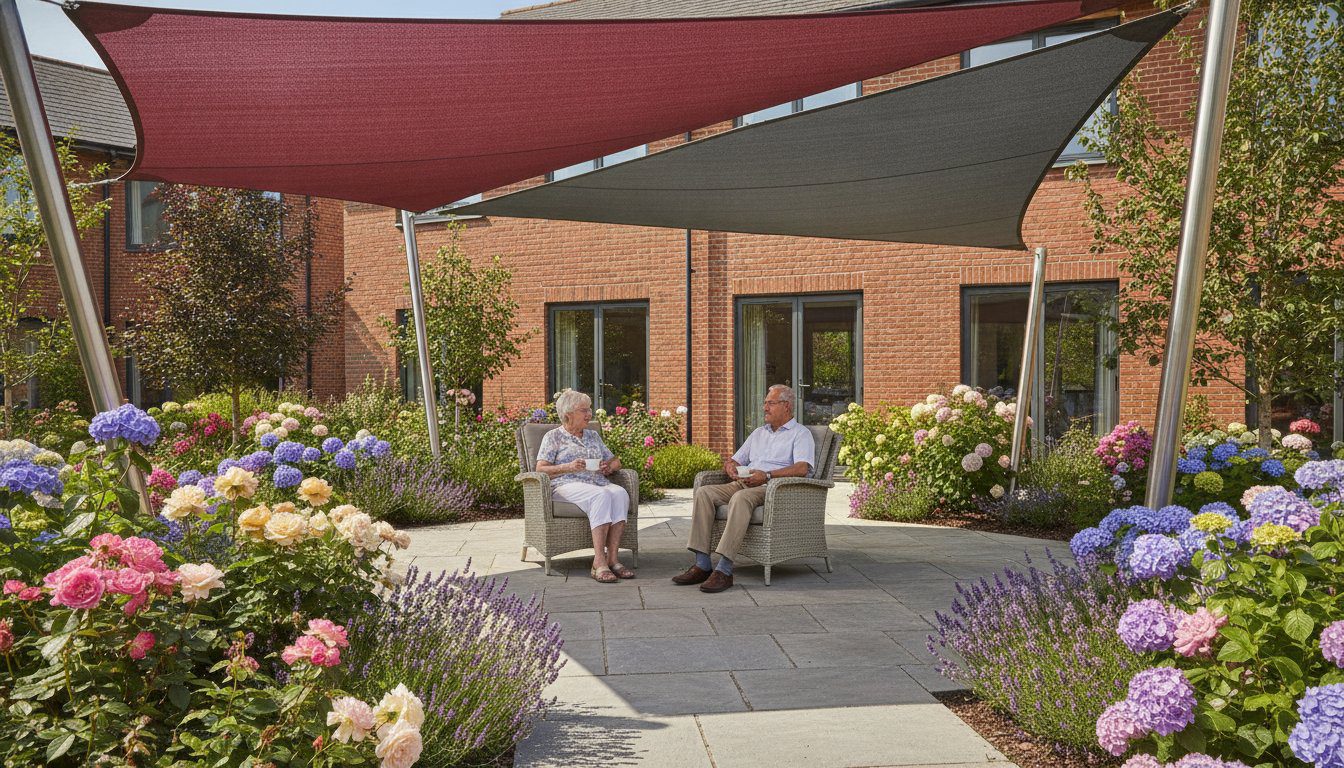
Care Home Garden Shade Solutions: Enhancing Resident Wellbeing and Safety
What if the most beautiful part of your care home becomes completely unusable for four months of the year? It’s a frustrating reality for many providers, where gorgeous gardens turn into “no-go zones” as soon as the sun comes out. You likely agree that every resident deserves fresh air and a change of scenery, yet concerns over heat stroke, skin sensitivity, and the trip hazards of flimsy umbrellas often keep everyone indoors.
Finding the right care home garden shade solutions is about more than just aesthetics; it’s a clinical necessity for resident health and safety. In this guide, you’ll discover how bespoke shading systems transform outdoor areas into safe, accessible, and therapeutic spaces that meet CQC standards for wellbeing. We’ll explore durable, professionally fitted options like rolling sun sails and arm awnings that require minimal staff intervention whilst providing year-round protection. From navigating wind safety to enhancing resident engagement, we’ve got you covered.
Key Takeaways
- Understand why professional care home garden shade solutions are a clinical necessity for protecting residents from UV sensitivity and heat-related risks.
- Learn the technical requirements for commercial-grade fabrics, including high UPF ratings and glare reduction strategies for residents with visual impairments.
- Compare the benefits of bespoke sail shades for communal patios against heavy-duty arm awnings that provide immediate shade outside lounge doors.
- Discover how to plan for safety by identifying high-wind corridors and ensuring that support posts do not become trip hazards for those using mobility aids.
- Explore how a bespoke design and professional fitting service minimises disruption to daily routines whilst creating a custom layout tailored to your courtyard.
The Vital Role of Outdoor Shade in Care Home Garden Design
A therapeutic garden is more than a collection of raised beds and level paths; it’s a space designed to actively promote recovery and peace of mind. Without reliable shade, however, these outdoor areas remain off-limits for much of the day. High-quality care home garden shade solutions provide the structural foundation that makes a garden truly usable. They act as a protective barrier, allowing residents to enjoy the sensory benefits of nature without the risks associated with direct sun exposure.
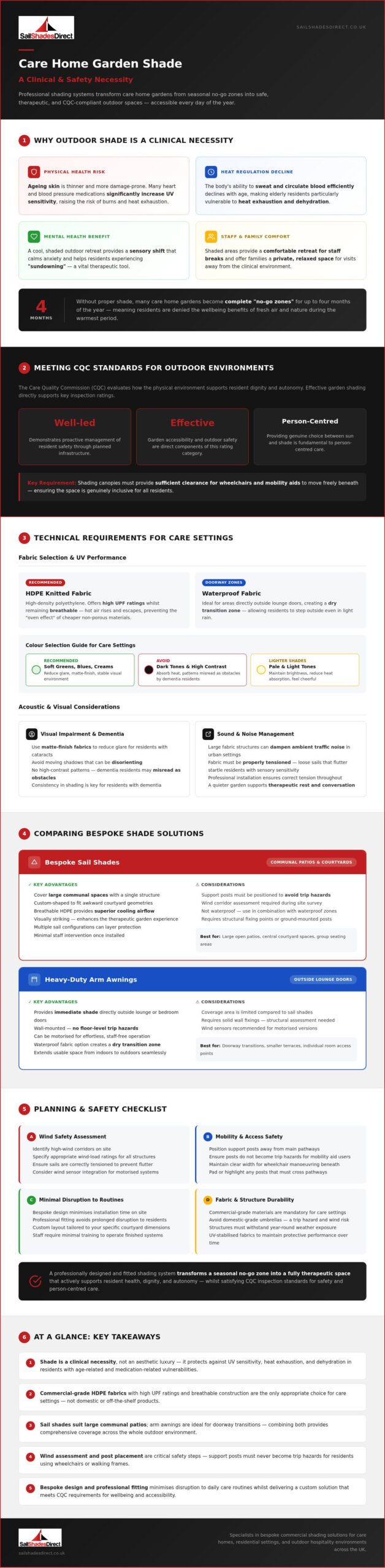
For many residents, the physiological risks are significant. Ageing skin is often thinner and more prone to damage, whilst many common medications for heart conditions or blood pressure can significantly increase UV sensitivity. Beyond physical health, a shaded retreat offers vital mental health support. For those experiencing “sundowning” or heightened anxiety, a cool, quiet spot outdoors can provide a necessary sensory shift that calms the mind. These zones also serve as a crucial reprieve for staff and visiting families, offering a comfortable space for breaks or private conversations away from the clinical environment.
Shade as a Tool for Thermoregulation
Elderly residents often struggle with heat regulation because the body’s ability to sweat and circulate blood efficiently declines with age. This makes them particularly vulnerable to heat exhaustion and dehydration in communal garden areas. Thermal comfort is the condition of mind that expresses satisfaction with the thermal environment, achieved in care settings when residents can enjoy the outdoors without physical strain or heat-related distress. By installing bespoke sail shades or arm awnings, you create a controlled microclimate that prevents core body temperatures from rising to dangerous levels.
Meeting CQC Standards for Outdoor Environments
The Care Quality Commission (CQC) increasingly looks at how the physical environment supports resident dignity and autonomy. Garden accessibility and safety are key components of “Well-led” and “Effective” ratings. Providing a genuine choice between sun and shade is a fundamental part of person-centred care. Effective care home garden shade solutions ensure that outdoor spaces are inclusive, offering enough clearance for wheelchairs and mobility aids to move freely beneath the canopy. When a garden is thoughtfully shaded, it demonstrates a proactive approach to resident safety and wellbeing that inspectors value.
This proactive approach to safety and accessibility should extend throughout the entire facility; for those looking to ensure reliable movement between floors, ElevatedStairlifts provides professional installation and servicing.
Technical Requirements for Care Facility Sun Protection
Selecting the right hardware for a care setting requires a deeper level of scrutiny than a standard residential project. Technical specifications for care home garden shade solutions must balance high-performance UV protection with the specific sensory needs of the residents. It isn’t just about blocking the sun; it’s about managing light, sound, and safety in a way that feels natural and unobtrusive.
Fabric Selection and UV Performance
Commercial-grade fabrics are the only viable option for high-traffic care environments. High-density polyethylene (HDPE) sails are particularly effective because they offer high UPF ratings whilst remaining breathable. This breathability is vital; it allows hot air to rise and escape, preventing the “oven effect” often felt under cheaper, non-porous materials. For areas directly outside lounge doors, you might consider waterproof fabrics to create a dry transition zone, but for large communal spaces, a knitted HDPE fabric provides superior cooling. Choosing lighter colours can help maintain brightness without the intense heat absorption of darker tones, keeping the space cheerful yet cool.
Acoustic and Visual Considerations
Visual comfort is a primary concern for residents with cataracts or other visual impairments. Excessive glare from white surfaces or harsh, moving shadows can be disorienting. By opting for matte-finish fabrics in soft greens, blues, or creams, you can reduce glare and provide a more stable visual environment. For residents living with dementia, consistency is key. We recommend avoiding high-contrast patterns that might be misinterpreted as obstacles or floor level changes.
Sound also plays a role in garden comfort. In urban settings, large fabric structures can actually help dampen ambient traffic noise, creating a more peaceful retreat. However, the installation must be professional to ensure the fabric is properly tensioned. Loose sails that “flutter” or snap in the wind can be startling for residents with heightened sensory sensitivity. If you’re unsure which configuration suits your courtyard layout, you can explore our range of bespoke shading systems to see how different tensions and materials perform in various settings.
Finally, durability in the British climate is a non-negotiable factor when evaluating care home garden shade solutions. Your shading system should be engineered to withstand sudden gusts and heavy rainfall without requiring constant staff intervention. By choosing stainless steel fittings and reinforced edges, you ensure the structure remains a permanent, low-maintenance asset to your facility rather than a seasonal headache.
Comparing Bespoke Shade Solutions for Residential Care Settings
Selecting the right hardware for your facility depends entirely on how each outdoor zone is used. Not all care home garden shade solutions are created equal; choosing the wrong system can lead to maintenance headaches or safety risks for residents. For large, communal courtyards where you want to create a striking visual focal point, bespoke sail shades are often the best choice. They can span vast areas with minimal ground posts, keeping walkways clear for residents using frames or wheelchairs.
Heavy duty arm awnings, by contrast, are the ideal solution for lounge exits. They provide an immediate “buffer zone” between the indoor and outdoor environments, protecting residents from sudden glare as they step outside. For smaller, isolated seating pods or garden cafes, giant umbrellas offer a versatile and sturdy option that can be moved if the garden layout changes. However, when you need the ultimate in staff-managed flexibility, rolling sun sails provide a high-end solution that adapts to the weather in seconds.
Sail Shades vs. Traditional Structures
Traditional structures like wooden gazebos often feature heavy corner posts that can become trip hazards or obstacles in a care setting. This is where bespoke sail shades UK providers offer a distinct advantage. Because these systems rely on high-tension fabric fixed to existing walls or slim, reinforced steel posts, they maintain an open, accessible floor plan. This tension is also critical for safety; it prevents water from pooling during heavy British downpours, which can cause cheaper, loose fabrics to sag or fail. You get a clean, architectural look that enhances the building’s exterior whilst prioritising resident safety.
Retractable Solutions for Maximum Versatility
Staff time is a precious resource in any care home. Manually winding out awnings or moving heavy umbrellas can be a physical strain and a distraction from resident care. Choosing motorized rolling sun sails allows your team to manage the environment with simple remote controls or wall switches. These systems can even be fitted with automatic wind sensors that retract the sails if a storm rolls in, protecting your investment without any human intervention. This level of automation ensures your care home garden shade solutions remain functional and safe, even during the most unpredictable British summers.
Planning and Safety: Implementing Durable Shading Systems
Installing a permanent shading structure in a care environment involves much more than simply picking a spot with a good view. A thorough site assessment is the first step in ensuring long-term safety. We look for high-wind corridors where gusts might be funnelled between buildings, as well as identifying the most secure structural mounting points on the existing masonry. For care home garden shade solutions to be truly effective, they must be engineered to withstand the specific pressures of their location without compromising the building’s integrity.
Structural Integrity and Wind Loading
In the UK, weather conditions can change in an instant. It is vital to understand how architectural sail shades UK are rated against the Beaufort scale. Whilst domestic-grade sails from high-street retailers often fail during the first autumn gale, commercial-grade systems are designed for permanent or semi-permanent use. Professional-grade sails are supported by engineered steel posts that are deep-set into concrete foundations to ensure they remain stable even in high-wind conditions. This level of structural security is what separates a professional installation from a temporary fix, reducing your long-term liability and maintenance costs.
Safety and Barrier-Free Access
Accessibility is a non-negotiable priority in care home garden design. When we plan an installation, we focus on organising the layout to keep support posts and fixings well away from main thoroughfares. Trip hazards are a significant risk for residents with limited mobility or visual impairments, so every structural element must be positioned with care. If a post must be near a path, we can use high-visibility markers or integrated planters to ensure it is easily seen. The goal is to create a seamless journey where the shade covers the entire path from the lounge doors to the seating areas, ensuring residents are never left exposed to the elements during their transit.
Winter care is another factor to consider during the planning phase. Whilst some systems like fixed sail shades can remain up year-round with the right tensioning, others might benefit from being retracted or stored during the harshest months. Professional fitting ensures that if a system does need seasonal adjustment, it’s a simple process that doesn’t require specialist tools or heavy lifting from your staff. To ensure your garden remains a safe and welcoming space all year round, you can book a professional site assessment with our expert team today.
Bespoke Care Home Shading with Sail Shades Direct
At Sail Shades Direct, we don’t just sell hardware; we provide a partnership that prioritises the comfort of your residents. We understand that care home managers face unique challenges, from tight budgets to strict health and safety audits. Our role is to simplify the process of implementing care home garden shade solutions by providing expertise that covers everything from initial wind-loading calculations to the final bolt. We take pride in our “can-do” attitude, ensuring that even the most awkward courtyard or exposed terrace can be transformed into a functional sanctuary.
Investing in high-quality shading creates a lasting legacy for your facility. A well-designed garden isn’t just a seasonal perk; it’s a powerful asset that increases the appeal of your home to prospective residents and their families. When a family sees a shaded, vibrant garden where residents are safely enjoying the fresh air, it sends a clear message about the quality of care and attention to detail provided within your walls. Quality is our signature, and we use heavy-duty materials designed to outlast standard domestic alternatives by years.
The Custom Design Journey
Every project begins with a conversation. We work closely with you to understand the specific behaviour and needs of your residents, whether that involves creating quiet sensory zones or large communal event spaces. Our design process often includes precise 3D modelling of shade patterns, allowing us to predict exactly where the sun will fall at different times of the day. This level of precision ensures no resident is ever left squinting in the glare. We can match fabric colours to your existing branding or select calming sensory palettes that complement heritage buildings and traditional garden layouts.
Why Choose Professional Installation?
Safety in a commercial care setting is paramount. Our team possesses deep expertise in installing heavy duty arm awnings and bespoke sails that are engineered for the rigours of the British climate. Professional installation gives you peace of mind, backed by structural guarantees and the use of high-quality stainless steel hardware that won’t rust or fail. We organise our work to minimise disruption, ensuring that daily routines and resident peace are respected throughout the fitting process.
Ready to reclaim your outdoor space? You can contact Jamie and the team for a bespoke national site survey to discuss your requirements in detail. We’ll walk your grounds with you, identify the best care home garden shade solutions for your specific layout, and provide a clear path toward a safer, more enjoyable garden for everyone. Let’s work together to make your outdoor areas the highlight of your facility.
Transform Your Garden into a Year-Round Sanctuary
Providing a safe outdoor environment is about more than just simple comfort; it’s a profound commitment to the dignity and health of every resident. By choosing professional care home garden shade solutions, you move beyond temporary fixes to create permanent, therapeutic spaces that truly withstand the British weather. We’ve explored how commercial-grade, high-UV fabrics and bespoke designs for complex facility layouts ensure your garden meets the highest safety standards whilst remaining a beautiful, welcoming retreat for families and staff alike. It’s about giving residents the freedom to enjoy fresh air without the risks of overexposure or heat stress.
Our national UK installation team is ready to help you navigate the technicalities of wind loading and accessibility, ensuring your new structure is as safe as it is stylish. Don’t let your outdoor areas sit empty during the summer months when they could be enhancing resident wellbeing every single day. Enquire about bespoke care home shading solutions today and take the first step toward a more usable, vibrant garden. We’re here to help you create a space where everyone feels supported and at ease.
Frequently Asked Questions
Are sail shades safe for dementia care gardens?
Yes, sail shades are safe for dementia care gardens when designed with specific sensory needs in mind. We use matte-finish fabrics to prevent disorienting glare and ensure all support posts are positioned well away from walking paths. By choosing calming, solid colours rather than complex patterns, you create a stable environment that reduces anxiety whilst providing essential UV protection for residents with heightened sensitivities.
Can bespoke awnings be operated easily by care home staff?
Our bespoke arm awnings are designed for effortless operation by busy care home staff. Motorised versions can be deployed or retracted at the touch of a button, or even automated with wind sensors to protect the system during sudden storms. This eliminates the need for manual winding or heavy lifting, allowing your team to focus their time and energy on resident care and daily activities.
Do we need planning permission for large sail shades in the UK?
In most cases, temporary or semi-permanent care home garden shade solutions don’t require planning permission as they are classified as non-permanent structures. However, rules can vary if your facility is a listed building or located in a conservation area. We recommend checking with your local planning authority for very large or permanently fixed installations to ensure full compliance with regional building regulations and safety standards.
What is the best fabric for maximum UV protection in a care home?
High-density polyethylene (HDPE) is widely considered the best choice for care settings because it blocks up to 98% of harmful UV rays whilst remaining breathable. This fabric allows hot air to escape, keeping the area beneath significantly cooler than standard polyester. For areas requiring complete rain protection, commercial-grade waterproof acrylic fabrics offer a durable alternative with excellent colour fastness and superior UV resistance.
How wind-resistant are your commercial shading solutions?
Our commercial-grade sail shades are engineered to withstand significant wind loads, often rated for use in Beaufort scale 6 or 7 conditions when properly tensioned. Retractable systems like arm awnings and rolling sun sails include safety features to retract during severe gales. Professional installation into reinforced steel posts or solid masonry ensures the structural integrity of your shading system during typical British weather patterns.
Are these shading systems easy to clean and maintain?
Yes, our shading systems are designed for low maintenance in busy commercial environments. HDPE fabrics are naturally resistant to mould and mildew; they can usually be cleaned with a simple low-pressure hose-down or mild soapy water. Because we use high-quality stainless steel fittings, the hardware won’t rust or degrade, requiring only occasional tension checks to keep the sail or awning looking its best year-round.
Can you install shade solutions in care homes with limited wall space?
We certainly can. If your facility has limited wall space or weak masonry, we use independent, deep-set steel posts to support our care home garden shade solutions. These posts are engineered to handle the tension of the sails without relying on the building’s structure. This flexibility allows us to create effective shade in central garden areas or courtyards that are completely detached from the main building.
How long does a professional installation typically take?
Most professional installations are completed within one to two days, depending on the complexity of the design and the number of structures being fitted. We pride ourselves on a tidy, efficient workflow that minimises disruption to your residents’ daily routines. After the initial site survey and bespoke fabrication, our national fitting team arrives fully prepared to complete the structural work and fabric tensioning quickly.