Commercial Awning Return on Investment: Costs and Potential Returns
A commercial awning can typically repay its investment in 1-3 years, depending on how often the sheltered space is used, average customer spend and energy savings. The commercial awning return on investment depends less on the structure alone than on how effectively it supports trading.
It’s understandable to focus on the upfront outlay: any improvement needs to justify the investment. But a shopfront awning may also create space for outdoor seating, help trade continue in changeable weather and reduce heat entering the building. This article explains how those potential gains affect payback, what to include in a realistic calculation and why results vary between businesses.
You’ll see how extra covers and trading days can contribute to revenue, how shading may affect cooling needs and how to weigh those benefits against ongoing costs. The aim is to help you decide whether an awning could make commercial sense for your premises.
Key Takeaways
- Estimate the extra outdoor trade by considering usable seating, customer spend and how often tables turn over.
- Account for seasonal weather: shelter may help keep outdoor areas in use for more of the year.
- Assess whether shading could reduce heat entering your premises and ease reliance on air conditioning.
- Compare potential revenue and energy savings with installation, upkeep and other ongoing costs to judge payback.
- Shape the awning around your premises and trading needs, so the covered space supports the way your business operates.
Outdoor seating utilisation and extra trading days
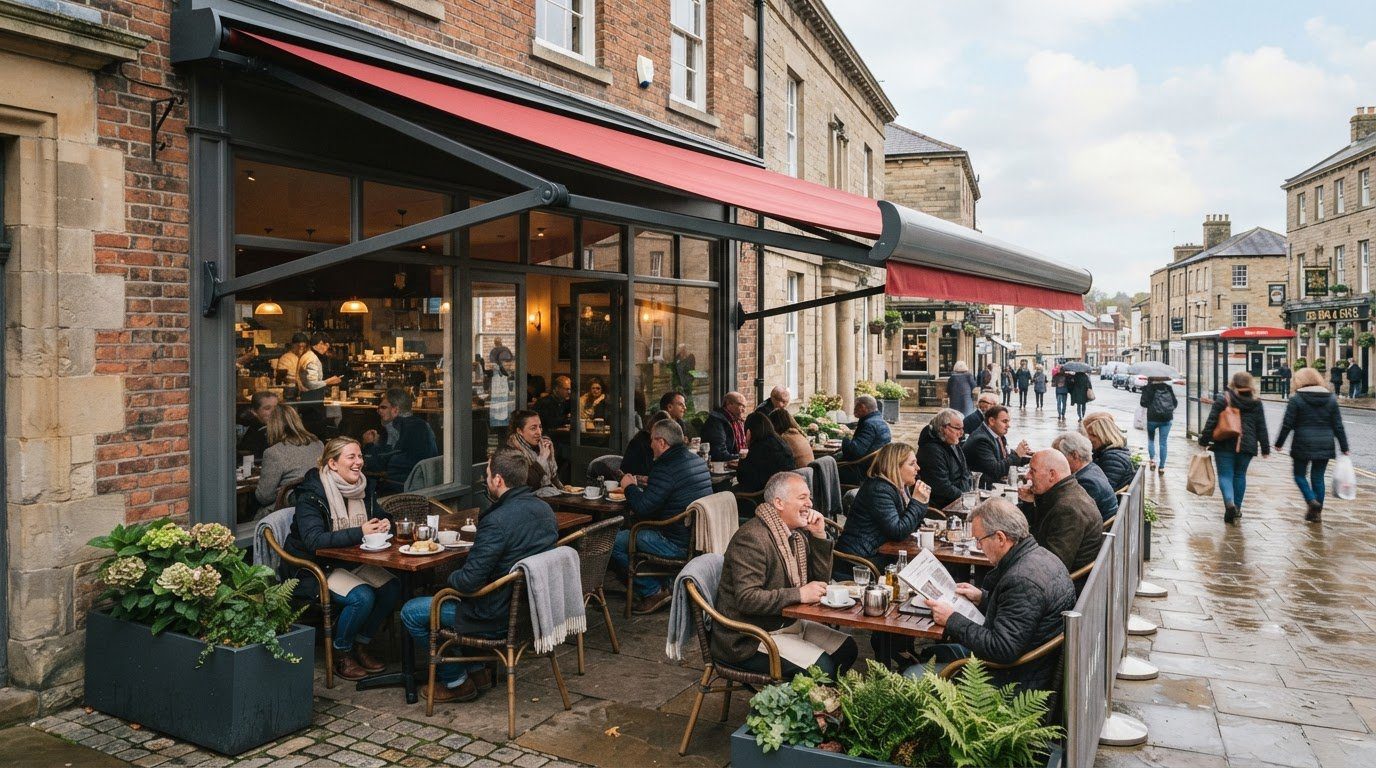
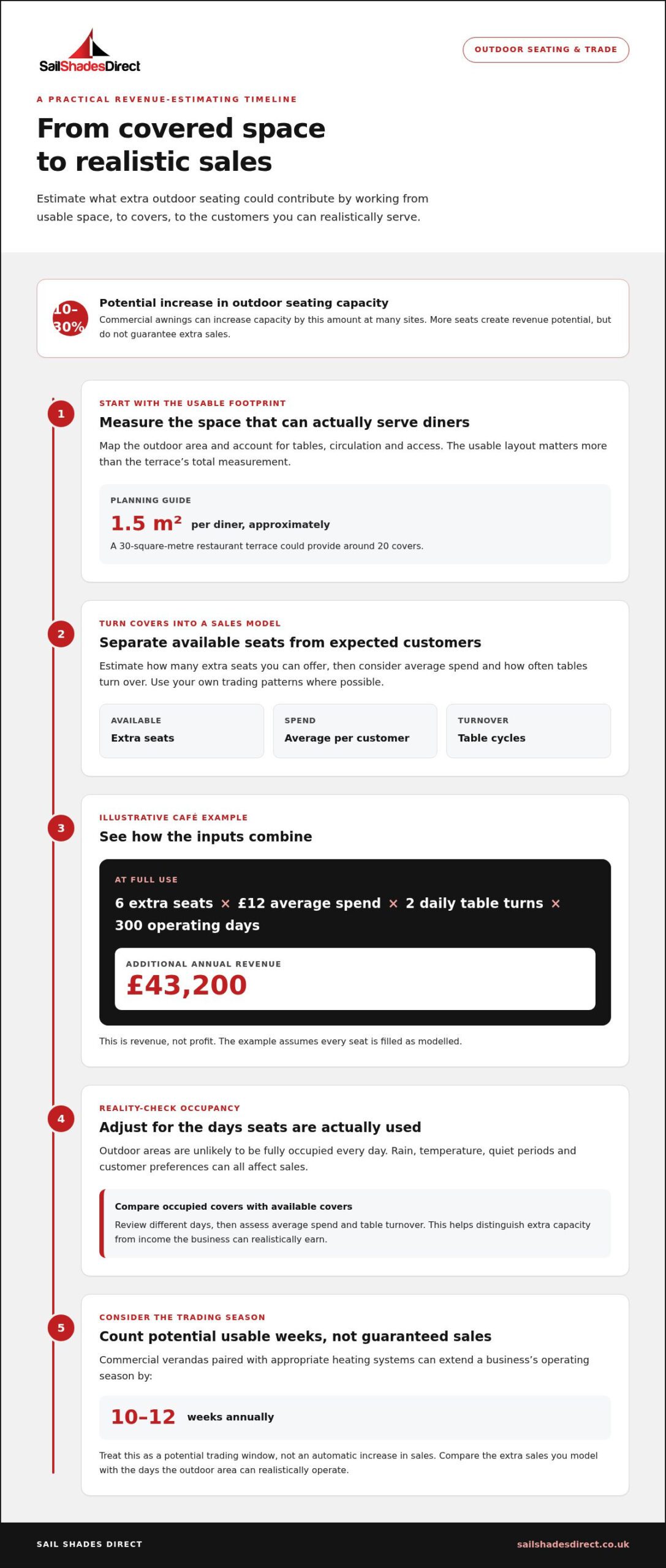
Awnings can make outdoor seating more comfortable by offering shelter from sun and rain. They can improve the use of existing outdoor floor space, but don’t create additional premises area. Commercial awnings can increase outdoor seating capacity by 10-30% at many sites.
To estimate capacity, start with the space available and allow about 1.5 square metres per diner. A 30-square-metre restaurant terrace could therefore provide around 20 covers. Actual layouts depend on tables, circulation and access, so the usable area matters more than the terrace’s total measurement.
More seats create revenue potential only when customers use them. Consider a typical small independent café example: six additional seats, a £12 average spend, two table-turnover cycles daily and 300 operating days produce £43,200 in additional annual revenue at full use. This is revenue, not profit, and assumes every seat is filled as modelled.
In practice, the area is unlikely to be fully occupied every day. Rain, temperature, quiet periods and customer preferences all affect whether extra seats generate sales. Compare occupied covers with available covers on different days, then assess average spend and table turnover. Using your own trading patterns makes the estimate more realistic.
Seasonal customisation can help keep an outdoor area useful for different occasions. A café might arrange covered seating for lunch, then adapt the layout for evening service or a private gathering. Commercial verandas paired with appropriate heating systems can extend a business’s operating season by 10-12 weeks annually. Treat this as a potential trading window, not an automatic increase in sales.
Comfort also shapes the customer experience. Shelter can give diners a place to relax outdoors in changeable weather, while a considered layout keeps tables practical and welcoming. Lighting can make a covered frontage more visible and inviting at night. These details may encourage customers to stay longer, though the effect on revenue depends on the venue’s service and demand.
To assess the opportunity, map the seating area and note when weather currently disrupts service. Estimate the number of usable covers, then model occupancy, spend and turnover separately. Finally, compare the potential extra sales with the days the outdoor area can realistically operate. This helps distinguish added capacity from income the business can actually earn, ensuring your investment through Sail Shades Direct delivers a measurable return.
Energy efficiency and cooling costs
By shading glazing, an awning can reduce direct solar heat entering a business. Cooling costs can fall by 5-15%, depending on glazing, orientation and HVAC. The same shade can also control daylight, reducing reliance on artificial lighting during bright periods. Include these potential savings in your return estimate, but assess them against the building’s actual energy use.
For lifetime costs, look beyond installation. Include upkeep, fabric cleaning, checks to the fixings and any repairs, then weigh these against energy savings and additional trading income. The cost of a commercial awning depends on the project. Dimensions, materials, operation, installation and site access all affect the quote.
Outdoor umbrellas, canopies and fixed shading suit different premises, so compare how each uses space and responds to weather. A giant umbrella can shade a defined outdoor area, while an awning can cover a shopfront or seating zone. Fixed shading provides permanent coverage; retractable designs can be opened or withdrawn as sunlight and use change. Return on investment depends on how often the chosen area is usable.
Manual and motorised operation differ in convenience and ongoing ownership. A manual awning avoids powered controls, while a motorised model can extend or retract at the touch of a button or through a programmable device. This flexibility can help staff adjust shade as conditions change, but include the chosen operating system and its maintenance needs in your calculation.
Planning and conservation requirements can apply to shopfront awnings, and branded canopies or valances may also require advertisement consent. An awning may need planning permission if it affects a building’s external appearance or is in a conservation area. Review the relevant planning requirements and any property or mall management rules before installation.
For fire safety and accessibility, keep entrances, escape routes, fire equipment, signs and pedestrian paths unobstructed. Restaurant outdoor seating applications typically require 1.5-2m of pedestrian clearance. Set the awning’s position and projection around safe access and the building’s applicable requirements, rather than treating the covered footprint as usable seating automatically.
Wind damage and repair work can reduce returns if an awning is left exposed in unsuitable conditions. Retract awnings when wind speeds exceed 20 mph, and schedule annual checks, clean the fabric and inspect the fixings. These routine tasks help identify wear early; include maintenance time and repair allowances in the ownership assessment.
Compare options against the job each must do: shade glazing, shelter customers or cover a service area. A tailored assessment of commercial shade options can help match the design and operation to the premises, so the investment supports practical use as well as energy efficiency.
Potential revenue growth from increased footfall and seating
Extra covered seating can increase a venue’s capacity, but capacity alone does not guarantee extra sales. A useful estimate connects three measures: available covers, average spend and table turnover. For example, a café should distinguish the number of seats it can offer from the covers it expects to fill during each service.
A Bath shopfront café example models 12 additional seats, a £15 average spend, 2.5 turnover cycles and 320 operating days. At full utilisation, that produces an estimated £144,000 in annual revenue uplift. Applying a seasonality weighting of 0.8 reduces the estimate to about £115,200. These figures illustrate the calculation, not a forecast for every café.
To calculate a more realistic uplift, adjust for utilisation before treating the result as income. The Bristol café example’s projected annual uplift is £21,600 at 50% utilisation and £34,560 at 80%. Compare those estimates with the venue’s own busy and quiet periods, average spend and table turnover. Then separate revenue from gross profit, since operating costs affect how much extra sales contribute to payback.
Gross-margin payback offers a more useful comparison than revenue alone. Multiply estimated additional revenue by the business’s gross margin to estimate the contribution available towards the investment. In a worked example, a 70% gross margin gives an estimated payback of approximately 0.53 years, or 6.4 months. Use the same method with actual costs and trading assumptions to understand what the result represents.
Outdoor space can also host private and corporate events, creating opportunities beyond routine café or restaurant service. A covered area might be used for a business reception, private meal or seasonal gathering. Estimate event income separately from everyday seating, accounting for available days, likely bookings and any extra staffing or service costs.
Footfall and branding can influence whether more people notice and choose a venue. Living Streets’ Pedestrian Pound research found that sales rose by 25% in areas where streets were improved for people on foot. This is evidence about street improvements, not a guaranteed awning effect. Still, a more visible frontage and comfortable outdoor coverage can help attract passing customers.
For a practical assessment, compare expected covers and event bookings with current trading. Test more than one utilisation assumption, such as the Bath example’s 0.8 seasonality weighting, then calculate gross profit rather than relying on top-line revenue. Include any energy savings separately, so each potential contribution to payback is visible without counting the same benefit twice.
Potential energy savings from reduced cooling needs
A commercial awning can reduce cooling costs by 5-15%, depending on glazing, orientation and HVAC. For a £6,000 annual energy bill, a 10% reduction from shading and window films equals £600 in annual savings. That example combines measures, rather than attributing the full saving to an awning alone.
The mechanism is straightforward: shading a window limits direct sunlight and solar heat entering the premises. Straits Research says window awnings can reduce solar heat gain by 65 to 77%, which may ease demand on air conditioning. The effect on energy bills depends on how much cooling the business uses and how the building faces the sun.
For a shop, reduced direct sunlight may help protect goods displayed in the window. Sunlight entering through commercial glazing can cause wooden furniture and flooring to fade, crack or become damaged. Shade may help preserve those surfaces and stock while maintaining a visible display that supports the shop’s appeal.
To assess potential energy savings, compare use during periods of strong sunlight with use in cooler periods. Note which rooms have large windows, their orientation and when cooling equipment runs. Then consider whether shading those windows could reduce heat gain. This gives you a practical way to identify where an awning might help, rather than assuming every area needs equal coverage.
Include any estimated saving as a separate benefit from extra sales. If shading reduces air-conditioning use in hot weather, for example, the energy saving can contribute to payback. Base the calculation on the business’s actual energy bills and cooling use. A building that relies little on air conditioning has less cooling spend to offset.
Shading may also help control daylight and reduce the need for artificial lighting. The balance matters: too much coverage can reduce useful natural light, while adjustable shade can respond to changing conditions. Consider how the windows serve customers and staff throughout the day, then weigh heat reduction against the light needed for displays and daily work.
For a clear comparison, record relevant energy costs, identify sun-exposed windows and estimate how often cooling operates. Assess the potential to reduce cooling alongside the protection of stock and interiors. These benefits work differently: energy savings can be measured against usage, while reduced fading or damage helps preserve the condition of the space.
Shopfront awning investment and potential returns
A shopfront awning is an investment in shelter, visibility and the way a frontage supports trading. Its cost depends on the project, with dimensions, fabric, operating technology and installation requirements among the factors that affect the quote. A commercial awning return on investment assessment should compare the total investment with measurable benefits, rather than judging the decision by the upfront cost alone.
Start with a simple payback calculation: divide the investment by the annual net benefit. Include additional gross profit from sales, not revenue alone, alongside any energy savings the business can attribute to shading. Commercial awning payback is typically described as a few months for low-cost parasols to 1-3 years for mid-range commercial awnings, depending on utilisation, average spend and energy savings. When estimating commercial awning return on investment, use assumptions that reflect the premises’ trading pattern.
A worked example estimates that an £8,000 awning installation has a simple payback of approximately 0.37 years, or 4.5 months, using the stated net benefit. The key lesson is the method: payback changes when projected sales, operating costs or energy savings change. Use a realistic trading assumption, then compare annual net benefit with the full project investment.
Hospitality venues are also reported to find their outdoor awning structures pay for themselves within 12-18 months. Treat this as a potential benchmark, not a target every shopfront will meet. A payback under three years is considered attractive in the provided market example; three to five years may be acceptable when branding or seasonal trading also matters.
The Metropolitan pub in Manchester reported a 500% return on investment within the first year after installing a modular all-weather awning system. That example shows why a business should assess how the structure supports its own trading model. A restaurant may value extra sheltered seating, while a retailer may focus more on frontage visibility and protecting window displays.
Fabric, metal and polycarbonate differ in durability, maintenance and cost considerations. Choose according to the intended use and shopfront conditions, then include expected upkeep in your return calculation. A well-specified commercial awning is expected to last well over a decade with routine maintenance, so consider benefits across its working life, not just its first season.
Retractable designs can be drawn back to admit sunlight or uncover an outdoor area for events. This flexibility can help a business adapt coverage to changing weather and customer needs. Fixed awnings provide consistent protection when permanent shelter is the priority. Match the design to the hours and uses that can generate profit, then calculate payback using realistic opportunities.
Ready to assess how a shopfront could gain shelter and visibility? Discuss your shopfront shading requirements and the way the space needs to support trading.
Sail Shades Direct: Bespoke Sail Shades
Sail Shades Direct helps businesses plan outdoor shade around their premises and how customers use the space. Bespoke Sail Shades and Rolling Sun Sails can suit open areas, while Arm Awnings can provide coverage beside a building. Giant Umbrellas offer another way to shelter a defined outdoor area.
Consider the shape of the site, the activity beneath the shade and whether the priority is customer seating, a service area or frontage comfort. These practical needs help guide the choice and make the investment assessment more relevant to everyday trading.
For a tailored discussion about your commercial outdoor space, contact Sail Shades Direct or visit the website.
Make your next decision with confidence
Before choosing a design, decide what you want the space to do for your business. Is the priority a more inviting frontage, a more practical outdoor area or shade beside the building? A clear purpose gives your commercial awning return on investment assessment a useful foundation, because you can judge the design against how your premises actually operate.
Then consider how customers, staff and the building use the area throughout the day. Sail Shades Direct offers Bespoke Sail Shades, Rolling Sun Sails and Arm Awnings for different outdoor settings. Sharing your priorities and site requirements can help shape a solution around your business, rather than treating shade as a one-size-fits-all addition.
Good planning turns a broad idea into a practical next step. Contact Sail Shades Direct to discuss your commercial shading needs and explore an approach that fits your space. A thoughtful design can help your outdoor area work harder for your business.
Frequently Asked Questions
What is the typical cost of a commercial awning in the UK?
There’s no single cost that applies to every commercial awning. The price depends on the project, with the quote shaped by factors such as size, material, operating mechanism and installation requirements. A shopfront with unusual dimensions or limited installation access may need a different solution from a straightforward frontage, so compare quotes against the same design requirements.
How do commercial awnings increase retail footfall and sales?
Commercial awnings can make a shopfront more noticeable and provide a more sheltered, welcoming entrance. A clear business name or logo can help passers-by recognise the premises, while a well-presented window display gives them a reason to pause. To assess any effect on sales, compare footfall and transactions before and after installation, noting changes in trading conditions or promotions that could also influence results.
What is the average lifespan and maintenance cost of a commercial awning?
Lifespan and maintenance costs vary with the materials, weather exposure, frequency of use and condition of the fixings. Cleaning needs, access for inspection and replacement parts all affect upkeep. For budgeting, separate routine care from occasional repairs, and record maintenance costs alongside trading and energy results to understand the ongoing effect on your investment.
How do you calculate the ROI and payback period for a commercial awning?
Calculate payback by dividing the total investment by the annual net benefit attributable to the awning. To calculate ROI, compare total benefits with total costs over your chosen assessment period, then express the difference relative to the investment. Use additional gross profit and energy savings, not sales revenue alone. Track actual results after installation and separate one-off costs from recurring benefits to make the comparison clearer.
Are there UK grants, tax relief or business rates implications for commercial awning installation?
Don’t include assumed grants, tax relief or business-rates savings in your base calculation. Their relevance depends on the business, the installation and the rules for any specific scheme or tax treatment. Keep potential support separate from the core payback estimate, which should use trading and energy benefits. This avoids relying on a saving before its eligibility and effect on your accounts are established.
How do awnings compare with outdoor umbrellas, canopies and fixed shading for cost and ROI?
Giant Umbrellas shade a defined outdoor area; awnings can cover a shopfront or seating zone. Fixed shading provides permanent coverage, while retractable awnings adapt to sunlight and use. Return on investment depends on how often the chosen area is usable.