
Extending the Outdoor Dining Season: 2026 UK Guide
What if the arrival of the October frost didn’t have to mean a sudden, sharp drop in your daily covers? It’s a familiar story for many in the UK hospitality industry. You’ve likely watched your vibrant terrace turn into a ghost town the moment the autumn rain starts, feeling the frustration of valuable square footage sitting empty whilst still costing you business rates. We understand that the British weather often feels like a silent partner taking an unfair cut of your profits.
The good news is that you don’t need a permanent, costly building extension to keep those tables turning. This guide reveals the secrets to extending the outdoor dining season for restaurants by creating a protected, high-end micro-climate that guests love. You’ll discover how to transform your terrace into a year-round revenue centre using bespoke weather protection like rolling sun sails and commercial-grade arm awnings. We’ll walk you through strategic planning, from navigating the 2026 pavement licence rules to selecting durable, storm-proof fabrics that survive the toughest UK winters. Let’s explore how to turn your outdoor space into a reliable, branded destination that thrives from October through to March!
Key Takeaways
- Learn how a 20% increase in year-round covers can significantly boost your bottom line by capturing the UK’s lucrative shoulder seasons.
- Discover how bespoke sail shades and rolling sun sails offer a versatile, professional solution for extending the outdoor dining season for restaurants.
- Understand the technical differences between fabric grades and why correct run-off angles are essential for keeping terrace guests dry during UK storms.
- Navigate the 2026 UK Pavement Licence landscape and identify exactly when your outdoor shading hardware requires formal planning permission.
- Find out how custom-engineered designs maximise every square inch of your floor space whilst ensuring your outdoor aesthetic matches your brand identity.
The Commercial Case for Extending the Outdoor Dining Season
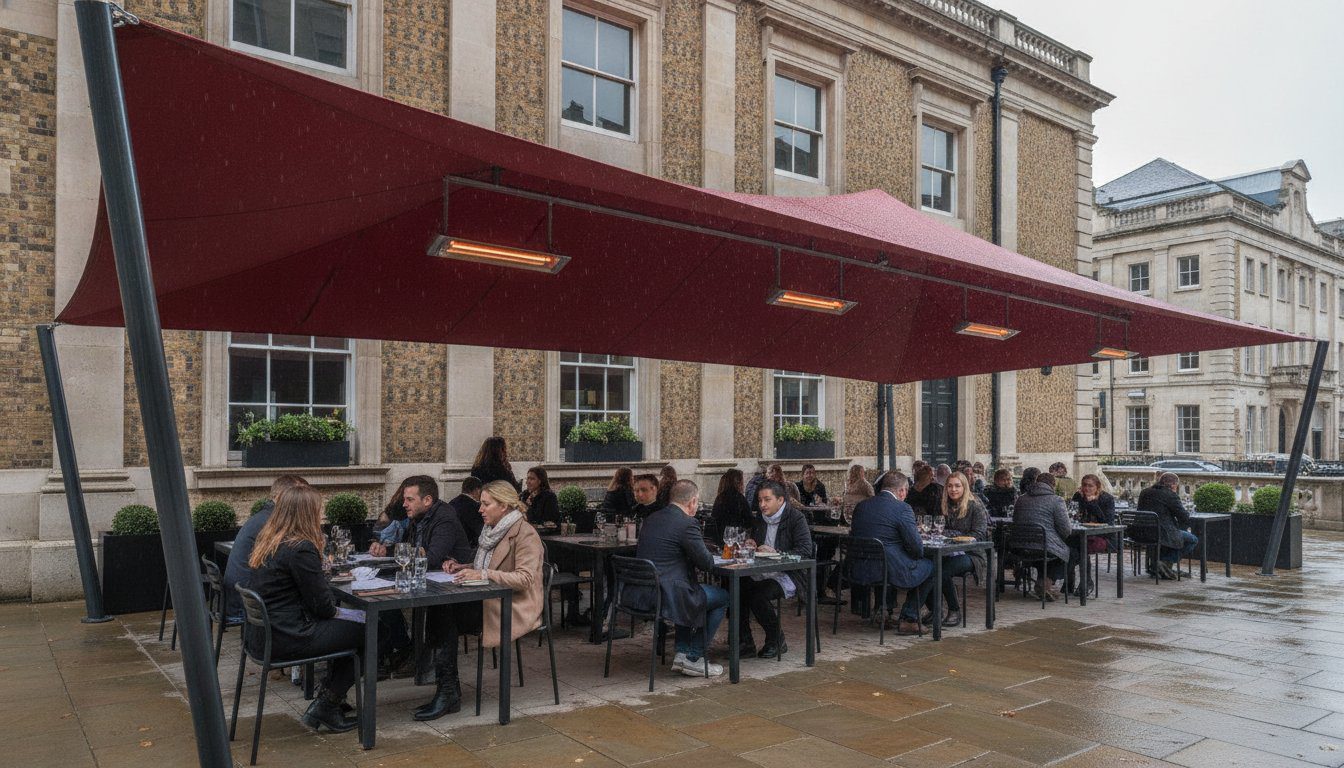
The UK hospitality market has traditionally viewed terrace dining as a three-month summer bonus. However, modern consumer behaviour has shifted dramatically. Looking back at the history of outdoor dining, it’s clear that whilst alfresco culture was once a Mediterranean novelty, it’s now a year-round expectation for British diners. We now talk about the ‘shoulder seasons’, those tricky months in spring and autumn where the sun is out but the air is crisp. By extending the outdoor dining season for restaurants, you aren’t just adding a few extra seats; you’re fundamentally changing your business’s revenue floor.
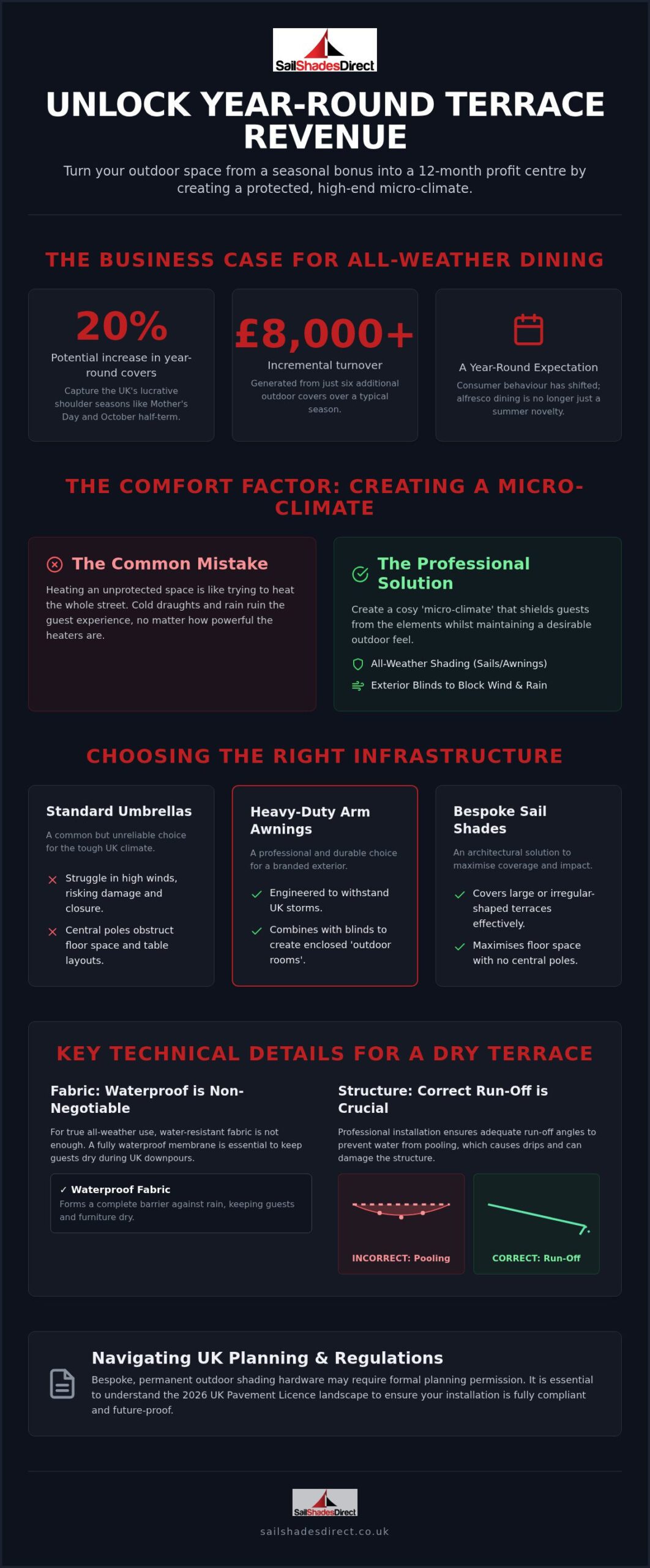
A 20% increase in year-round covers can be the difference between a struggling site and a thriving one. Think of your terrace not as a seasonal extra, but as a permanent revenue centre that works for you 12 months a year. Moving away from a ‘summer-only’ mindset allows you to capture trade during busy periods like Mother’s Day or October half-term, times when indoor capacity is often stretched to its limit. It’s about reliability. When a guest knows your terrace is always comfortable, they’ll book it regardless of the forecast.
Calculating the ROI of Terrace Weatherproofing
Investing in a bespoke arm awning or a rolling sun sail system is a financial decision as much as an aesthetic one. Unlike high-cost, static garden pods that can feel cramped and disconnected from the restaurant’s energy, bespoke shading allows for a more flexible use of space. Industry data suggests that just six additional outdoor covers can generate approximately £8,000 in incremental turnover over a typical season. When you factor in increased table turnover during rainy spells, the payback period for professional weatherproofing is often shorter than you might expect. A high-end, branded exterior also acts as a visual magnet, pulling in footfall from the street whilst your competitors’ terraces sit empty and uninviting.
Guest Psychology and the Comfort Factor
Diners will happily sit outside in November, but only if they feel protected. Many businesses make the mistake of installing heaters without addressing the wind and rain. Heating alone fails if a cold draught is whistling around a guest’s ankles; you’re essentially trying to heat the whole street. True comfort comes from creating a ‘micro-climate’ using exterior blinds and tensioned fabric structures. This approach maintains that desirable outdoor feel whilst providing a cosy, sheltered sanctuary. Combined with strategic lighting and high-quality textiles, you can transform a damp patio into an atmospheric destination that keeps guests ordering drinks long into the evening.
Infrastructure Essentials: Selecting the Right Shading Hardware
Choosing the right hardware is the foundation of a successful year-round terrace. Whilst giant umbrellas are a popular choice for many, they often struggle in the high-wind environments typical of UK winters. For businesses serious about extending the outdoor dining season for restaurants, bespoke solutions offer far greater reliability and aesthetic appeal. Unlike off-the-shelf products, custom engineering ensures your shading can withstand the specific wind loads of your location, preventing costly damage during seasonal storms.
Utilising tensioned fabric allows you to cover large or irregular terrace shapes that traditional umbrellas simply cannot reach. These systems aren’t just functional; they create a striking architectural statement that enhances your building’s facade. By using custom-engineered mounting points, we ensure that every installation is structurally sound and safe for public areas. For a deeper look at the materials and engineering behind these systems, you can view our bespoke sail shades UK technical guide. This approach allows for maximum floor space usage, as you aren’t restricted by central poles or heavy bases that can obstruct guest movement and table layouts.
Rolling Sun Sails and Retractable Systems
The UK weather is famously unpredictable. A bright, sunny afternoon can turn into a drizzly evening in minutes. Rolling sun sails offer the ultimate versatility, allowing your staff to adapt to the conditions in real-time with motorised controls. These systems are particularly effective for managing guest comfort during the transition from afternoon sun to evening chill. Retractable solutions also offer a significant legal advantage. Because they aren’t permanent structures, they often bypass the stricter planning regulations associated with fixed extensions. It’s always wise to consult the official UK pavement licence guidance to ensure your setup remains fully compliant with local authority standards. If you’re looking to balance flexibility with professional protection, you might want to browse our range of retractable systems to see how they can fit your specific terrace layout.
Waterproof vs. Water-Resistant: Navigating the UK Climate
The British autumn is notoriously fickle, often swinging from bright sunshine to driving rain in the space of a single lunch service. For any business owner, understanding the technical specifications of their shading is the only way to ensure their investment survives the winter. When you’re looking at extending the outdoor dining season for restaurants, the distinction between ‘water-resistant’ and ‘waterproof’ isn’t just semantics; it’s the difference between a dry guest and a refund.
Water-resistant fabrics, like many high-street acrylics, are designed to bead off light showers but will eventually soak through during a sustained downpour. In contrast, commercial-grade PVC-coated polyesters are truly waterproof, offering a complete barrier against the elements. However, fabric choice is only half the battle. Without a correctly engineered ‘run-off’ angle, even the best waterproof sail will succumb to water pooling. This weight can stretch the fabric or, in extreme cases, compromise the mounting points. We always design with a minimum pitch to ensure water clears the surface immediately, preventing the ‘belly’ effect that ruins cheaper installations.
Ensuring your structure can withstand British gales is about more than just the fabric; it’s about the tensioning and the integrity of the mounting posts. Custom-engineered systems are built to handle specific wind loads, whereas off-the-shelf products often have to be dismantled as soon as the breeze picks up. Don’t ignore UV protection just because it’s October, either. The autumn sun can still cause significant fading to high-end furniture and discomfort for guests, making UV-stable fabrics a necessity for long-term durability.
The Technical Difference in Fabric Performance
For commercial hospitality environments, a fabric should ideally possess a hydrostatic head rating of at least 10,000mm to be considered truly fit for professional outdoor use.
Bespoke commercial fabrics are engineered for a lifespan of 10 to 15 years, whereas off-the-shelf retail options often degrade within two or three seasons due to UV exposure and mechanical wear. Many of our high-performance textiles now feature self-cleaning coatings. These use rainwater to wash away urban pollutants and soot, which is a massive help for restaurants in busy city centres where manual maintenance is difficult and time-consuming.
Side Protection and Wind Management
Even a perfectly dry guest will leave if they’re shivering. This is where the ‘wind-chill’ factor becomes your biggest enemy. Whilst a roof protects from rain, exterior blinds are essential for blocking the biting winds that can make a terrace feel ten degrees colder than it actually is. By integrating clear ‘window’ panels into your blinds, you can create a protected sanctuary without losing the connection to the street or the view that makes alfresco dining so appealing. If you’re planning a more comprehensive setup, check out our guide on exterior blinds for patios to see how side protection can complete your year-round strategy.
Operational Planning and UK Regulations for 2026
The regulatory landscape for 2026 offers much more certainty than the transition years following the pandemic. The temporary pavement licence regime was made permanent across the UK by the Levelling-Up and Regeneration Act 2023, providing a stable foundation for businesses to invest in high-quality outdoor infrastructure. When you’re extending the outdoor dining season for restaurants, it’s vital to remember that whilst the regime is national, local councils still set their own fees and conditions. For example, authorities such as Hillingdon and Hammersmith & Fulham currently charge £500 for a new licence and £350 for a renewal, whilst Colchester City Council sets fees at £450 and £275 respectively.
Compliance isn’t just about the fee; it’s about the footprint. You must maintain a clear pedestrian footway of 1.5 to 2 metres at all times to ensure accessibility. Professional installation is non-negotiable in public spaces, as most councils require proof of public liability insurance between £2 million and £5 million. If your site is a listed building or sits within a heritage conservation area, bespoke shading becomes even more important. Local planners often prefer retractable arm awnings or rolling sun sails over permanent timber or metal structures, as they preserve the architectural integrity of the building whilst providing the necessary weather protection.
Planning for Temporary vs. Permanent Structures
There’s a significant legal distinction between a permanent extension and a retractable shading system. Permanent structures with solid roofs often trigger complex planning applications and must comply with strict building regulations. In contrast, bespoke sail shades and arm awnings are frequently classified as non-permanent, making the approval process smoother. To satisfy council safety officers, we provide all necessary documentation, including precise wind load calculations and fire retardancy certificates. This professional approach ensures your installation is both safe for the public and fully compliant with local by-laws.
Integrating Heating and Lighting Safely
To keep guests comfortable from October through to March, you’ll need to integrate heat and light directly into your outdoor structure. Infrared heaters are the most efficient choice, as they warm the people rather than the air, but they must be mounted at safe distances from the fabric. Motorised systems and integrated LED lighting require professional electrical sign-off to ensure they’re weather-rated for the UK climate. Managing energy costs is a priority for any operator, so we recommend using sensors or timers to ensure heaters only run when tables are occupied. If you’re ready to navigate the logistics of a year-round terrace, you can book a professional consultation to discuss your site’s specific requirements.
Bespoke Shading: Transforming Terraces into Revenue Centres
Generic, off-the-shelf solutions often leave gaps that allow the wind to penetrate, undermining the comfort of your guests. When you’re serious about extending the outdoor dining season for restaurants, a bespoke approach is the only way to ensure every table remains profitable. Custom designs allow you to maximise every square inch of available floor space, turning awkward corners or narrow passages into premium seating areas. It’s about precision. We don’t just provide cover; we create a seamless extension of your indoor dining room that feels intentional and high-end.
Your terrace is also a vital part of your brand’s visual identity. Matching fabric colours and integrating your logo into the design transforms a functional structure into a powerful marketing tool. At Sail Shades Direct, we bring over 10 years of experience in the UK market to every project, moving from professional design to nationwide installation. By using durable, high-quality materials engineered for high-wind environments, we ensure your investment remains a high-performing asset for years to come. This future-proofing is essential for maintaining a consistent, professional aesthetic that attracts footfall even on the greyest November afternoon.
The Power of Customisation
One-size-fits-all umbrellas often fail in professional hospitality settings because they create ‘dead zones’ around poles and heavy bases. Designing for difficult spaces like narrow alleyways, rooftop terraces, or uneven gardens requires a level of engineering that generic products can’t match. Bespoke sail shades can be tensioned over irregular footprints, providing a sleek, modern look that traditional structures lack. They’re a more flexible and cost-effective alternative to garden pods, which can often feel static and isolated. For more information on how custom engineering can solve your site’s specific challenges, take a look at our commercial shading solutions UK guide.
Getting Started with Your Terrace Transformation
The journey to a year-round terrace begins with a detailed consultation. Our process includes comprehensive site surveys and 3D design visualisations, allowing you to see exactly how the new structure will interact with your building’s architecture. We manage the entire project, ensuring that lead times for bespoke manufacturing are kept efficient and that professional fitting is scheduled around your service hours to minimise disruption. Don’t let another season of lost revenue pass you by. It’s time to reclaim your outdoor space and turn it into a reliable, year-round destination. Contact Sail Shades Direct for a commercial consultation today to find out how we can help you grow your business.
Future-Proof Your Terrace for Year-Round Success
Transforming your outdoor area into a resilient revenue centre is no longer a seasonal luxury; it’s a strategic necessity in the 2026 hospitality market. We’ve explored how moving beyond a summer-only mindset allows you to capture vital trade during the colder months, provided you have the right infrastructure in place. By prioritising bespoke engineering over off-the-shelf products, you ensure your terrace remains a safe, atmospheric sanctuary that can withstand the most challenging British gales. Your outdoor space should be an asset, not a weather-dependent liability.
Navigating the permanent pavement licence landscape is much simpler when you choose retractable systems that councils favour. With over a decade of hospitality expertise and a dedicated team providing expert UK-wide installation, we’re ready to help you master the art of extending the outdoor dining season for restaurants. Our bespoke engineering for high-wind areas ensures your investment is as durable as it is beautiful. Ready to see what’s possible for your site? Book a Professional Commercial Shading Consultation today to start your transformation. We’re excited to help you turn your terrace into your restaurant’s most valuable asset.
Frequently Asked Questions
Do I need planning permission for a restaurant sail shade in the UK?
Most retractable or temporary sail shades don’t require formal planning permission because they aren’t permanent buildings. However, if your restaurant is a listed building or located within a conservation area, you’ll likely need to consult your local planning office. It’s always best to verify with your specific council before installation. Our bespoke systems are often viewed more favourably than permanent extensions because they preserve the architectural integrity of the site whilst providing essential weather protection.
How much wind can a commercial-grade sun sail withstand?
Commercial-grade sun sails are custom-engineered to withstand significant wind loads, often rated for gales exceeding 50mph depending on the specific site requirements. Unlike domestic versions, our systems use heavy-duty tensioning and reinforced mounting points to ensure structural safety during British storms. The exact rating depends on the height, location, and angle of the installation. We provide precise wind load calculations for every project to ensure your terrace remains safe and reliable for guests throughout the year.
Are bespoke awnings better than giant umbrellas for pub gardens?
Bespoke arm awnings generally offer superior wind resistance and larger coverage areas compared to giant umbrellas. Whilst umbrellas are versatile, their central poles can obstruct table layouts and guest movement. Awnings provide a clear, unobstructed floor space, which is vital for extending the outdoor dining season for restaurants with high footfall. They also integrate more seamlessly with exterior blinds to create a fully enclosed environment, offering a level of comfort that free-standing umbrellas simply cannot match.
Can I use outdoor heaters under a fabric sail shade or awning?
Yes, you can safely use infrared heaters under fabric shades, provided they’re installed at the correct distance from the material. Infrared technology is ideal because it warms people directly rather than the air, making it highly efficient for open-sided terraces. We recommend professional mounting to ensure compliance with fire safety standards and manufacturer guidelines. Using integrated timers or sensors helps manage energy costs whilst ensuring your guests remain cosy during the colder autumn and winter months.
How long does the installation of a commercial shading system take?
Most professional installations are completed within one to three days, depending on the complexity of the site and the type of hardware selected. This doesn’t include the lead time for bespoke manufacturing, which varies based on the custom specifications of your project. We work closely with your team to schedule the fitting during off-peak hours or closed periods. This approach minimises disruption to your daily service whilst ensuring your new revenue centre is ready for use.
What is the best waterproof fabric for a restaurant terrace?
PVC-coated polyester is often the best choice for year-round use because it’s 100% waterproof and incredibly durable. For a softer, more traditional look, high-grade breathable acrylics with a high hydrostatic head rating are also excellent options. These fabrics are treated to resist UV fading and mould, ensuring they maintain their professional appearance over time. We’ll help you select the right textile based on your terrace’s exposure to wind, rain, and the specific aesthetic of your restaurant’s branding.
How do exterior blinds help extend the dining season?
Exterior blinds are essential for blocking the wind-chill factor that makes even heated terraces feel uncomfortably cold. By creating a physical barrier against crosswinds and driving rain, they allow you to maintain a stable micro-climate within the seating area. This is a critical component in extending the outdoor dining season for restaurants, as it transforms a simple roof into a fully protected dining room. Adding clear window panels ensures guests still enjoy the outdoor atmosphere without the discomfort.
What maintenance is required for commercial shading structures?
Routine maintenance involves basic cleaning to remove debris and regular inspections of the tensioning systems and mounting points. Many of our high-performance fabrics feature self-cleaning coatings that use rainwater to wash away soot and pollutants, which is particularly useful in urban environments. We recommend an annual professional check-up to ensure all motorised components and structural fixings remain in peak condition. This proactive approach protects your investment and ensures the long-term safety of your staff and diners.