
Off-the-Shelf Shade Sail Problems: Choose the Right Type
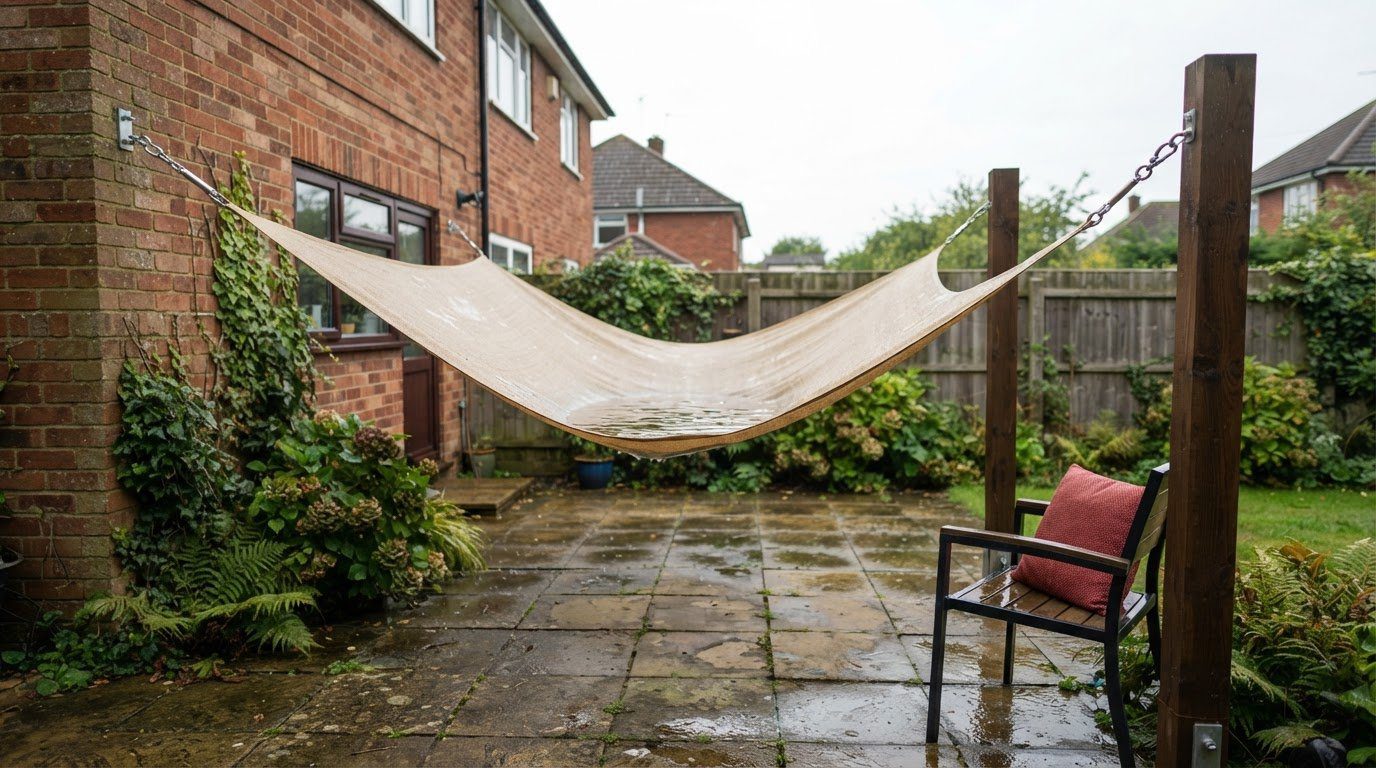
Common problems with off-the-shelf shade sails include a poor fit, difficulty achieving tension and water pooling when the sail is too flat. The fabric should be taut, with corners set at different heights to help rain run off. A ready-made sail can still work well when its dimensions suit the space and the fixing points.
It’s frustrating to expect a straightforward fit, then find that the corners sit too low or the sail doesn’t cover the area you had in mind. The right option depends on your garden’s shape, the position of secure fixing points and whether the layout allows the sail to be tensioned and sloped.
This guide covers practical ways to address pooling and tension problems, what to consider when measuring and choosing a shape, and when a custom-made sail may fit better than an off-the-shelf option. Use these points to compare the choices against your space and make a confident decision.
Key Takeaways
- Reduce pooling by planning a clear slope and keeping the sail taut, while choosing fabric suited to your need for shade, airflow or rain protection.
- Assess fixing points and support structures before adjusting tension; a sail needs secure anchors to sit properly.
- Measure the space, clearances and intended coverage to choose a shape that fits your garden rather than forcing a standard size.
- Compare off-the-shelf and custom-made options by how well each suits your fixing points and layout; bespoke sizing can help with awkward spaces.
1. How do I stop water pooling on my shade sail?
Water pooling usually points to a sail that is too slack or too flat. Set the corners at different heights so the fabric forms a clear slope, with high and low points guiding rain towards an edge. For waterproof fabric, an installation slope of 20 to 30 degrees helps water run off rather than collect.
Pull the sail taut between secure fixing points. Slack fabric can sag under standing water, and the added weight may stretch the material or strain seams and connections. If the sail has a seam, position it parallel to the downward slope, not across the path of runoff. Placement and tension work together: tightening a flat sail alone won’t create drainage.
Fabric choice matters too. Breathable shade-sail fabric lets hot air escape, which can make the space more comfortable, but may also let water through during heavy rain. Waterproof fabric offers more rain protection, although moisture in the air, such as overnight dew, mist or fog, can still make the area below damp. Check which side should face down: waterproof sails may need their seams and label on the underside.
To limit sagging, check that each corner stays tensioned and that runoff has a clear route. If water still gathers, reassess the corner heights and sail placement instead of repeatedly tightening the fabric. A flat canopy can hold water even when its edges feel firm.
Take a removable sail down before forecast strong winds or severe weather. Wind can make a sail act like a wing, transferring force to its posts and walls; pooled rain adds further strain. If the sail remains in place, pooling or flapping is a sign to reassess tension and drainage before conditions worsen.
2. Should a shade sail be tight or loose?
A shade sail should be taut, not slack. Loose fabric can flap, make noise and wear faster, while poor tension can leave corners sagging. Check that every corner connects to a secure fixing point. Turnbuckles, pulleys or ratchet straps can help adjust tension.
Fixing points may need to be further apart to create enough tension. That may not be possible with an off-the-shelf sail if its dimensions don’t suit the available structures. Don’t force a fit by pulling against weak supports. A visible slope in at least one direction helps rain drain, and placement should also account for the sun’s path throughout the day.
For waterproof fabric, fit the shade sail with its seams and label facing down. The waterproof treatment is on one side, so fitting the sail upside down can cause leaks. If it’s already fitted the wrong way up, turning it around may resolve the issue without damaging the fabric.
For UK installations, use secure anchor points and structures that can carry the sail’s loads. Fascia boards, soffits and other weak supports may not be designed for constant high loads. A builder or engineer can assess structural poles and fittings; chemical anchors may be suitable for masonry. These checks matter because wind transfers force from the sail to its supports.
Applicable building or safety requirements depend on the structure and site. Prioritise sound supports, secure fixings and correct tension; the sail fabric cannot compensate for weak anchors.
UK costs depend on the sail’s size and material, the fixing points and whether installation is included. The price depends on the case and is given after a quote request; supply-only arrangements leave installation to be organised separately.
If standard dimensions don’t suit your fixing points or coverage needs, consider a sail planned around your space rather than forcing an awkward installation.
Measuring the area and choosing the right sail shape
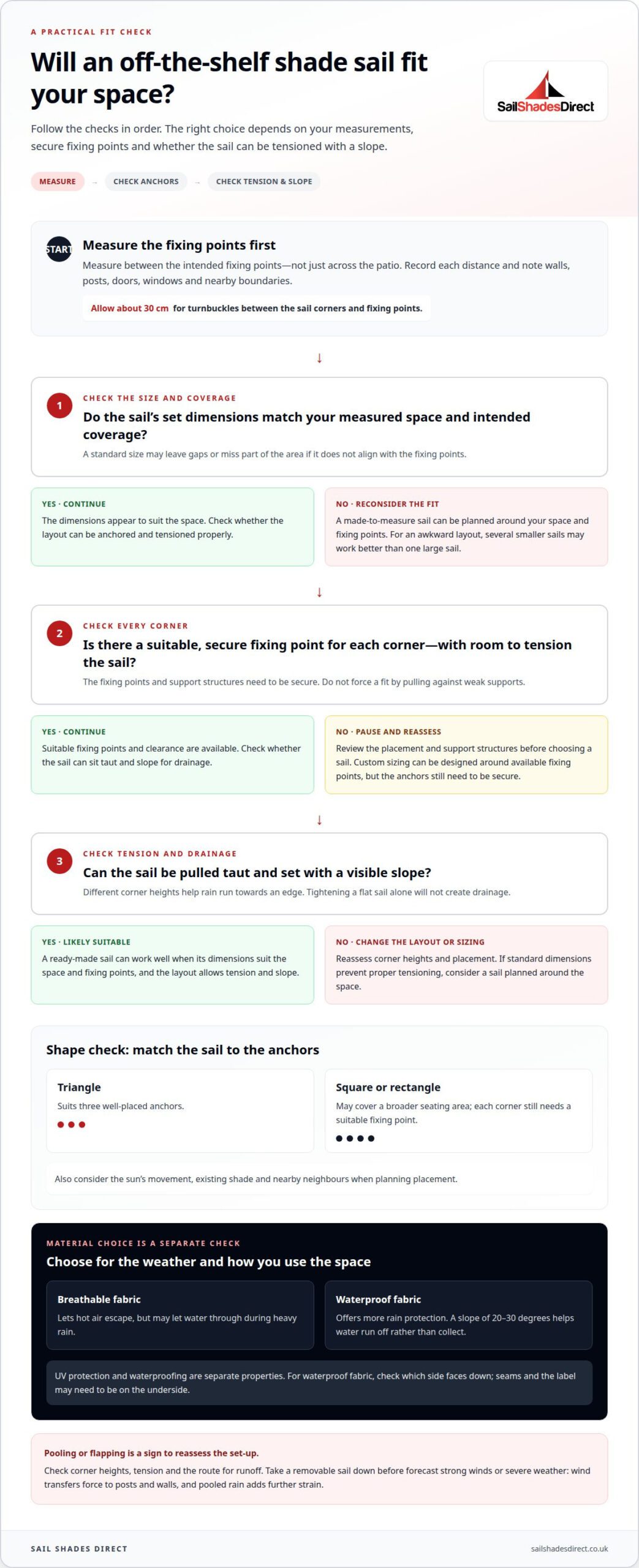
Measure between the intended fixing points, not just across the patio you want shaded. Record each distance and note walls, posts, doors, windows and nearby boundaries. Allow about 30 centimetres for turnbuckles between the sail corners and fixing points. That clearance gives room for tensioning; without it, a sail may be difficult to pull taut.
Shape matters as much as area. A triangle suits three well-placed anchors, whilst a square or rectangle may cover a broader seating area. Each corner needs a suitable fixing point, and the sun’s movement, existing shade and neighbours all affect placement. For an awkward layout, several smaller sails can work better than one large sail.
Off-the-shelf sails come in set dimensions, so they may leave gaps or miss part of the intended area. A made-to-measure sail can be designed around the available fixing points and the shape of your outdoor space. Either option still needs a layout that allows proper tensioning.
Check fabric specifications too. UV protection and waterproofing are separate properties, so don’t assume a UV-resistant sail is waterproof. Breathable fabric lets hot air escape, while waterproof fabric offers rain protection. Match the material to the weather conditions and how you plan to use the space.
Good-quality shade sails can last 5 to 15 years or longer, depending on materials and environmental conditions. Low-quality fabric may last 1 to 5 years. Check what the product states about UV protection, water resistance and care, rather than judging quality by colour or shape alone.
Planning permission is site-specific, so don’t assume every shade sail installation has the same requirements. The location and proposed support structures can affect planning considerations. Seek guidance from your local planning authority before building substantial supports.
4. Custom-made versus off-the-shelf shade sails
An off-the-shelf sail can suit a simple layout when its dimensions match the space and anchor positions. Problems with off-the-shelf shade sails often arise around angled boundaries, uneven walls or existing structures. A sail that doesn’t align with the fixing points may leave gaps, cover too little or be difficult to tension correctly.
A custom sail is designed around the space’s measurements, shape and fixing points. This can make it a practical option for awkward gardens or areas where standard dimensions provide poor coverage. Choose ready-made when the layout fits; consider custom sizing when the space, desired coverage or supports don’t align with standard options. If problems with off-the-shelf shade sails stem from a mismatch with your layout, a tailored size may be more suitable.
Compare fabric and construction, not just the initial fit. Low-quality sails may last between 1 and 5 years, while low-cost sails rarely last more than one or two seasons. Durability also depends on materials and exposure to weather. Check the product’s stated use, care guidance and construction details, including seams and hardware.
There’s no single wind-speed figure that applies safely to every off-the-shelf sail. Wind forces depend on the sail’s size, fabric, shape, tension, fixing hardware and exposure, and pass through the anchors to supporting structures. A sheltered position and secure installation matter, but they don’t make every sail suitable for every weather condition.
For either type, consider the whole setup: how much shade you need, where the sun falls, whether the fixing points allow tension and how exposed the garden is. Quality materials can support durability, but they can’t make up for a poor fit or weak supports. A standard sail is a sensible choice when these factors align; consider custom sizing when they don’t.
If your layout needs a tailored fit, explore custom shade options suited to your outdoor space.
Sail Shades Direct: Rolling Sun Sails
Sail Shades Direct can help you find an outdoor shading solution that suits your space, whether standard dimensions leave gaps or the fixing points call for a tailored design. Rolling Sun Sails offer an adjustable alternative, while Bespoke Sail Shades can be designed around your layout and coverage needs. Arm Awnings and Giant Umbrellas provide other ways to create outdoor shade.
When you get in touch, share the shape of the area, where you need shade and any constraints around the fixing points. These details help guide a practical discussion about the right type of shading for your garden or commercial setting.
Contact Sail Shades Direct to discuss your outdoor shade requirements.
Choose shade that works with your plans
Your outdoor space should work for the way you want to use it, rather than forcing you to put up with awkward coverage. If problems with off-the-shelf shade sails stem from an unusual layout or fixed anchor positions, start by considering those constraints. Think about the areas you want shaded and how you use them throughout the day.
Sail Shades Direct offers Bespoke Sail Shades and Rolling Sun Sails for different outdoor shading needs, alongside Arm Awnings. The right option depends on your space and the shade you want, not simply on choosing the nearest standard size. Describing your setting clearly can help shape the conversation.
Ready to explore an option that suits your plans? Contact Sail Shades Direct today to discuss your outdoor shading requirements and take the next step towards a more comfortable space.
Frequently Asked Questions
Custom made versus ‘off-the-shelf’: which type of shade sail do you need?
Choose an off-the-shelf sail when its dimensions suit your layout and desired coverage. A made-to-measure sail may work better for unusual boundaries, awkward fixing positions or gaps left by standard sizes. For example, a narrow patio beside an angled wall may need a different shape from a straightforward square seating area. Problems with off-the-shelf shade sails often come down to this mismatch.
How do I stop water pooling on my shade sail?
First, clear away leaves or twigs that could obstruct runoff. Then look for sagging fabric, loose fittings or a low point where rain can collect. These are common causes of pooling and may strain the material over time. To address problems with off-the-shelf shade sails, assess whether the sail’s dimensions and fixing positions suit the space rather than repeatedly tightening a poor fit.
Ready for Shade That Works?
Start with how you use your outdoor space, then consider which type of shade suits it. Sail Shades Direct offers Bespoke Sail Shades, Rolling Sun Sails and other outdoor shading options. If you’d like help discussing a suitable direction, call Sail Shades Direct on 01752 816125. Describe your layout and what you want shaded to begin the conversation.
Should a shade sail be tight or loose?
A shade sail should be taut, not loose enough to flap. Check the turnbuckles periodically, as they can loosen and affect tension over time. Look for movement at the fixings, stretched stitching or sagging fabric. If tightening doesn’t resolve the slack, the fixing positions and sail dimensions may not suit each other.
What are the 5 main reasons why a shade sail leaks?
Possible causes include fitting waterproof fabric upside down, insufficient slope, slack fabric, water crossing a seam, or rain driven beneath the sail by wind. Note where the water appears to narrow down the cause: a seam leak differs from water entering around an edge. Check whether the fabric is meant to be waterproof, as breathable material can let rain through.
Will a Shade Sail Work for Your Outdoor Space?
A shade sail can suit a patio, garden seating area or play space if there’s room for suitable fixing points and useful coverage. Consider the sun’s path, existing shade and nearby boundaries before choosing a shape. For a tricky layout, several smaller sails may work better than one large canopy, especially if a single sail would leave parts of the area exposed.