Questions to ask your awning installer about fit and shade
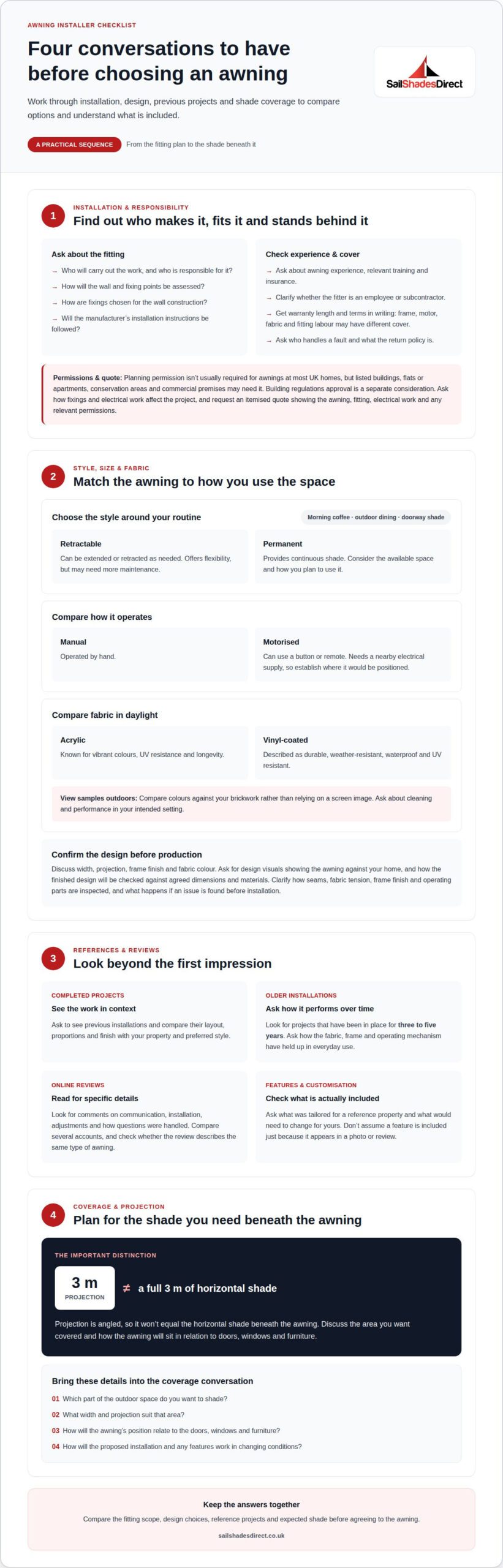
The installer’s name alone won’t tell you who makes your awning or how much useful shade it will provide. The most useful questions to ask your awning installer cover the manufacturer, who carries out the fitting, fabric and style choices, and the shade you can expect across your space. A 3 m projection won’t give you a full 3 m of horizontal shade, because the awning sits at an angle.
It’s sensible to want an awning that looks right and works well where you need it. The answers you get can help you compare options and understand what’s included before you commit. This guide covers installation, design and fabric, previous projects and reviews, then explains how to discuss coverage and projection so your plans suit the space you want to shade.
Key Takeaways
- Clarify who makes the awning, who installs it and whether the written warranty covers the product, the fitting or both.
- Compare awning styles and fabric samples in daylight, considering how you’ll use the space and how much flexibility you want.
- Look beyond online reviews by viewing previous installations, including projects that have been in place for three to five years.
- Plan shade around the area you want covered: projection is angled, so it won’t equal the horizontal shade beneath the awning.
1. Can I Install the Awning Myself or Do I Need Professional Installation?
A wall-mounted awning attaches to your property’s structure, so installation involves more than marking holes. The installer should assess the wall and choose fixings suited to its construction. Ask who will carry out the work and how they check the fixing points. Installation methods vary by awning type, and the manufacturer’s instructions should be followed. These are practical questions to ask your awning installer before agreeing to a fitting.
Accreditation isn’t the only measure of suitability. Ask about experience installing awnings, relevant training, insurance and who will be responsible for the work. A company’s general trading history may not show its team’s hands-on experience with your type of property, so ask about that specifically. These questions to ask your awning installer help clarify accountability if an installation issue arises.
Planning permission isn’t usually required for awnings at most UK homes, but listed buildings, flats or apartments, conservation areas and commercial premises may need it. Building regulations approval is a separate consideration. Ask how the proposed fixings and any electrical work affect your project.
Installation pricing depends on the awning, labour, access and any electrical work or permissions; the price is provided after a quote request. Ask for an itemised quote showing what’s included, such as the awning, fitting, electrical work and any relevant permissions. This makes the scope easier to understand before you agree.
Get the warranty length and terms in writing. Ask whether product coverage applies to the frame, motor, fabric or all three, and whether installation labour has separate cover. Some awning warranties cover the product rather than the fitting, so clarify who handles a fault and whether the installer is an employee or subcontractor. Ask about the return policy before finalising the purchase, too.
Poor fitting can cause problems later, particularly if the fixings don’t suit the wall or the installation fails to follow the manufacturer’s instructions. Ask how the installer assesses the structure, chooses fixings and checks the finished awning. The answers can help you decide whether professional installation is the practical choice for your outdoor space.
2. Awning style, size and fabric selection
Start by considering how you’ll use the space, whether for morning coffee, outdoor dining or shade over a doorway. Ask how retractable and permanent styles suit that purpose. Retractable awnings can be extended or retracted as needed, while permanent options provide continuous shade. Retractable designs offer flexibility but may need more maintenance. Consider the available space, how you’ll use the awning and which features matter most.
Manual and motorised awnings differ in how they operate and their cost. Manual models are operated by hand, while motorised options can use a button or remote. A motorised model needs a nearby electrical supply, so establish where it would be positioned before choosing. Ask how each option would fit your routine and whether the added functionality is useful for your outdoor space.
Fabric affects both appearance and practical performance. Acrylic fabrics are known for vibrant colours, UV resistance and longevity. Vinyl-coated fabrics are described as durable, weather-resistant, waterproof and UV resistant. Ask how the fabric performs in your intended setting and how to clean it. Compare colours in daylight against your brickwork rather than relying on a screen image.
Frame finish, colour and proportions also shape the result. Ask for design visuals to compare options against your home, and view fabric samples outdoors. Discuss the width and projection needed for the area, then consider how the awning will sit in relation to doors, windows and furniture. Seeing a sample beside your brickwork can make colour choices clearer.
Before production, ask how the finished design will be checked against your agreed dimensions and selected materials. Find out how seams, fabric tension, frame finish and operating parts are inspected, and what happens if an issue is found before installation. Clear answers help you understand the fabrication process, not just the finished appearance. To explore different awning styles and fabric choices, compare options with your space and daily use in mind.
3. Customer references and online reviews
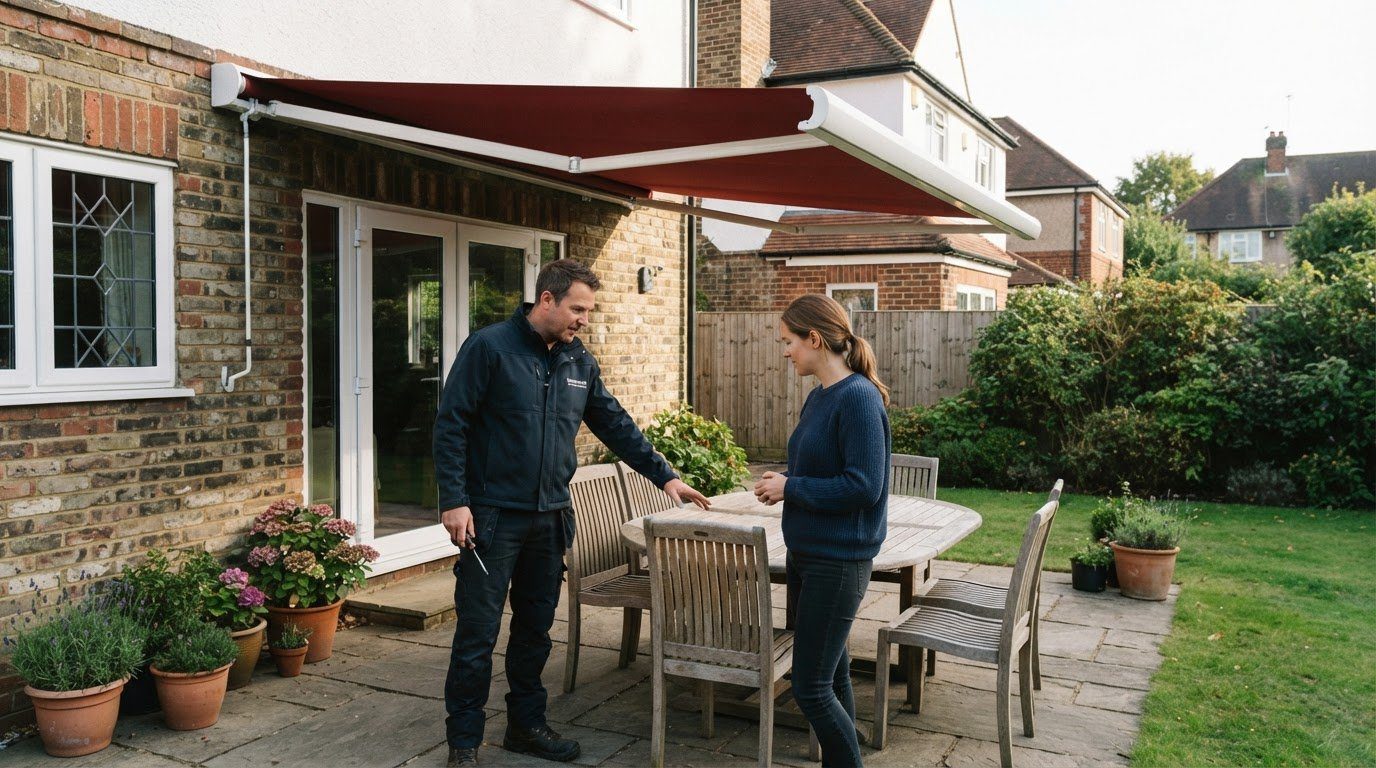
Online reviews can show how a company communicates, while completed projects let you see the work itself. Ask to see examples of previous awning installations, then compare them with your property’s layout and the style you’re considering. A photo of a retractable awning over a patio, for example, can help you judge its proportions and finish.
Ask to see reference projects from several years ago. Find out how the awning has performed over time, including whether the fabric, frame and operating mechanism still meet the owner’s needs. An older installation can show how the product holds up in everyday use, beyond the first impression of a newly completed job.
Reviews are most useful when they describe specific parts of the process. Look for details about communication, installation, adjustments and how questions were handled. Compare several accounts rather than relying on one unusually positive or negative review. If a review discusses a retractable model, check whether it’s the same type of awning you’re considering.
Ask for design visuals showing your proposed awning on your home. They can help you compare customisation choices, such as width, projection, frame finish and fabric colour, before settling on a design. If a reference project has prompted you to reconsider a style, ask what was tailored for that property and what would need to change for yours.
Discuss practical details shown in project examples, too. Ask how the awning’s position relates to doors, windows and the area you want to use. If you’re considering wind sensors, ask what they would do with the proposed installation and how the system responds to changing conditions. Don’t assume a feature is included just because it appears in a photo or review.
Use the conversation to connect reference projects with your own priorities. Prepare a shortlist of questions, identify the details that matter most and ask for relevant examples. Comparing past work, customer feedback and design visuals can help you judge whether the proposed awning suits your home and expectations.
4. Awning shade coverage and projection
Plan around the ground you want shaded, not just the awning’s stated projection. A 3 m projection does not create a full 3 m of horizontal shade because the awning sits at an angle. Ask the awning company to show how the proposed projection translates to usable coverage beneath it, including the area nearest the wall.
Start with a practical example: mark the dining table, chairs or doorway you want protected. Then ask how mounting height and pitch affect the shaded area. The mounting position influences both, so a projection that suits one wall may cover a different area when installed elsewhere. Ask where the shade will fall and how the proposed position affects coverage.
Sunlight moves throughout the day, changing where shade falls. Tell the installer when you use the space most, such as at lunch or in the late afternoon. Ask them to consider the sun’s direction at those times and explain which parts of the seating area will stay shaded. This keeps the plan focused on your routine, not just measurements on paper.
Explain whether you want protection from sun, rain or both. An awning can provide shade or cover from rain, but the protected area depends on its position and angle. Discuss nearby doors, windows and furniture, then ask how the intended coverage will work around them. Retractable options let you adjust coverage as conditions change.
Before agreeing to the design, ask to see the projection and width mapped against your property, alongside the expected shaded area. Check the plan against your actual table or seating arrangement rather than assuming the full projection means equally deep shade on the ground. If you want to shade a particular corner or keep a route through the garden clear, point it out during planning. These questions to ask your awning installer connect the drawings with how you’ll use the space.
Clear coverage planning can make an outdoor area more comfortable and help protect furniture from the elements. For a shade solution shaped around your space, explore bespoke shade options.
Sail Shades Direct: Bespoke Sail Shades
Sail Shades Direct helps you turn coverage plans into an outdoor shading solution suited to your space. If you know what you want to shade but are weighing up different formats, the range includes Bespoke Sail Shades, Rolling Sun Sails, Arm Awnings and Giant Umbrellas.
Share how you use the area, what you want to shade and where sunlight causes the most discomfort. Those details help shape a practical discussion about fit, style and coverage. Sail Shades Direct provides design, fabrication and installation for outdoor sun protection systems, bringing the decisions together from planning through to fitting.
A bespoke option may suit an outdoor area with particular dimensions or layout requirements, while an Arm Awning can provide a wall-mounted shade solution. The right choice depends on your space and how you want to use it. Contact Sail Shades Direct to discuss your outdoor shading plans.
Make your next step a confident one
Before moving ahead, write down what matters most: which part of the garden you want to use, the atmosphere you want to create and the practical details that will shape your choice. Take those priorities into a conversation with your installer. The questions to ask your awning installer can help turn broad ideas into a clear plan for your home.
Think beyond the awning itself. Consider how shade will affect your routine, how the design will sit alongside your property and what you need to understand before installation. A useful discussion should give you a clearer sense of the options and how they relate to your outdoor space.
When you’re ready to explore a solution for your home, Contact Sail Shades Direct today. A considered plan is a good starting point for making more of your outdoor space.
Frequently Asked Questions
Who actually makes it, and is it exclusive to that installer?
The maker may be the installer, a separate manufacturer or a fabricator producing a made-to-measure design. Ask who makes the awning and whether it’s a standard model or made to your specification. A bespoke design doesn’t necessarily mean it’s exclusive. Ask what is tailored to your order, such as its dimensions, fabric choice or configuration.
Are there additional features or accessories available?
Options depend on the awning model, so ask which additions suit the design you’re considering. For example, ask whether controls, wind sensors or other accessories can be fitted, what each one does and whether it changes how you operate the awning. Request a written breakdown of any selected extras, so the specification reflects your choices rather than assumptions.
Can I install the awning myself or do I need professional installation?
Professional installation is generally a practical choice for an awning fixed to a property, because secure mounting depends on the structure and suitable fixings. DIY fitting also means taking responsibility for positioning and following the manufacturer’s instructions. Before deciding, consider whether you can safely handle the awning and complete each installation step accurately. Ask who will resolve any fitting issues afterwards.
Can I see examples of previous installations?
Yes, ask to see completed projects that resemble your intended setup rather than browsing unrelated examples. A wall-mounted awning over a patio, for instance, may be more useful than a different type of shade structure. Look at how the finished installation sits against the building and whether its proportions suit the space. Ask which design decisions were tailored to that project.
Can you see or touch the actual fabric and frame before committing?
Ask to handle physical samples before choosing. A sample lets you feel the fabric and compare its appearance with the frame finish, which can be difficult to judge on a screen. Consider how the material looks beside your outdoor furniture and existing features. If you’re choosing between two colours, view them together to make the difference easier to assess.
How long will it genuinely take to arrive, and is that in writing?
Delivery timing varies depending on whether an awning is made to order abroad or held closer to you. Ask for the expected delivery window in writing, and clarify whether it refers to dispatch, arrival or installation. Ask what could affect the estimate and how any changes will be communicated. This helps you plan without treating an early estimate as a fixed appointment.