
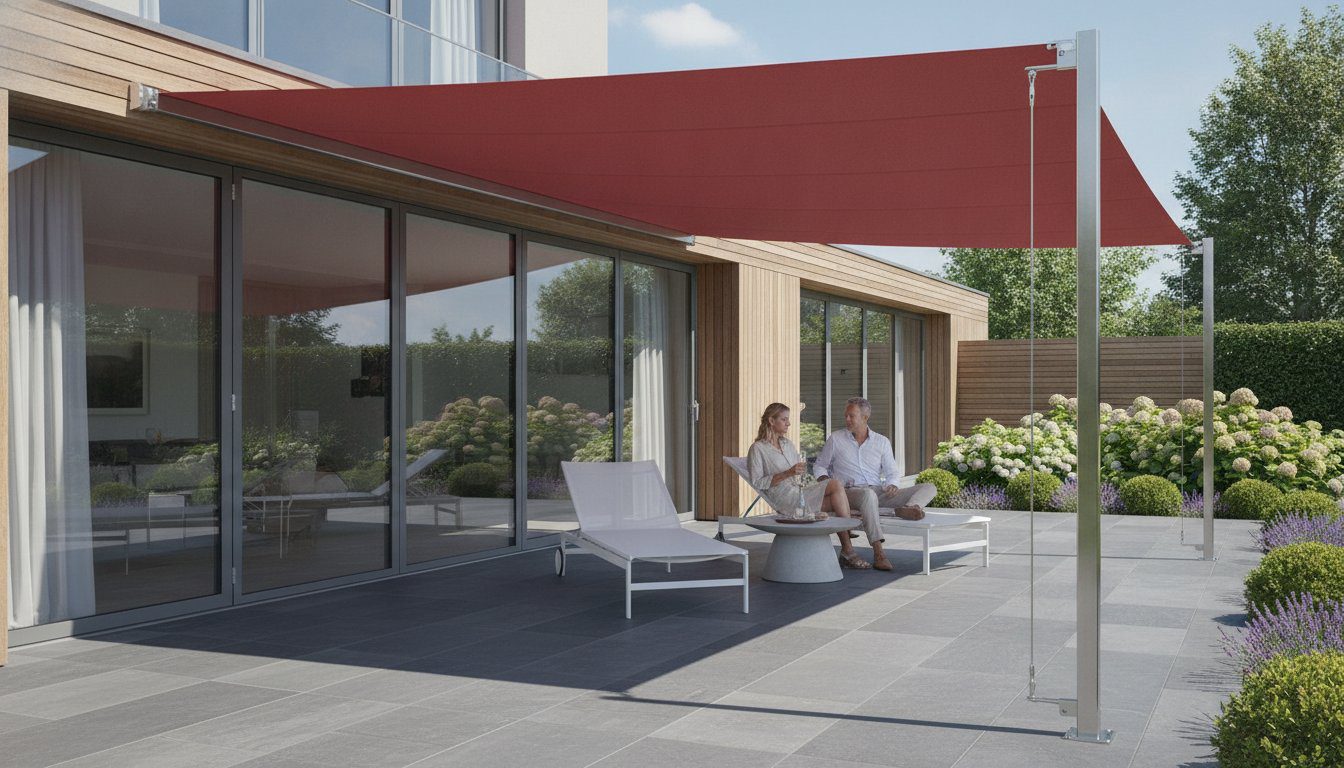
Rolling Sun Sails Installation: The 2026 Professional Planning Checklist
A rolling sun sail is far more than just a piece of fabric; it’s a sophisticated piece of engineering that must withstand the specific pressures of the British climate. You’ve likely spent hours imagining how a bespoke sail will transform your terrace into a versatile sanctuary, yet the technical reality of a rolling sun sails installation often brings up more questions than answers. It’s understandable to worry about structural integrity during a coastal gale or feel confused by the choice between manual and motorised mechanics.
We’re here to turn that uncertainty into confidence. This guide offers a comprehensive 2026 professional planning checklist designed to ensure your shade is installed with precision, safety, and long-term durability. We’ll explore everything from sun-path alignment and tensioning requirements to the essential engineering standards that guarantee a professional-grade finish. By the end, you’ll have a clear roadmap to creating a perfectly tensioned, high-end outdoor environment that stands the test of time.
Key Takeaways
- Master the art of sun-path analysis to ensure your bespoke shade aligns perfectly with your terrace’s unique layout and usage.
- Identify the specific engineering standards required for a safe rolling sun sails installation, focusing on structural fixing points and high-tension hardware.
- Evaluate the practical differences between motorised and manual mechanisms to select the system that best suits your lifestyle and property scale.
- Follow a professional-grade commissioning process that includes rigorous deployment tests and the integration of smart wind-sensing technology.
- Learn how to protect your investment against the British weather by understanding the essential maintenance and safety protocols for 2026.
Pre-Installation Planning: Evaluating Your Outdoor Space
Before the first bolt is tightened or a single post is set, a successful rolling sun sails installation begins with a deep dive into the environment. Every garden or commercial terrace has its own unique micro-climate and architectural quirks. We don’t just look at where the fabric looks best; we analyse how the structure interacts with the shifting elements. It starts by defining the primary purpose of your new shade. Are you looking to protect a delicate seating area from the midday glare, or do you need a robust solution for a hot tub that requires privacy as much as UV protection? Defining this early ensures the engineering matches your lifestyle needs.
A bespoke approach also requires a keen eye for the prevailing wind direction. In the UK, wind loads are a critical factor in structural safety. By planning for aerodynamic sail positioning, we can ensure the system works with the wind rather than against it. This “engineering-first” mindset is what separates a professional installation from a generic DIY attempt. To understand the foundational concepts of these structures, it helps to look at What is a Shade Sail? and how they have evolved into the complex, retractable systems we use today.
Sun Path Analysis and Dynamic Shading
The sun doesn’t sit still, and neither should your shade strategy. We recommend using a sun-path app or commissioning a professional survey to map exactly how shadows fall across your space at different times of the year. This data allows us to position the sail for maximum efficiency. One of the greatest benefits of a rolling system is its versatility; you can adjust the deployment as the sun moves across the sky. If you want to use the space during a typical British summer drizzle, you might consider waterproof sail shades to ensure your plans aren’t dampened by the weather. Mapping the sun’s trajectory ensures that when you’re ready to relax, the shade is exactly where you need it to be.
Spatial Clearance for Furling Mechanisms
Precision is everything when it comes to the mechanics of a rolling sail. You must account for “dead zones” where the furling pole or the rolling mechanism will sit. These components require clear space to operate without hitting gutters, tree branches, or architectural features. We carefully evaluate the mounting height to maintain comfortable headroom whilst the sail is fully deployed. It’s equally important to plan for the “stacking” area. This is the space where the fabric gathers when the sail is retracted. Without proper clearance, you risk fabric abrasion or mechanical strain, which can compromise the long-term durability of your investment. We take the time to ensure every millimetre is accounted for before fabrication begins.
Structural Requirements: Identifying Secure Fixing Points
A successful rolling sun sails installation relies entirely on the strength of your anchor points. Unlike a standard parasol or a lightweight gazebo, a rolling sail operates under high tension to maintain its sleek, architectural profile. This tension is transferred directly into the host building or support posts. We must evaluate whether your property’s masonry, be it traditional brick, flint stone, or a modern timber frame, is capable of withstanding these lateral forces without compromise. It isn’t just about the fabric; it’s about the engineering behind the scenes. Whilst UK regulations vary, reviewing international awning building code requirements provides a useful baseline for understanding the structural loads and safety factors these systems must support.
We often encounter modern UK homes built with thermalite or lightweight blocks. These materials require a specialised approach to ensure the fixing doesn’t pull through the substrate. If you’re unsure about the load-bearing capacity of your property, our team can help you assess your structural requirements before fabrication begins. By distributing the load across multiple brick courses using heavy-duty wall plates, we protect the aesthetic and structural integrity of your home whilst providing a rock-solid foundation for your shade.
Masonry and Wall Plate Specification
Standard expansion bolts are rarely sufficient for high-tension sails in older UK masonry. They create internal pressure that can lead to “spalling” or cracking of the brickwork. Instead, we utilise chemical anchors. These involve injecting a high-strength resin into a pre-drilled hole, which then bonds the threaded stud to the masonry without creating stress. To further protect your property, we specify bespoke wall plates that are significantly larger than standard brackets. These plates must be placed at least five brick courses from the top of a wall or gable end. This positioning ensures there is enough weight and structural mass above the fixing to prevent the top courses from lifting or shifting under wind load.
High-Tension Supporting Posts
Where a building wall is unsuitable or the design requires a freestanding element, independent supporting posts are essential. For properties in coastal areas, we specify anodised aluminium or 316-grade stainless steel to prevent corrosion from salt air. The depth of the concrete footing is just as vital as the post itself. This calculation depends on your soil type; sandy soil requires a wider, deeper base than heavy clay to resist the “lever” effect of the sail in a gust. You can find more detailed technical specifications in our guide to architectural sail shades UK. Every post is an engineered component designed to keep your outdoor space safe and perfectly tensioned for years to come.
System Selection: Motorised vs Manual Rolling Mechanisms
Once the structural foundations are established, the next decision involves how you want to interact with your shade. Choosing the right mechanism is a pivotal step in your rolling sun sails installation, as it dictates both the ease of use and the level of protection your property receives during unpredictable weather. For large-scale domestic projects or commercial terraces, the sheer weight of high-tension fabric makes motorisation an attractive, and often necessary, choice. Smaller spaces might benefit from the simplicity of a manual furling system, which offers a tactile, “set-and-forget” approach for seasonal use. If you’re still exploring the full range of options available, our overview of modern patio shading solutions covers the latest architectural trends and adaptive technologies transforming British outdoor spaces.
The Advantages of Smart Motorisation
The primary benefit of choosing motorised rolling sun sails is the seamless integration of safety and luxury. We often recommend systems utilising RTS (Radio Technology Somfy) or similar smart controls, allowing you to deploy your sail via a remote, smartphone app, or even voice command. The real value lies in autonomous protection. By integrating wind and sun sensors, your sail can retract automatically when gusts exceed safety limits or deploy when the sun reaches a certain intensity. Modern motors also feature “soft-start” and “soft-stop” technology. These gentle movements reduce the initial jerk on the fabric and hardware, significantly preserving the life of your bespoke sail and ensuring the mechanism remains quiet and smooth for years.
Manual Furling for Simpler Spaces
For those seeking a budget-conscious or lower-maintenance alternative, manual systems remain a popular choice for garden shading. These typically utilise an endless rope loop or a detachable crank handle to furl the fabric around a central pole. Whilst they lack the “hands-off” convenience of electric versions, they are incredibly reliable and require no electrical wiring. If you’re considering a more straightforward setup, retractable shade sails UK offer a versatile manual alternative that works beautifully for smaller patios or hot tub areas. These systems are perfect for homeowners who prefer a direct, mechanical connection to their outdoor equipment.
Comparing maintenance requirements is essential for long-term satisfaction. Electric motors are generally sealed units that require little attention, though they do rely on a stable power supply and occasional sensor calibration. Manual winch systems are simpler but may require periodic lubrication of the moving parts to prevent salt-air seizing, especially in coastal regions. Perhaps most importantly, consider emergency retraction. If a sudden UK squall hits, a motorised sensor will react in seconds even if you aren’t home. With a manual system, you’ll need to be present to secure the sail, making the choice as much about your lifestyle as it is about the mechanics.
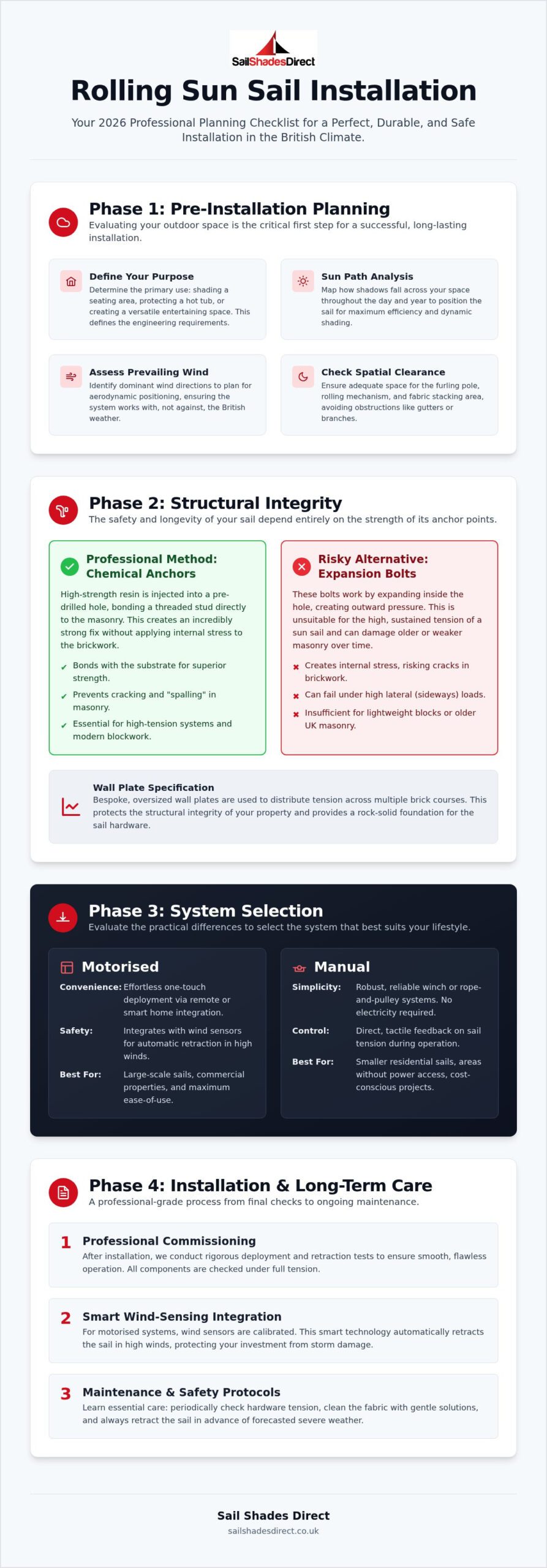
The Professional Installation Checklist
Installation day is the moment your vision becomes a structural reality. To ensure a flawless rolling sun sails installation, we follow a rigorous sequence that prioritises precision over speed. It begins by verifying every bespoke measurement against the original site plan before a single hole is drilled. Even a minor discrepancy in the distance between fixing points can compromise the tension of the final sail. Once the wall plates and posts are in position, we allow for the necessary curing time of the chemical anchors, ensuring the foundation is rock-solid before any load is applied.
Assemble the rolling mechanism with care, paying particular attention to the furling pole’s orientation. This is a complex assembly that requires a steady hand and a keen eye for detail. If you want to ensure your project meets these high standards, you can book a professional installation consultation with our expert team today. We take the stress out of the technical setup so you can focus on enjoying your new outdoor environment.
Precision Levelling and Alignment
A perfectly level furling pole is non-negotiable. If the pole is even slightly off-kilter, you’ll experience “telescoping” of the fabric, where the sail bunches at one end during retraction. This leads to permanent creases and mechanical strain on the motor. We also check for “squareness” between the furling unit and the outer tensioning points. If the sail isn’t pulled back at a perfect 90-degree angle, it will never sit flat. For motorised systems, ensure the electrical cable is installed with a drip loop. This simple curve in the wire prevents rainwater from tracking along the cable and entering the motor housing or the wall cavity.
Tensioning and Fabric Calibration
The hallmark of a professional installation is a drum-tight finish. This high level of tension is essential for effective water run-off and to prevent the fabric from whipping in the wind. We adjust each corner tensioner individually to distribute force evenly across the entire sail surface. To verify the tension, use the thumb-press method: when you press firmly into the centre of the fabric, it should feel rigid and offer immediate resistance with only a few millimetres of give. Finally, we calibrate the motor limits or manual stops to ensure the sail cannot be over-extended, protecting the seams and the rolling mechanism from unnecessary stress.
Post-Installation: Commissioning and Long-Term Care
The final phase of a successful rolling sun sails installation is the commissioning process. This is where we bridge the gap between structural assembly and daily operation. We begin with a series of full deployment tests to ensure the fabric moves with absolute fluidness and the motor operates with a quiet, reassuring hum. It’s during these initial runs that we identify any minor friction points or alignment issues that could cause premature wear. This stage is about more than just checking if it works; it’s about ensuring the system feels refined and effortless to use.
Once you’re satisfied with the mechanical movement, it’s time to think about how this new structure fits into your lifestyle. A well-placed rolling sail shouldn’t exist in isolation. Instead, it should be integrated into your bespoke sail shades UK overall garden plan, complementing your existing landscaping and outdoor furniture. By treating the sail as a core architectural element, you create a cohesive environment that feels like a natural extension of your home’s interior.
Sensor Calibration and Safety Testing
Safety is our priority, especially given the volatility of British weather. We set up automated wind sensors that act as a digital guardian for your investment. To test these, we manually trigger the retraction mechanism to simulate a high-wind event, ensuring the sail responds instantly. We also verify the “home” position settings. This ensures the sail closes tightly and securely against the cassette or furling pole, preventing fabric flapping whilst retracted. In the event of a power cut, we’ll walk you through the manual override procedure, ensuring you’re never left with a deployed sail during a storm.
Seasonal Fabric and Hardware Maintenance
High-grade technical fabrics require specific care to maintain their UV-reflective properties and aesthetic appeal. We recommend using only pH-neutral cleaning agents and soft brushes to remove organic debris; harsh chemicals can strip away protective coatings. After the first month of use, it’s vital to check all shackles and turnbuckles. The initial “settling” of the structure can sometimes lead to slight tension loss, which is easily corrected with a quick adjustment. For long-term reliability, plan for a professional service every 2 to 3 years. This allows a technician to lubricate internal motor components and inspect the structural integrity of all fixing points, giving you total peace of mind for the seasons ahead.
Transform Your Terrace with Engineered Precision
Achieving a flawless finish for your outdoor space requires more than just high-quality fabric. It demands an engineering-first mindset that prioritises structural integrity and precise alignment from the very start. By following this 2026 planning checklist, you’ve gained the insights needed to navigate the complexities of sun-path analysis, secure masonry fixings, and the technical nuances of smart motorisation. A successful rolling sun sails installation is the result of meticulous preparation and a commitment to professional standards.
Our expert UK-wide fitting team is ready to bring this level of bespoke engineering to your specific project. We utilise durable, high-performance fabrics and marine-grade hardware to ensure your new shade stands strong against the British elements for years to come. Whether you’re looking to optimise a private patio or a large commercial terrace, we have the versatile “can-do” attitude to handle even the most complex architectural requirements. Don’t leave your comfort to chance. Let’s create a space that offers a true reprieve from the pressures of daily life.
Ready to take the next step? Book your professional site survey for rolling sun sails today and let our specialists turn your vision into a perfectly tensioned reality.
Frequently Asked Questions
Can I install a rolling sun sail on a timber-framed house?
Yes, it’s entirely possible with the right engineering approach. We use specialised spreader plates to distribute the high tension across multiple timber studs rather than relying on a single fixing point. This ensures the structural integrity of your home remains intact whilst providing a secure foundation for the sail. It’s a bespoke process that accounts for the specific load-bearing capacity of your timber frame to ensure long-term safety.
How much wind can a professional rolling sun sail installation withstand?
A professional rolling sun sails installation is designed to be deployed in winds up to approximately 30mph, which is a strong breeze on the Beaufort Scale. Beyond this, the system is engineered to retract for safety. Automated wind sensors are essential here; they protect the fabric and hardware from the extreme loads generated by sudden UK gales, ensuring your investment stays safe even when you aren’t home.
Do I need planning permission for a rolling sun sail in the UK?
Most residential installations fall under “Permitted Development” and don’t require formal planning permission in the UK. However, if you live in a listed building or a conservation area, you should always consult your local planning office before starting. Commercial terraces almost always require a permit due to the scale and public nature of the structure, so it’s best to check local regulations early in the planning stage.
What is the difference between a rolling sail and a standard awning?
The primary difference lies in the tension and the architectural profile. A standard awning relies on folding arms to support the fabric, whereas a rolling sail is a high-tension system held between fixed points and a central furling pole. This allows for much larger, bespoke shapes that offer a modern look. Sails also handle wind loads differently, often providing a more stable and versatile shading solution for large patios.
Can the rolling mechanism be integrated with my smart home system?
Yes, most motorised systems utilise Radio Technology Somfy (RTS) which connects seamlessly with popular smart home hubs. This allows you to organise your shading via smartphone apps, voice commands, or automated schedules. You can set the system so your sail deploys automatically as the sun reaches its peak during the afternoon, ensuring your terrace is perfectly cool and shaded before you even step outside to enjoy it.
How long does a professional installation typically take?
A standard rolling sun sails installation usually takes between one and two days on-site. We first install the primary wall plates and posts, which require a curing period for the chemical anchors to reach full strength. Once these foundations are set, the assembly of the rolling mechanism and final fabric tensioning is completed. This phased approach ensures the structure is perfectly level and capable of handling the high tension required.
Is it possible to automate the sail to close when it rains?
Yes, we can integrate rain sensors that trigger the motor when moisture is detected on the fabric. This is particularly useful if you’ve chosen a waterproof material and want to protect your outdoor furniture from a sudden drizzle. Whilst rain sensors add convenience, wind sensors remain the most critical safety feature to prevent structural strain during the heavy, gusty downpours that are common across the UK climate.
What happens if the power fails whilst my motorised sail is deployed?
Every motorised system we install includes a manual override facility as a standard safety measure for your peace of mind. You’ll be provided with a detachable crank handle that allows you to furl the sail manually if the electricity goes out. This ensures that even during a power cut, you can quickly secure your property and protect the fabric before the weather turns or a sudden summer storm arrives.