
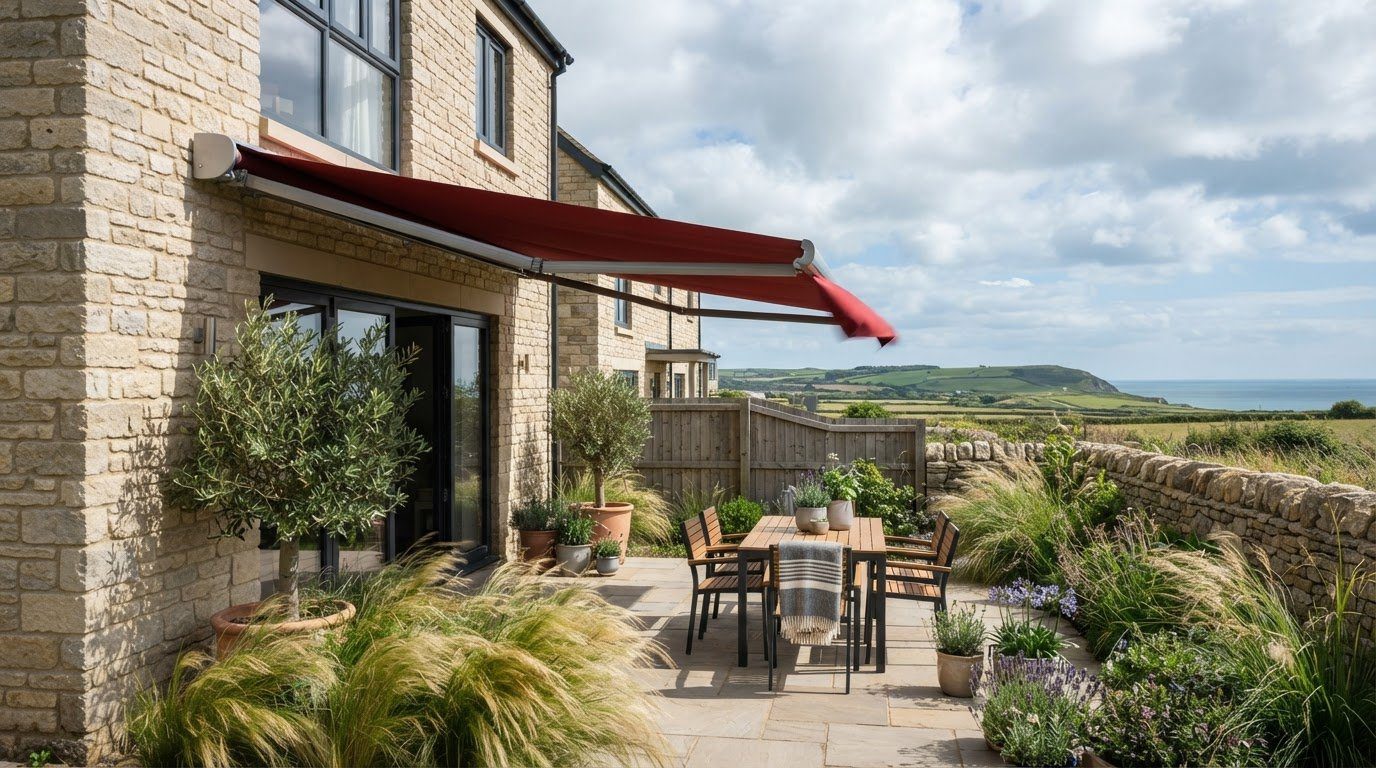
Wind rating for patio awnings: assess your exposure and setup
A higher wind rating alone won’t make an awning safe in every setting. For a domestic garden awning, the recommended minimum is Class 2, with a higher class for an exposed garden. Whether an existing setup can be improved depends on the awning, its fixings and the conditions around it.
It’s understandable to focus on the class printed on a product, but wind resistance also depends on how securely the awning is installed and how sheltered the site is. Retract it as strong winds approach, even if it has a stated rating.
This guide explains what EN 13561 classes mean, how installation and fixings affect performance, and why coastal, hillside and open sites need extra thought. You’ll also learn what to consider when assessing an existing awning or pergola, so you can make a more informed decision about wind protection for your outdoor space.
Key Takeaways
- Use the Beaufort scale as a practical guide to changing wind, and retract an awning before gusts become a risk.
- Compare EN 13561 classes carefully: a higher class indicates greater tested wind resistance, but doesn’t make an awning suitable for every site.
- Assess the wall or supporting structure, fixings and awning projection together, as installation quality affects how wind loads are carried.
- For exposed or coastal settings, weigh up the site conditions and whether a different shading arrangement would better suit your space.
Can I upgrade my awning or pergola with wind protection?
Possibly, but wind protection involves more than fitting stronger brackets. The Beaufort scale, awning class, fixings and site exposure can all help identify where an existing setup may be vulnerable.
Beaufort Scale and Wind Speeds
The Beaufort scale describes wind strength through both speed and its visible effects. It helps you judge conditions on the ground, rather than relying only on a forecast’s average wind speed.
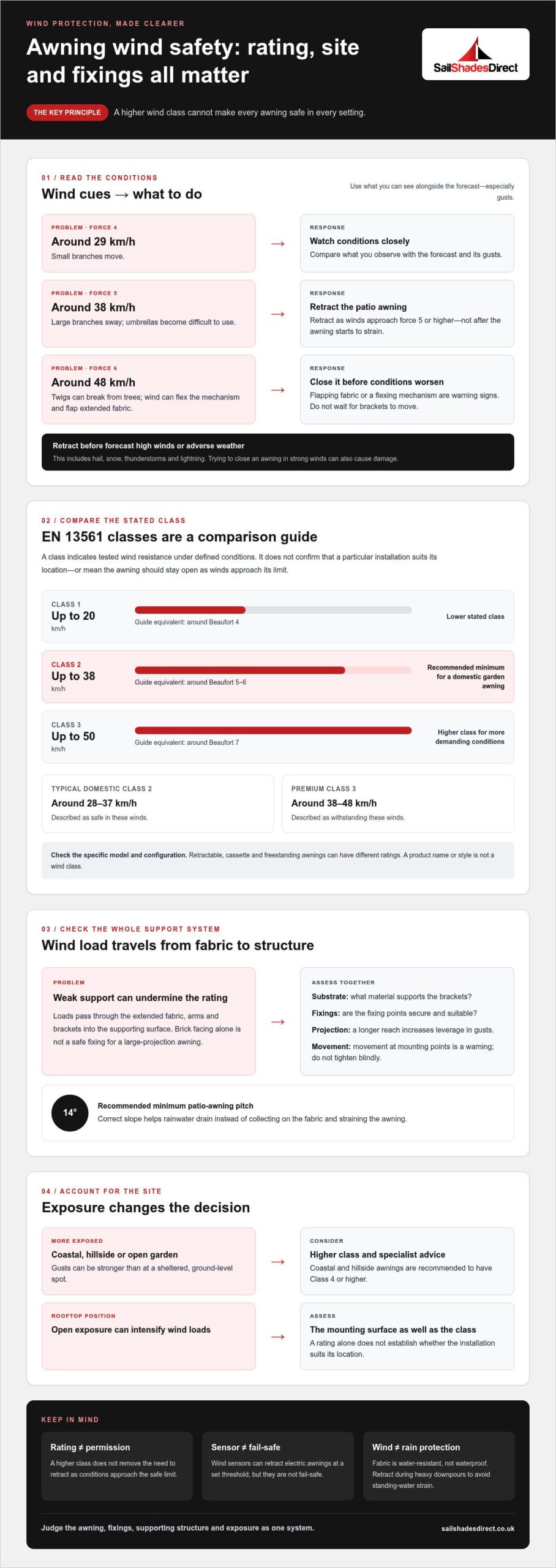
At Beaufort force 4, wind is around 29 km/h and small branches move. At force 5, around 38 km/h, large branches sway and umbrellas become difficult to use. Force 6 is around 48 km/h, when twigs can break from trees. Compare what you observe with the forecast, especially gusts.
Wind Effects on Awnings
Wind pressure can make extended awning fabric flap and the mechanism flex. Treat these as warning signs: retract the awning rather than waiting for the breeze to strengthen or the brackets to move.
Retract a patio awning as winds approach Beaufort force 5 or higher, around 38 km/h. Retract it before forecast high winds or adverse weather, including hail, snow, thunderstorms or lightning; trying to close it in strong winds can also cause damage. Wind sensors can retract electric awnings at a set threshold, but they aren’t fail-safe.
Wind speed gives useful context: loose objects may move noticeably at 20-28 km/h, umbrellas can become difficult to use at 40-50 km/h, and large fabric systems face structural stress around 60 km/h or higher.
Wind Speeds for Awning Classes
Awning classes indicate the wind speeds a rated awning is designed to withstand under its test conditions. They provide a basis for comparison, not permission to leave an awning open in any breeze.
The guide’s class equivalents are Class 1 up to 20 km/h, around Beaufort 4; Class 2 up to 38 km/h, around Beaufort 5-6; and Class 3 up to 50 km/h, around Beaufort 7. A domestic garden awning is recommended to have at least a Class 2 rating, with a higher class for exposed gardens.
Consider the rating alongside the awning’s position, size and installation. A higher class doesn’t remove the need to retract it as conditions approach its safe limit. An exposed site can experience stronger gusts than a sheltered, ground-level spot.
UK awning wind-resistance classes under EN 13561
EN 13561 provides tested wind-resistance classes for higher-specification awnings. A wind rating for patio awnings helps compare products, but it doesn’t establish whether every installation suits its location.
Retractable, cassette and freestanding awnings may have different ratings because their designs, dimensions and supports differ. Check the stated class for the specific model and configuration. Style alone doesn’t determine wind resistance, so individual product details are more useful than assumptions about a whole category.
Wind-resistance classes provide a way to compare how awnings perform in testing. Most domestic awnings sold in the UK are in classes 1 to 3. Typical domestic Class 2 awnings are described as safe in winds around 28-37 km/h; premium Class 3 awnings are described as withstanding 38-48 km/h.
Testing applies a defined load to the lead rail with the awning fully extended. The test uses the largest size in the product range to assess performance under consistent conditions. Use the result to compare models, but remember that product testing doesn’t assess your property’s wall or installation.
Which UK brands publish ratings? Higher-specification awnings may have a tested, certified EN 13561 rating, but the class applies to a product or range, not automatically to every model from its manufacturer. Check the model’s stated class when comparing options.
Names such as VertiTex II aren’t wind-resistance classes. A wind rating for patio awnings should be stated as an explicit class for the relevant model. Don’t infer it from a product name or cassette design.
Wind resistance is different from rain protection. Treated awning fabric is water-resistant, not waterproof, and prolonged heavy rain can soak through. Retract the awning during heavy downpours, as standing water can strain the fabric and arms.
Fixings, substrate and installation quality
A secure awning depends on the connection between its brackets and the supporting structure. A wind rating on paper can’t make up for weak fixing points or unsuitable installation.
Fixings and Substrate
The substrate is the material supporting the brackets, such as masonry or another structural surface. It matters because wind loads pass from the extended awning through its arms and brackets into that support.
Fixing a large-projection awning into brick facing alone is unsafe. The visible outer layer may not provide the necessary support, so the wall construction and bracket positions must be considered together. If an existing awning moves at its mounting points, treat that as a warning and don’t tighten the fixings blindly.
Projection affects the forces involved: a longer reach increases leverage during gusts. An awning that projects further from a wall places greater demands on its support than one with a smaller projection. The right fixing arrangement depends on the substrate, bracket layout and awning dimensions.
Installation Quality and Awning Pitch
Installation quality means aligning and securing the awning to suit its structure and position. Correct pitch matters too: a minimum slope of 14° is recommended for patio awnings, helping rainwater drain away rather than collect on the fabric.
Coastal and rooftop positions need particular attention because open exposure can intensify wind loads. Awnings at coastal or hillside properties are recommended to have Class 4 or higher, alongside specialist advice. Rooftop installations also need their mounting surface assessed, rather than relying on the awning’s class alone.
Before changing an existing setup, assess the brackets, supporting surface, projection and pitch as one system. A wind sensor may automatically retract an electric awning at its set threshold, but it can’t strengthen weak fixings or correct poor installation. Retract the awning before forecast high winds rather than waiting for the weather to put the structure under strain.
Site exposure and coastal or hillside conditions
Shelter, nearby buildings and the site’s position affect how wind reaches an awning. Assess the patio itself instead of relying on a product rating alone.
Assessing Site Exposure
Site exposure describes how freely wind reaches an outdoor space and affects its shading structure. A sheltered patio beside buildings faces different conditions from an open terrace with little protection.
Consider nearby walls, open fields, roof edges and the direction of gusts. An exposed garden or elevated position may experience stronger gusts than a sheltered, ground-level space. A wind rating for patio awnings is most useful when weighed against conditions at the exact location, not treated as a guarantee for every setting.
Choosing a System for Patio Exposure
Choose a system by matching its design and wind performance to the patio’s exposure. Retractable awnings suit light winds, but should be retracted as stronger gusts approach.
For consistently windy conditions, retractable fabric pergolas have higher wind-speed ratings than awnings and may be a better fit. For an open terrace, a pergola or louvre roof is recommended over a retractable awning. Consider how you use the outdoor area and how changing weather affects it before selecting a system.
Coastal and Hillside Conditions
Coastal and hillside sites can be especially exposed, so their awnings need careful matching to local conditions. Class 4 or higher is recommended for these properties, alongside specialist advice.
A high class alone doesn’t account for installation, projection or shelter around the structure. At a hillside home, gusts may reach an awning with little obstruction; a coastal patio may also be exposed. Assess these factors together when deciding whether an awning suits the site.
Wind Exposure and Gusts
Gusts are brief increases in wind speed that can place sudden loads on an extended awning. Check gust forecasts as well as average wind speeds, since gusts can be higher and cause damage.
Sensors can automatically retract electric awnings when wind exceeds a set threshold, but they aren’t fail-safe. Retract the awning before high winds are expected, rather than relying on sensors alone. The wind rating for patio awnings is one part of assessing a suitable setup. Explore shading options for exposed patios to consider what could suit your outdoor space.
Sail Shades Direct: Bespoke Sail Shades
Sail Shades Direct can help you choose a shading setup suited to your outdoor space and its exposure. If your existing awning seems unsuitable for the site, or you’re planning a new installation, discuss the layout, fixing points and how you use the area before choosing a solution.
Options include Bespoke Sail Shades, Rolling Sun Sails, Arm Awnings and Giant Umbrellas. Each suits a different space and purpose, so the right choice depends on the site and the protection you need. Changing products alone doesn’t establish a particular wind-resistance class; consider any rating alongside the installation and local conditions.
Contact Sail Shades Direct to discuss a shading solution tailored to your setting.
Make your next decision site-specific
Before changing your setup, build a clear picture of how the space behaves. Note which directions expose the awning to wind, where the brackets meet the structure and how you use the area when the weather changes. These details help turn a general concern into a practical discussion about a suitable design for your home.
A wind rating for patio awnings is most useful when considered alongside conditions at your property and the way the system is installed. Whether you’re assessing an existing arrangement or planning a new one, a tailored discussion can help you explore suitable shading options while keeping the site in mind.
Contact Sail Shades Direct to discuss your outdoor space and take the next step with confidence.
Frequently Asked Questions
What is a Wind Rating?
A wind rating indicates the wind load an awning is designed to withstand under defined test conditions. It helps you compare products, but doesn’t guarantee an awning is safe in every location. For example, a rating doesn’t account for weak supporting masonry or a particularly exposed position. Consider the product rating alongside its fixing points and how you’ll operate it as the weather changes.
What wind ratings are available for patio awnings in the UK?
UK awnings may carry EN 13561 wind-resistance classes from Class 1 to Class 5, although most domestic awnings are in classes 1 to 3. The class and stated wind speed can vary by product. For a domestic garden, the guide recommends at least Class 2, with a higher class for exposed settings. Check the specific model’s rating rather than assuming all awnings in one category match.
What wind speed in mph can a patio awning withstand?
The listed EN 13561 equivalents are around 17 mph for Class 1, 24 mph for Class 2 and 30 mph for Class 3. These figures describe the rated awning class, not a recommended operating speed for every property. A gust, long projection or vulnerable installation can change the practical risk. Retract the awning before strong winds arrive, even if its class appears suitable.
What do European wind resistance classes for awnings mean?
European classes rank an awning’s tested resistance to wind, with higher classes indicating greater resistance under the test conditions. EN 13561 includes five classes, from Class 1 through Class 5. The label helps compare products, but doesn’t rate the wall, fixings or exposure at your home. Treat the class as one part of choosing a setup, not as permission to leave it extended in worsening weather.
How is an awning’s wind rating tested and certified?
EN 13561 testing applies a defined load to the leadrail while the awning is fully extended. The test uses the largest size in the product range, giving a consistent basis for assessing the model’s wind resistance. Look for the standard and class attached to the particular product. A test result doesn’t assess the condition of your property’s wall or whether its installation suits your site.
Are there UK building regulations or standards for patio awning wind ratings?
EN 13561 is the relevant product standard for tested awning wind-resistance classes. Its rating describes the awning’s performance in the test, rather than certifying the supporting wall, fixings or complete installation. That distinction matters: an awning with a stated class still needs a suitable substrate and correct installation. For a particular building project, consider the structure and installation requirements separately from the product’s wind class.