
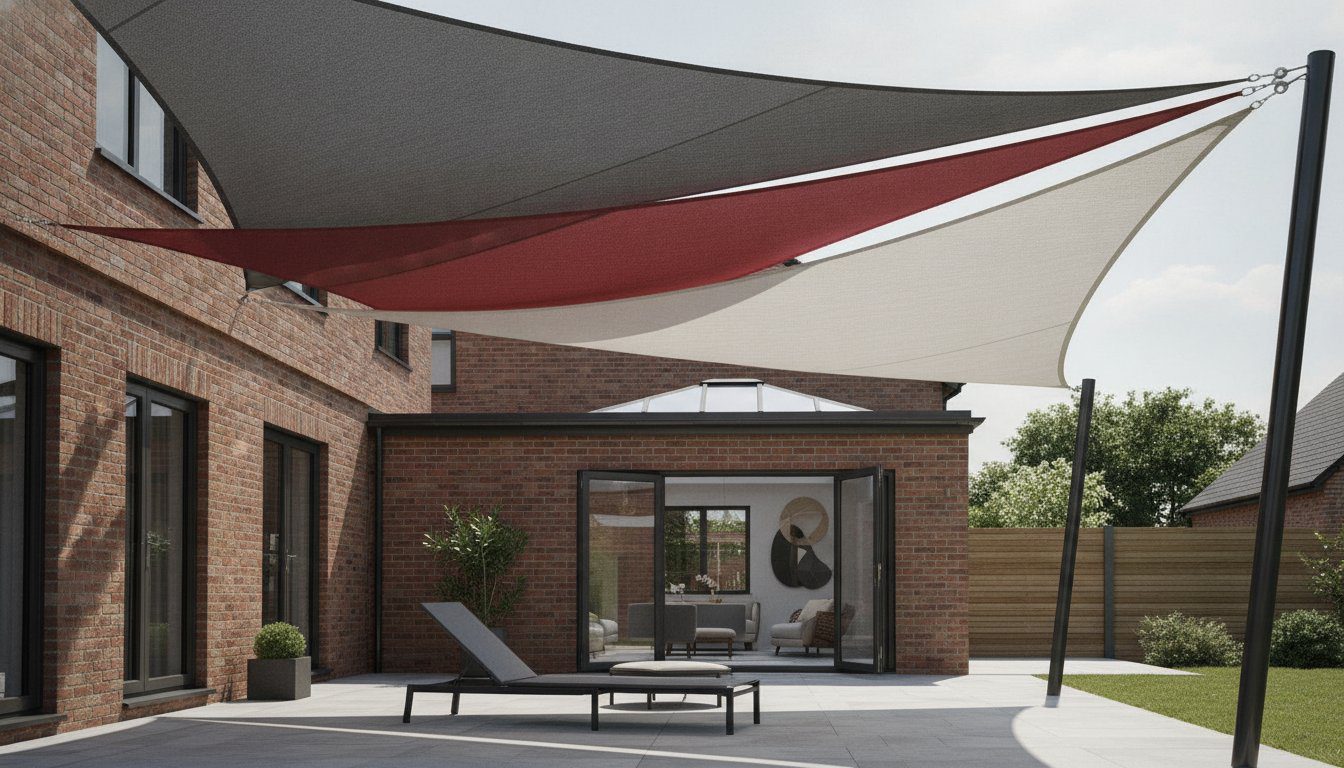
How to Choose and Maintain Durable Outdoor Sun Sails in 2026
Why is it that most budget shade solutions seem to lose their shape and vibrancy before the first British summer even hits its stride? It’s incredibly frustrating to invest time and effort into your outdoor space only to watch your fabric sag or see its colour fade under the glare of the July sun. We understand that you want a premium, permanent retreat that offers complete UV protection for your family without the constant worry of high winds or heavy downpours. Finding truly durable outdoor sun sails in 2026 requires looking beyond the retail shelf and understanding the engineering behind high-density fabrics and marine-grade hardware.
In this guide, we’ll share the professional secrets to selecting and installing high-tension sails that are built to withstand the unique British elements for years. You’ll discover how to finally distinguish between waterproof and water-resistant materials, learn the installation tricks that prevent sagging, and find out how to keep your bespoke shade looking pristine with minimal effort! From advanced fabric technologies to the precision of professional tensioning, we’re here to help you create a maintenance-free sanctuary that lasts.
Key Takeaways
- Understand how fabric weight, measured in grams per square metre, and UV resistance determine the long-term lifespan of your shade.
- Learn when to choose breathable HDPE for high-tension areas or waterproof PVC options to handle the unpredictable British rain.
- Discover why bespoke engineering and 3D ‘Hypar’ curves are essential for creating durable outdoor sun sails that resist sagging and wind damage.
- Identify why Grade 316 stainless steel hardware is the non-negotiable standard for coastal and high-exposure UK gardens.
- Master simple seasonal cleaning and inspection routines to extend your sun sail’s service life and maintain its premium appearance.
What Defines a Truly Durable Outdoor Sun Sail?
When we talk about durability in the context of the British climate, we aren’t just discussing whether a fabric survives a single summer. True durability is the ability of a structure to maintain its physical tension and vibrant colour whilst aggressively resisting UV degradation and the inevitable threat of mould. A durable outdoor sun sails installation must act as a high-performance shield, staying taut and beautiful despite the relentless cycle of damp mornings and scorching afternoons. It’s a balance of chemistry and physics that separates professional-grade solutions from the flimsy alternatives found in local garden centres.
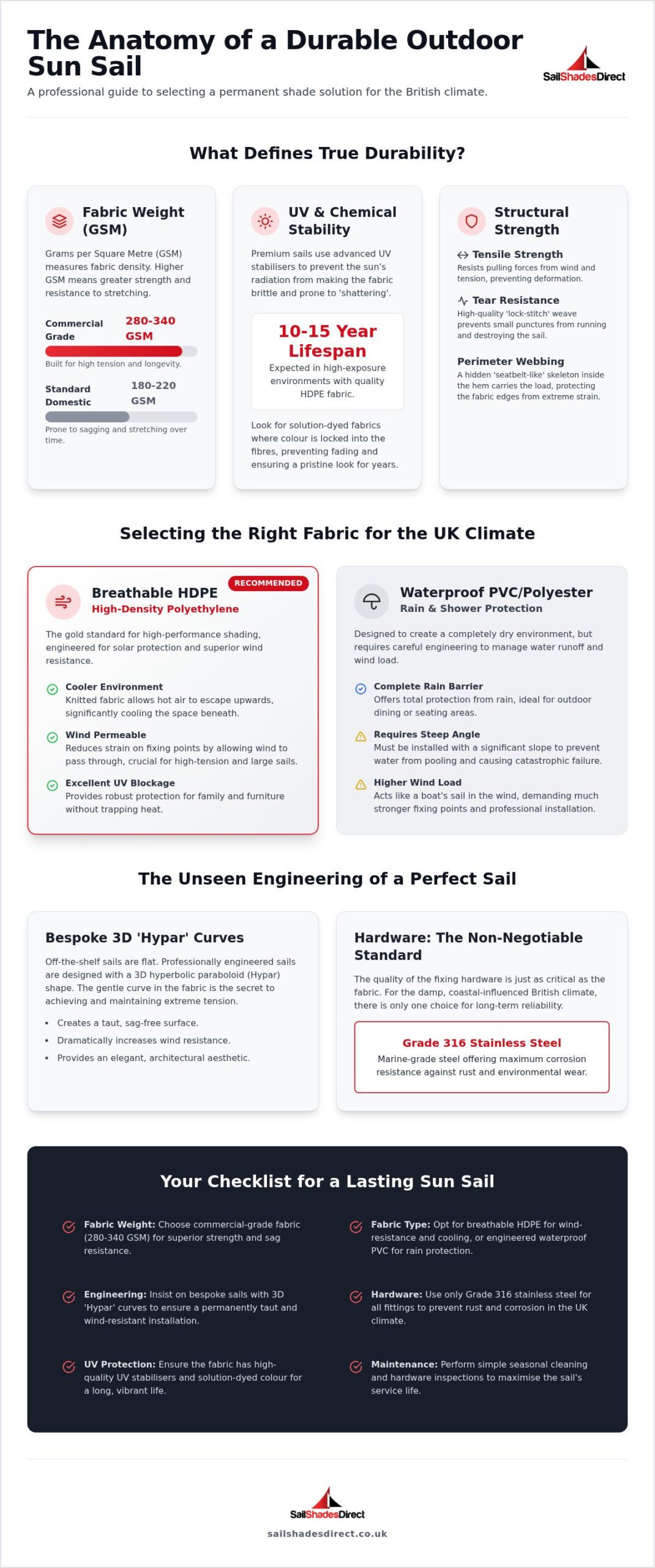
The first metric you should look for is the GSM, or Grams per Square Metre. This value determines the density and weight of the fabric. Whilst a standard domestic sail might hover around 180 to 220 GSM, commercial-grade materials typically sit between 280 and 340 GSM. This extra weight isn’t just for show; it provides the structural “meat” required to hold thousands of kilograms of tension without the fibres stretching out of shape. Without this density, your sail will eventually resemble a wet blanket rather than a crisp architectural feature.
Chemical stability is equally vital. High-quality fabrics incorporate UV stabilisers, such as German-engineered BASF anti-aging agents, to protect the polymer chains from breaking down. Without these additives, the sun’s radiation makes the fabric brittle, leading to “shattering” where the material literally turns to dust under pressure. As explored in the history of the Shade sail, the evolution of these materials has moved from basic canvas to highly sophisticated HDPE (High-Density Polyethylene) designed to last 10 to 15 years in high-exposure environments.
Tensile Strength vs. Tear Resistance
Tensile strength and tear resistance are often confused, yet they perform very different roles. Tear resistance is about the weave pattern; a high-quality lock-stitch ensures that if a stray branch causes a small puncture, the hole won’t “run” or unzip across the entire surface. Tensile strength is the structural side of the coin. In high-wind UK environments, tensile strength is the measure of how much pulling force the fabric can withstand before the fibres physically snap or permanently deform under the weight of a gale. To support this, durable outdoor sun sails feature hidden perimeter webbing, a heavy-duty seatbelt-like skeleton that carries the load instead of the fabric edges taking the strain.
UV Stability: Protecting the Colour and the Core
The British sun might feel elusive, but UV rays are constantly at work breaking down the molecular bonds of your shade. Selecting fabric sun shades for patios that won’t fade amongst the elements requires checking the colour-fastness rating. Premium materials are solution-dyed, meaning the pigment is locked into the fibre during the liquid stage of production rather than being printed on top. This ensures that the deep charcoal or vibrant blue you fell in love with stays that way for years, rather than turning into a dusty grey after one season.
Selecting the Right Fabric Grade for Longevity
Choosing the right fabric isn’t just about picking a favourite colour; it’s about deciding how your shade will interact with the unpredictable UK climate. Whilst many off-the-shelf options use lightweight polyester, investing in “Commercial Grade” materials is the most reliable way to ensure you have truly durable outdoor sun sails. These higher-grade fabrics, typically ranging from 280 to 340 GSM, are designed to remain under high tension for years without losing their structural integrity or becoming a victim of “fabric creep,” where the material permanently stretches and sags.
The primary choice for most homeowners and businesses comes down to two distinct categories: breathable High-Density Polyethylene (HDPE) and waterproof PVC or Polyester. Each serves a specific purpose. Breathable fabrics are engineered for solar protection and wind resistance, whilst waterproof options are designed to create a completely dry environment. Understanding the trade-off between airflow and rain protection is the first step in designing a space that feels comfortable rather than claustrophobic.
Breathable HDPE: The Wind-Resistant Choice
HDPE is the gold standard for high-performance shading. Because it’s a knitted fabric, it features thousands of tiny gaps that allow hot air to escape upwards, keeping the area beneath significantly cooler than a solid roof. This “breathability” also provides a massive mechanical advantage known as reduced wind-loading. Instead of acting like a solid sail that catches every gust, the fabric allows air to pass through, which drastically reduces the stress placed on your fixing points and posts. It’s no surprise that HDPE remains the favourite material for bespoke sail shades UK designers use to create striking, architectural shapes that stay taut in coastal winds.
Waterproof Fabrics: Managing Rainwater Run-off
If your goal is to host a garden party regardless of a British drizzle, waterproof PVC-coated polyester is the answer. However, these sails require a much more technical installation. Because the fabric is solid, water cannot pass through it; it must be directed away. We always recommend a minimum pitch of 20 to 30 degrees to prevent water from pooling in the centre. Pooling is the silent killer of sun sails; the weight of the water stretches the fibres, leading to permanent damage. For those who need robust rain protection but prefer a retractable solution, comparing these sails to heavy duty arm awnings can help you decide which system suits your lifestyle best.
If you’re unsure which fabric grade will best suit your garden’s orientation and wind exposure, we’re always happy to offer professional guidance on the best materials for your specific project.
How to Optimise Tension and Structural Integrity
A sagging sail is a failing sail. Why do professional installations look like crisp, architectural masterpieces whilst DIY attempts often look like laundry hanging on a line? The secret lies in the ‘Hypar’ (Hyperbolic Paraboloid) principle. By setting your fixing points at varying heights, you create a three-dimensional curve with high and low points. This double-curvature isn’t just for aesthetics; it creates opposing tension across the fabric surface, which prevents the sail from flapping in the wind. When durable outdoor sun sails are engineered with this 3D geometry, they become incredibly stable, shedding wind and rain far more effectively than a flat, two-dimensional sheet.
Achieving this “drum-tight” finish requires mechanical advantage. We move away from simple ropes and instead rely on heavy-duty turnbuckles and D-shackles. For most residential projects, you should aim for a tension force of approximately 50kg to 100kg per corner, depending on the overall span. This level of force ensures the fabric remains taut even as it expands slightly in the summer heat. If your tension is too low, the fabric will vibrate amongst the fittings, leading to premature wear and potential hardware failure.
The 5-Step Process for High-Tension Installation
Success starts with a methodical approach to the hang. First, establish robust fixing points; we prefer heavy-duty steel posts or reinforced wall plates over simple eye-bolts. Second, lay your sail out on a clean tarpaulin to organise your corners and hardware without dragging the fabric through the dirt. Third, make your initial attachments using D-shackles to ensure a central, balanced fit. Fourth, enter the tensioning phase, where you use turnbuckles to slowly and evenly remove every wrinkle from the fabric. Finally, perform a lock-off by tightening the nuts on your turnbuckles to prevent wind vibration from loosening the fittings over time.
Hardware Essentials for Wind Resistance
Maintaining Your Sun Sail for Maximum Service Life
Even the most durable outdoor sun sails require a small amount of attention to reach their full 10-15 year potential. Think of it like a high-end car; it’s engineered for performance, but it still needs a periodic service to keep it running smoothly. The most critical period for any new installation is the first 4 to 6 weeks. During this window, the fabric and hardware settle into their final positions. You’ll likely notice a slight softening of the tension as the fibres align under the constant load. A quick five-minute adjustment with your turnbuckles to re-tension the sail back to its “drum-tight” state is essential to prevent the micro-vibrations that eventually cause fabric abrasion.
Establish a seasonal routine to protect your investment. Every spring and autumn, take a few minutes to check your Grade 316 hardware for any signs of loosening or wear. Look closely at the points where the fabric meets the corner rings, as this is where the highest stress occurs. If you live near the coast, salt build-up can eventually stiffen the fittings, so a simple rinse with fresh water is often all that’s needed to maintain the smooth operation of your turnbuckles and shackles.
Cleaning and Mould Prevention
Forget the power-washer. Whilst it’s tempting to blast away winter grime, high-pressure water can strip the UV-resistant coatings and damage the knitted HDPE structure. Instead, use a mild soap solution and a soft-bristled brush to gently lift dirt. Focus on removing organic debris like leaves, twigs, or bird droppings as soon as they settle. If left to rot, these materials create a perfect breeding ground for mould, which can cause permanent staining even on premium fabrics. Crucially, always ensure the sail is 100% bone-dry before you ever consider folding it for long-term storage; moisture trapped in a packed sail is the fastest way to ruin the material.
When to Take Your Sail Down
You should always keep a sensible eye on the Beaufort scale. While our bespoke systems are designed for high-wind resistance, we recommend removing the fabric if gusts are forecast to exceed 50mph. Similarly, snow loading is a significant risk for any horizontal structure in the UK. Even durable outdoor sun sails aren’t designed to carry the dead weight of a heavy snowfall, which can stretch the fibres beyond their elastic limit. If you require a shading solution that stays active 365 days a year without the need for seasonal removal, you might want to explore the benefits of bespoke exterior window blinds or consider how outdoor roller blinds for patio UK installations can provide a year-round architectural barrier against wind and glare.
If you’re worried about the condition of your existing system or need a professional to handle your seasonal maintenance, get in touch with our expert team today for tailored advice on keeping your shade in peak condition.
Why Bespoke Engineering is the Ultimate Durability Solution
While high-grade fabric and marine-grade hardware provide the foundation, the ultimate secret to durable outdoor sun sails lies in the precision of the fit. Bespoke engineering ensures that tension is distributed with absolute uniformity across the entire fabric surface, leaving no room for the diagonal creases that plague standard-sized alternatives. These creases aren’t just an eyesore; they represent areas of uneven stress where the fabric will eventually thin and tear. When a sail is custom-cut for your specific space, every millimetre of material works in harmony to maintain that essential, drum-tight finish.
A key component of this custom approach is the use of precise ‘catenary curves’ along the edges of the sail. These inward-curving arcs are mathematically designed to translate the pulling force from the corners into the centre of the fabric. Without these curves, a sail will always sag in the middle, regardless of how much you tighten the turnbuckles. Professional design also accounts for the unique wind-tunnel effects of your property. Whether it’s a coastal breeze funnelled between buildings or swirling gusts in a sheltered courtyard, we tailor the height and angle of each fixing point to ensure the structure remains stable and silent during a storm.
The Problem with ‘Off-the-Shelf’ Standard Sizes
The “close enough” sizing of ready-made sails is a recipe for premature failure. When you try to force a standard square or triangle into a space that doesn’t perfectly match its dimensions, you end up with uneven tension. This leads to constant flapping, which acts like a hammer on your wall fixings and rapidly degrades the fabric fibres. Replacing a cheap, ill-fitting sail every 18 months is a false economy that leads to mounting frustration. Many homeowners find that a bespoke sail integrates beautifully with heavy duty patio umbrellas to create a comprehensive, professional shading plan that covers every zone of their garden with style and longevity.
Professional Fitting: The Sail Shades Direct Difference
Choosing a professional installation means you don’t have to guess where the strongest structural points of your home are located. Our expert site surveys identify exactly where to place heavy-duty posts or reinforced wall plates to handle years of high-tension loads. You’ll benefit from the peace of mind that comes with Jamie’s personal oversight and a genuine pride in craftsmanship that off-the-shelf retailers simply cannot provide. We take a “can-do” approach to complex spaces, turning awkward corners into stunning architectural features. Ready for a permanent solution? Contact Sail Shades Direct for a bespoke consultation and let’s build something that lasts.
Ready to Invest in Lasting Outdoor Comfort?
Creating a premium outdoor environment shouldn’t be a temporary fix. By prioritising high-density fabrics and the structural integrity of 3D ‘Hypar’ engineering, you ensure your investment survives the best and worst of the British weather. The secret to durable outdoor sun sails always comes down to a combination of professional-grade materials and the precise tension that only a custom-fit solution can provide. When you move away from standard sizes and embrace bespoke engineering, you eliminate the sagging and flapping that shorten the lifespan of lesser products.
With over 10 years of expert UK craftsmanship, we specialise in delivering shading systems that feature durable Grade 316 stainless steel hardware as standard. Our bespoke designs are tailored to your property’s specific wind exposure, taking the stress out of the selection and installation process. We’re here to help you reclaim your garden or commercial terrace with a shade that looks as good in five years as it does on day one. Book your bespoke sail shade consultation with Sail Shades Direct and let’s start designing your perfect outdoor reprieve today!
Frequently Asked Questions
Can durable outdoor sun sails be left up all year round in the UK?
It’s generally not recommended to leave your sails up throughout the British winter. While durable outdoor sun sails are built for resilience, heavy snow loading can stretch the fibres beyond repair, and extreme winter gales may exceed the structural limits of your fixing points. We advise taking them down between November and March to ensure they remain in peak condition for the summer months.
How do I stop my sun sail from sagging in the middle?
You can prevent sagging by ensuring your sail has the correct catenary curves and is tensioned using high-quality turnbuckles. A flat sail will always sag; you need to create a three-dimensional ‘Hypar’ shape by setting your fixing points at different heights. This creates opposing tension across the fabric, which keeps the surface taut and prevents water from pooling in the centre.
What is the best fabric for a wind-resistant shade sail?
High-Density Polyethylene (HDPE) is the superior choice for wind resistance. Because it’s a knitted material, it allows air to pass through the fabric, which significantly reduces the pressure on your posts and wall plates. This breathability, combined with a high fabric density of 280 to 340 GSM, provides the perfect balance of strength and airflow for the UK climate.
Is a waterproof sun sail better than a breathable one?
Neither is better in a general sense; it depends entirely on your primary goal. A breathable HDPE sail is best for cooling and wind resistance, blocking up to 95% of UV rays whilst allowing heat to escape upwards. A waterproof PVC or polyester sail is ideal for rain protection, but it requires a much steeper pitch of at least 20 degrees to prevent water from pooling and damaging the fabric.
How much wind can a high-quality bespoke sun sail handle?
A professionally engineered bespoke sail can typically handle gusts of up to 50mph. However, we always recommend removing the fabric if a severe storm warning is issued or if winds are forecast to exceed the Beaufort Scale 9 threshold. This proactive approach protects both the fabric and your property’s structural integrity from unpredictable extreme weather events.
Do I need planning permission for a permanent sail shade installation?
In most UK residential cases, sun sails are considered temporary structures and don’t require planning permission. However, if your installation is exceptionally large, very high, or located on a listed building or in a conservation area, it’s always wise to check with your local planning office first. Commercial installations often have different requirements regarding square footage and height limits.
How often should I clean my durable outdoor sun sails?
You should aim to clean your sail at least twice a year, ideally in the spring before the main season and in the autumn before storage. Regular maintenance involves removing organic debris like leaves and bird droppings, which can cause mould growth. A gentle wash with mild soap and a soft brush is all that’s required to keep durable outdoor sun sails looking premium for years.
Can I install a bespoke sail shade myself, or do I need a professional?
While simple DIY kits exist, we strongly recommend professional installation for high-tension bespoke systems. Achieving the correct tension of 50kg to 100kg per corner requires specialised hardware and an expert understanding of structural fixing points. A professional ensures the system is safe, wind-resistant, and aesthetically perfect, saving you the cost of premature repairs or hardware failure.