
Fabric Sun Shades for Patios: A 2026 Comparison Guide to Outdoor Comfort
A patio shade shouldn’t be a temporary fix that sags after the first summer breeze or tears the moment the British weather gets lively. If you’ve ever struggled with a cheap, standard-sized cover that offers more frustration than actual UV protection, you know that not all fabric sun shades for patios are created equal. It’s perfectly natural to want an outdoor space that feels like a true extension of your home, yet many find themselves caught between confusing technical jargon and fabrics that simply aren’t up to the task.
We understand that your garden is a sanctuary from the daily grind, and we’re here to ensure it stays that way. In this 2026 comparison guide, you’ll discover how to select high-performance systems that balance elegant aesthetics with professional-grade durability. We’ll break down the vital differences between waterproof and water-resistant materials, whilst exploring how bespoke engineering can perfectly fit even the most non-standard patio shapes. Ready to transform your outdoor living experience into something truly extraordinary? Let’s dive into the details of long-term shading solutions that provide real peace of mind.
Key Takeaways
- Learn the critical differences between HDPE mesh and solution-dyed acrylic to ensure your outdoor cover maintains its colour and UV-blocking performance for years.
- Discover how to choose between the architectural elegance of fixed tensioned sails and the operational flexibility of retractable arm awnings or giant umbrellas.
- Understand the importance of wind load calculations and professional-grade anchor points to keep your installation secure during unpredictable British weather.
- See how bespoke fabric sun shades for patios utilise curved-edge technology and industrial-grade Gore-Tex thread to eliminate sagging and ensure a precision fit.
- Identify the specific material properties required to transform a non-standard garden layout into a weather-protected sanctuary that handles sun and light rain with ease.
Understanding Fabric Sun Shades for Patios: More Than Just a Cover
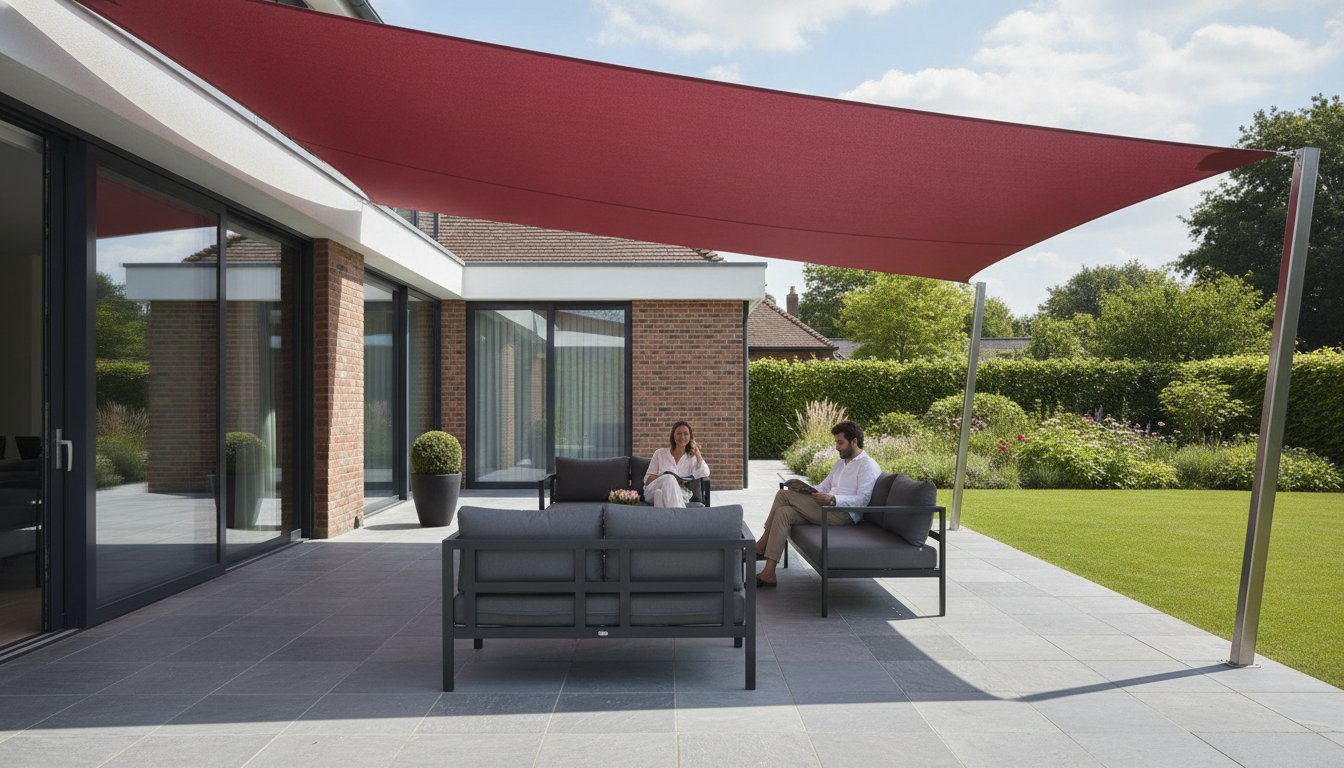
Think of your patio as a blank canvas waiting for its final, functional touch. High-quality fabric sun shades for patios aren’t just simple pieces of cloth; they are sophisticated, tensioned systems designed to extend your living space with precision. Whether you opt for a fixed Shade sail, a retractable arm awning, or a rolling sun sail, these structures serve as a versatile barrier against the elements. They don’t just block the light. They manage UV filtration and glare whilst dramatically lowering surface temperatures, ensuring your outdoor area remains usable even when the sun is at its peak.
Beyond the technical specifications, there’s a profound psychological shift that occurs when you define an outdoor space. By installing a professional fabric system, you effectively create an “outdoor room” that encourages genuine relaxation. It’s about more than just shade. It’s about carving out a dedicated sanctuary where you can escape the pressures of the day. This sense of enclosure provides a reprieve that feels personal and grounded, turning a simple garden into a destination for socialising or quiet reflection. For many UK homeowners, fabric is the preferred medium because it offers a lightness and architectural elegance that heavy, permanent structures often lack.
Fabric vs. Hard-Roof Structures: The Flexibility Factor
You might wonder why fabric is often superior to a traditional wooden pergola or a metal gazebo. The answer lies in airflow. Hard-roof structures tend to trap rising heat, creating a stifling “greenhouse effect” that can make summer afternoons uncomfortable. In contrast, high-performance fabrics are engineered for breathability. They allow warm air to escape whilst maintaining a cool pocket of comfort below. There’s also the matter of seasonal versatility. Whilst a timber roof is a permanent fixture, fabric systems like arm awnings or bespoke sails offer the ease of retraction or removal. You can enjoy the full warmth of the winter sun and then deploy your protection the moment the seasons shift, giving you total control over your patio’s microclimate.
The British Weather Challenge: UV Protection and Rainfall
Our weather is famously fickle, which presents a unique challenge for any outdoor improvement. You need a solution that handles intense UV rays one hour and a sudden Atlantic drizzle the next. This dual requirement is where the distinction between “water-resistant” and “fully waterproof” textiles becomes vital. Whilst many mesh fabrics are designed primarily for ventilation, premium solution-dyed acrylics offer a more robust shield against the rain. A bespoke design ensures that the fabric is tensioned correctly to prevent “puddling,” a common cause of structural failure in cheaper imports. By using industrial-grade stitching and precise engineering, we create a weather-protected sanctuary that stands up to the unpredictable British climate without sagging or tearing.
Comparing Shade Sail Fabrics: HDPE Mesh vs. Solution-Dyed Acrylic
Choosing the right material for your fabric sun shades for patios isn’t just about picking a pretty colour. It’s an engineering decision. You’re essentially deciding how your patio will breathe, how it will handle a sudden British downpour, and how long it will look like new. In the professional shading industry, two dominant players lead the way: High-Density Polyethylene (HDPE) mesh and solution-dyed acrylic. Whilst they might look similar from a distance, their manufacturing processes and performance characteristics are worlds apart.
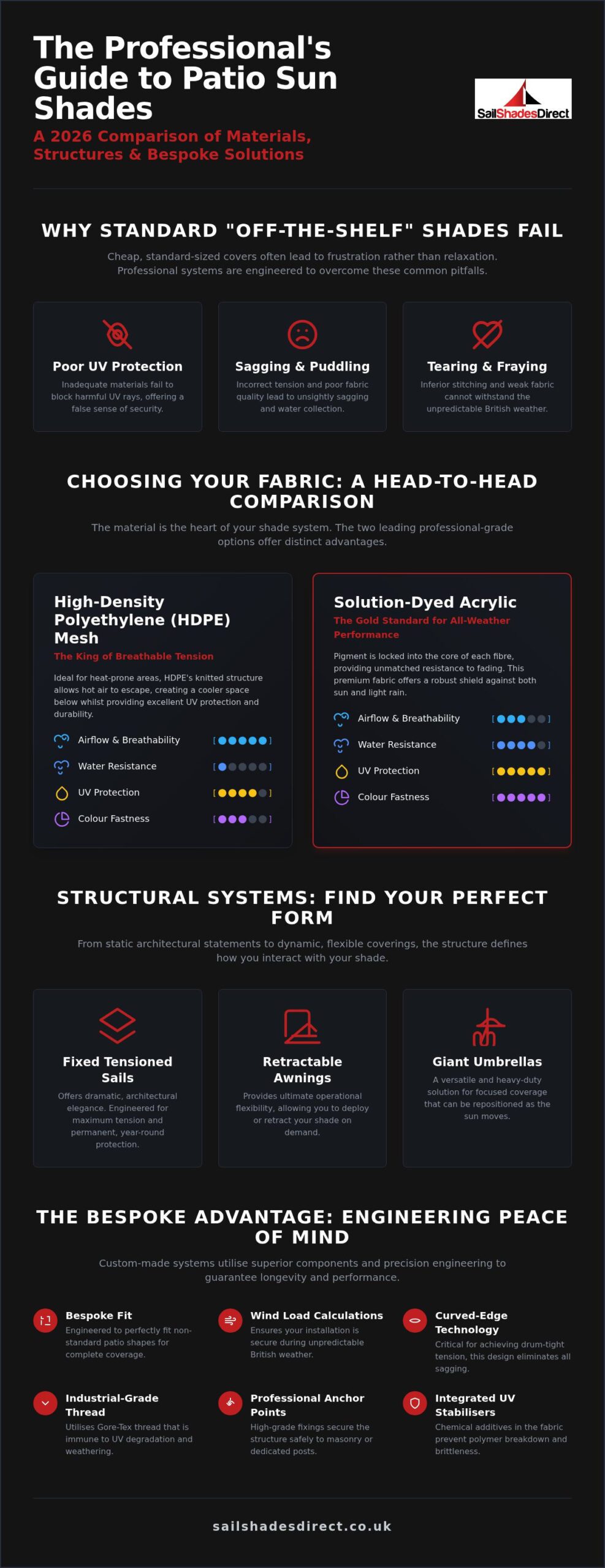
Solution-dyed acrylic is the gold standard for colour fastness because the pigment is added to the liquid polymer before it’s even spun into yarn. This means the colour is locked into the very core of every fibre, rather than just sitting on the surface like a printed pattern. On the other hand, HDPE mesh is a heavy-duty material often used in commercial settings where structural tension is the priority. To ensure these materials last, manufacturers include a vital component: UV stabilisers are chemical additives integrated during the fabric’s production that absorb or reflect harmful radiation, preventing the polymer chains from breaking down and turning the material brittle.
HDPE Mesh: The King of Breathable Tension
If your garden feels like a heat trap, HDPE mesh is your best ally. Its knitted structure features thousands of tiny gaps that allow hot air to rise and escape directly through the fabric. This “breathability” can reduce the temperature underneath by a significant margin. Because it’s a mesh, it’s also wind-permeable, making it a much safer choice for exposed or high-wind locations where a solid fabric might act like a giant, dangerous sail. For those looking for maximum durability, commercial-grade HDPE typically weighs around 340 GSM (grams per square metre), providing a much sturdier solution than the 180-220 GSM found in standard imports. This material is the foundation of high-quality bespoke sail shades UK homeowners trust for long-term performance.
Solution-Dyed Acrylic: Luxury, Colour, and Waterproofing
For a patio that feels like a true extension of your interior design, solution-dyed acrylic is unbeatable. It has a soft, woven texture that mimics indoor upholstery, offering a level of aesthetic warmth that mesh cannot match. Beyond its looks, it’s highly effective at repelling water, making it the perfect choice for those who want to sit outside during a light summer drizzle. Because the colour is integrated into the fibre, these fabrics are incredibly resistant to fading, even after years of exposure to the sun. This makes them the ideal material for heavy duty arm awnings, where a premium look and water protection are paramount. If you’re unsure which material suits your specific garden microclimate, our team can help you select the ideal fabric for your project.
Structural Comparison: Sails, Awnings, and Giant Umbrellas
Choosing between different fabric sun shades for patios often comes down to a balance between architectural impact and daily flexibility. Do you want a striking, permanent fixture that defines your garden’s geometry, or a system that disappears when the clouds roll in? The footprint of each solution varies significantly. Tensioned sails usually require independent structural poles or robust wall-mounting plates, whilst awnings rely heavily on the structural integrity of your property’s masonry. For those seeking a central focal point without wall attachments, heavy duty patio umbrellas offer a robust, freestanding alternative that can be easily repositioned or closed during winter months.
Tensioned Sail Shades: Architectural Statement
Tensioned sails are the ultimate choice for homeowners who want to make a bold design statement. By using marine-grade stainless steel hardware and “hypar” (hyperbolic paraboloid) geometry, these sails create stunning three-dimensional shapes that standard covers simply can’t match. This permanence is their greatest strength. Once installed, they provide season-long protection without the need for daily setup or adjustment. Because they are bespoke, they can be engineered to cover irregular patio shapes, awkward corners, or narrow passages that traditional square awnings cannot reach. It’s a reliable solution that offers consistent, high-performance shading.
Retractable Awnings and Rolling Sun Sails: Adaptive Comfort
If the unpredictable UK weather makes you hesitate about a permanent structure, adaptive systems provide shading on demand. Retractable arm awnings and motorised rolling sun sails allow you to react instantly to changing conditions. With the push of a button, you can deploy a vast canopy of protection or retract it completely to enjoy the evening stars. Modern systems often feature full-cassette housings. These encase the fabric in a protective metal shell when not in use, preventing the textile from being exposed to winter dampness or debris. This significantly extends the system’s lifespan whilst maintaining a clean, minimalist look on your property’s exterior.
Planning Your Patio Shade: Wind Loads and Sun Orientation
Planning the perfect installation for fabric sun shades for patios requires more than just measuring the floor space. It’s a precise exercise in engineering and environmental observation. A common mistake is focusing solely on the fabric, whilst forgetting that any shade system is only as strong as its anchor points. When the wind picks up, a large fabric canopy effectively becomes a giant sail. Without professional-grade fixings, the lateral forces generated can easily pull down a standard fence post or damage domestic brickwork. This is why we prioritise structural integrity from the very first design stage.
Beyond the physical strength of the installation, you must consider the “three-dimensional” nature of effective shading. A flat, horizontal sail is a recipe for disaster in the UK, as it allows rainwater to “puddle” in the centre, eventually leading to fabric stretching or structural failure. By introducing height variations between your anchor points, you create the necessary pitch for water runoff. This architectural twist doesn’t just look sophisticated. It ensures your sanctuary remains weather-protected and taut, regardless of the season.
Calculating the Sun Path for Maximum Coverage
The sun’s position is never static. A shade that provides perfect cover directly overhead at noon might be completely useless by 4 PM when the sun drops lower in the sky. To get the most from your investment, we recommend observing your patio’s shadow patterns at different times of the day before finalising your design. If you struggle with low-angle glare during summer evenings, you might need more than just a horizontal sail. Integrating bespoke exterior window blinds or vertical drop screens can provide that extra layer of protection when the sun dips below the main canopy’s reach. For homeowners with glass extensions or bifold doors, exterior blinds for patios offer a sophisticated thermal solution that prevents your living space from turning into a greenhouse during peak summer hours.
Managing Wind Resistance in Exposed Environments
In exposed or coastal locations, wind resistance is your primary concern. There is a vast difference between a temporary DIY shade and a permanent architectural installation. Whilst entry-level options might need taking down at the first sign of a breeze, professional systems are designed to handle significant wind loads. We often utilise structural steel posts and heavy-duty wall plates to ensure the system stays put. For retractable solutions, motorised sensors can be programmed to automatically close the shade if wind speeds exceed safe limits, providing an essential safeguard for your home. If you’re ready to design a system that stands up to the elements, you can consult our technical team for a bespoke site assessment.
The Bespoke Advantage: Why Custom-Made Fabric Shades Prevail
If you’ve ever seen a shade sail flapping miserably in a light breeze, you’ve witnessed the failure of “off-the-shelf” geometry. Standard, straight-edged fabric sun shades for patios are inherently prone to sagging because they cannot be tensioned evenly across their entire surface. This is where bespoke engineering changes the game. By using “curved edge” technology, also known as catenary curves, we ensure that every ounce of tension applied at the corners is pulled through to the very centre of the fabric. It’s the difference between a tidy, architectural feature and a messy, temporary cloth that collects water and debris.
Beyond the technical tension, there is the vital matter of architectural harmony. A professional design service ensures your new structure doesn’t “clash” with your home’s existing lines. We look at the heights of your windows, the flow of your garden paths, and the specific masonry of your house to create a system that feels like it was built with the property. This meticulous approach prevents the “afterthought” look of standard imports, positioning your patio as a high-value, engineered extension of your home rather than just a garden with a cover.
Precision Engineering for Longevity
The durability of a bespoke shade lies in the details you can’t see from across the garden. Whilst mass-produced items often use simple webbing edges, our professional systems frequently utilise “wire-in-sleeve” technology. This involves a stainless steel cable running through the perimeter of the sail, allowing for much higher tension levels without the risk of the fabric tearing. We also insist on using industrial-grade, UV-resistant Gore-Tex Tenara thread for all stitching. Unlike standard polyester thread that can become brittle and snap after a few summers, this thread is designed to outlast the fabric itself. Whilst a standard polyester shade might struggle to survive more than two seasons before the fibres degrade, a bespoke solution-dyed acrylic system is engineered to provide a decade of reliable service. To understand the full selection and maintenance process behind durable outdoor sun sails, our dedicated 2026 guide walks you through every professional consideration from fabric choice to long-term care.
Designing Your Outdoor Reprieve with Sail Shades Direct
Your journey to a weather-protected sanctuary starts with a conversation, not a catalogue. We guide you through the entire process, from the initial site assessment and sun-path analysis to the final professional fitting. This collaborative approach removes the stress of DIY guesswork and ensures your investment is protected by expert craftsmanship. We take pride in handling the complex calculations of wind loads and anchor points so you don’t have to. If you’re ready to stop settling for temporary fixes and start enjoying a truly bespoke outdoor environment, we’re here to help. Contact us today to book your bespoke design consultation and take the first step towards a more comfortable, elegant patio.
Ready to Master Your Outdoor Microclimate?
Transforming your garden into a weather-protected sanctuary requires more than just a quick fix. You now understand how material choice, from breathable HDPE mesh to luxury solution-dyed acrylic, dictates both comfort and longevity. By prioritising structural integrity and precise sun-path planning, you can avoid the common pitfalls of sagging fabrics and inadequate UV protection. High-performance fabric sun shades for patios are an investment in your lifestyle, providing a versatile reprieve from the pressures of daily life whilst adding genuine architectural value to your home.
At Sail Shades Direct, we combine UK-based bespoke manufacturing with professional installation nationwide to ensure your vision is realised with engineering precision. Our industrial-grade fabric options are designed to withstand the unpredictable British weather, giving you total peace of mind. Don’t leave your outdoor comfort to chance. Request a bespoke patio shading consultation from our expert team today! We’re ready to work with you to create the perfect environment for relaxation and socialising.
Frequently Asked Questions
Are fabric sun shades for patios waterproof?
Most fabric sun shades for patios are water-resistant rather than fully waterproof. HDPE mesh is designed to be porous to allow airflow, whilst solution-dyed acrylic fabrics offer a much tighter weave that repels water effectively. To prevent leaking, you must install the fabric at a minimum 20-degree angle. This ensures rain runs off the surface rather than “puddling” and soaking through the fibres.
Can I leave my fabric shade sail up all year round in the UK?
It is generally not recommended to leave tensioned sails up during the winter months in the UK. Whilst they are built for durability, heavy snow loads and extreme winter gales can put immense pressure on the anchor points. Retractable systems, such as arm awnings or rolling sun sails, should be kept in their protective cassettes when not in use. Removing your sail during the coldest months will significantly extend its overall lifespan.
What is the best fabric for a sun shade?
The best fabric depends entirely on your specific needs and garden layout. If your primary goal is cooling an exposed patio, HDPE mesh is superior because its knitted structure allows heat to escape upwards. However, if you want a luxury aesthetic and protection from light rain, solution-dyed acrylic is the preferred choice. Both materials are high-performance options, but they serve different functional purposes in your outdoor space.
How do I clean and maintain my patio fabric shade?
Regular maintenance involves gently brushing off loose debris and washing the fabric with mild, lukewarm soapy water. Avoid using harsh chemicals or power washers, as these can strip away the protective UV coatings and damage the fibres. It’s also wise to check the tension of your system periodically. A taut fabric is less likely to suffer from wind damage or collect dirt and water over time.
Do fabric sun shades provide 100% UV protection?
High-quality fabric shades typically block between 90% and 98% of harmful UV rays. The exact level of protection depends on the colour and density of the weave, with darker colours often providing slightly higher UV filtration than lighter shades. Whilst no fabric offers total 100% protection, a professional-grade shade creates a much safer environment for your family to enjoy the outdoors during peak summer hours.
How much wind can a fabric sun shade withstand?
A professionally installed, bespoke system can often withstand winds up to 30 or 40 miles per hour depending on the specific engineering. However, it’s always best to retract or remove your shade if a severe weather warning is issued. Cheap, off-the-shelf versions are much more vulnerable and may fail at far lower wind speeds. Proper structural anchoring and tensioning are the most critical factors in determining wind resistance.
What is the difference between a shade sail and a patio awning?
The main difference lies in their structure and how they operate. A shade sail is a fixed, tensioned fabric canopy that stays in place throughout the season. A patio awning is a retractable system, usually mounted to a wall, that can be extended or retracted as needed. Sails are often better for covering irregular shapes, whilst awnings provide the flexibility of shading on demand for changing weather conditions.
Can I install a bespoke fabric sun shade myself?
Whilst DIY installation is possible for small, temporary covers, we strongly recommend professional fitting for bespoke systems. Correct installation requires precise calculations for wind loads and tensioning to ensure the fabric doesn’t sag or damage your property’s masonry. Our team handles the heavy-duty anchoring and structural engineering required for a long-term solution. This ensures your sanctuary remains safe and beautiful for many years to come.