
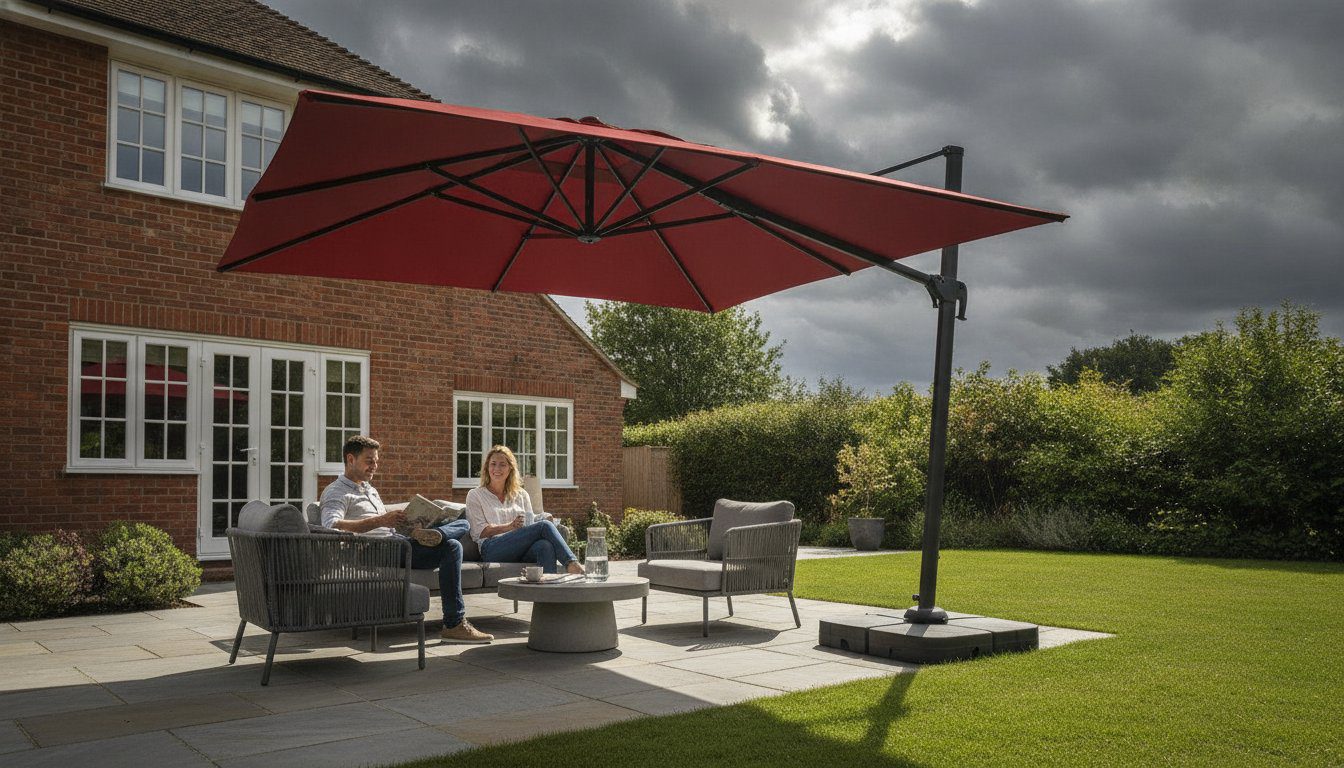
Heavy Duty Patio Umbrellas: The 2026 British Guide to Durable Shading
Have you ever watched a sudden British gust turn a “sturdy” garden parasol into a twisted mess of broken ribs and torn fabric? It’s a frustratingly common sight across UK gardens, where standard retail options often fail to handle our unpredictable coastal winds and heavy downpours. You deserve an outdoor space that feels like a genuine sanctuary, not a safety hazard you’re forced to dismantle at the first sign of a breeze.
This guide will help you move beyond flimsy seasonal replacements and identify genuine heavy duty patio umbrellas that offer commercial-grade durability and wind-certified safety. We’ll explore the engineering behind high-tensile frames, marine-grade fabrics that refuse to fade, and the professional installation techniques that ensure your shading remains a permanent, beautiful fixture of your landscaping. From understanding wind-testing benchmarks to choosing bespoke finishes that align with your garden’s aesthetic, you’ll discover how to create a shaded retreat that stands firm whilst others fold.
Key Takeaways
- Learn to distinguish between marketing jargon and genuine engineering by focusing on the three pillars of durability: frame integrity, fabric resilience, and base stability.
- Discover why solution-dyed acrylic outperforms standard polyester, ensuring your canopy colours remain vibrant whilst resisting the harsh British elements.
- Compare the functional benefits of cantilever designs against the superior wind-stability of traditional centre-post heavy duty patio umbrellas.
- Understand the critical role of professional ground anchors and wind tunnel testing in securing your investment against gale-force gusts.
- Explore how bespoke giant umbrellas can be tailored to your specific landscaping requirements, providing a permanent shading solution that enhances both style and safety.
Defining True Heavy Duty Patio Umbrellas for the UK Climate
In the world of garden retail, “heavy duty” is a term thrown around loosely. You’ll see it on a budget parasol in a supermarket aisle just as often as on a high-spec engineered system. But in the British Isles, where a sunny afternoon can turn into a 30mph gust in minutes, true durability isn’t about marketing labels. It’s about physics. Authentic heavy duty patio umbrellas are built to survive the elements, not just look pretty in a showroom. They represent a shift from temporary, “disposable” garden furniture to permanent architectural shading that adds value to your property.
While the history and types of umbrellas stretch back centuries, the modern British version has had to evolve significantly. We don’t just deal with sun; we deal with driving rain, coastal salt spray, and the “wind tunnel” effect found in urban courtyards or exposed terraces. To withstand this, a shading solution must excel in three specific areas: frame integrity, fabric resilience, and base stability. If one of these pillars fails, the whole structure becomes a liability during a summer storm. Engineering for the UK means over-specifying every component to ensure safety and longevity.
The Difference Between Residential and Commercial Grade
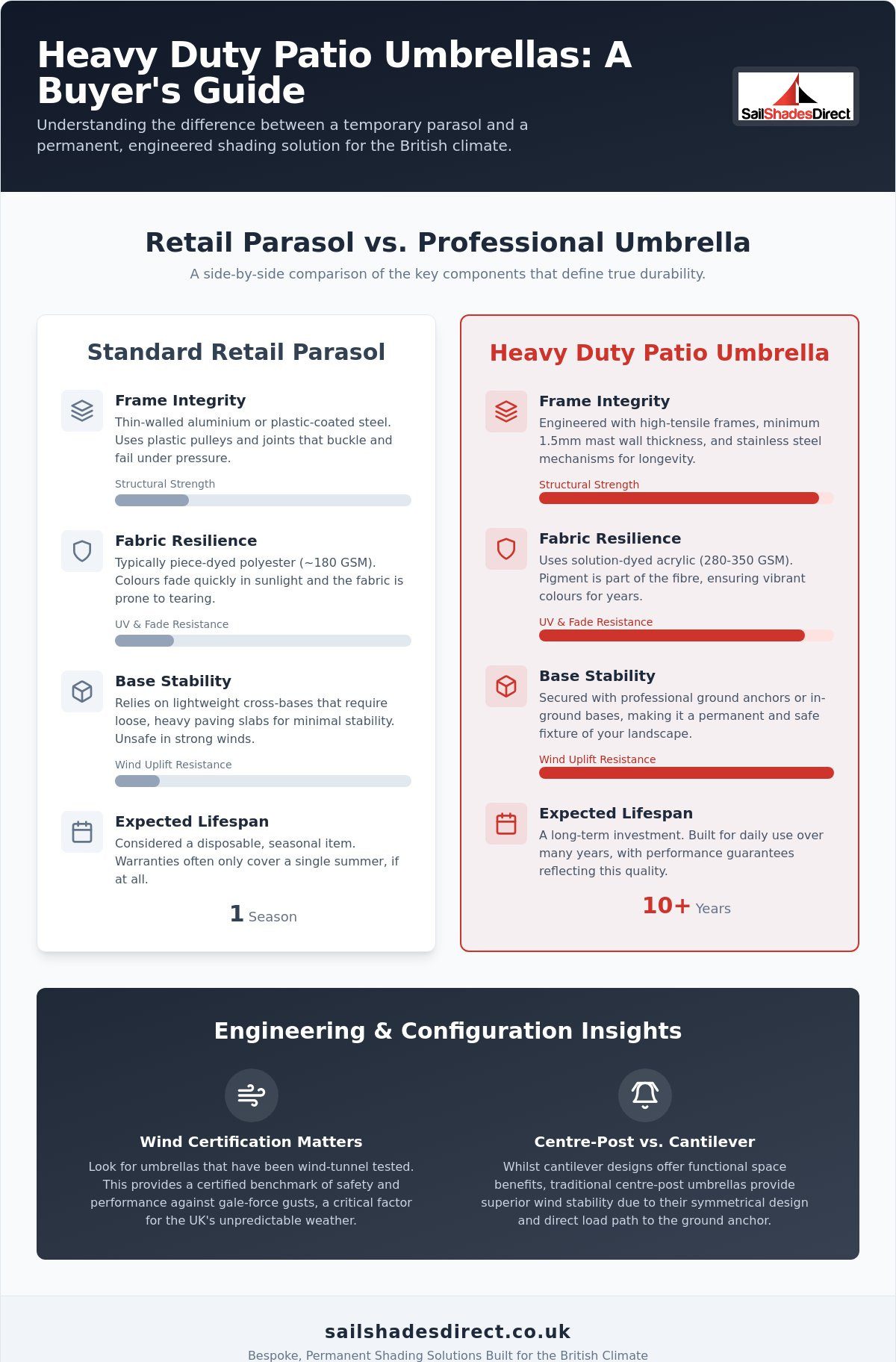
The main distinction lies in the skeleton of the structure. Residential models often use thin-walled aluminium or even plastic-coated steel that buckles under pressure. Commercial-grade systems require a minimum of 1.5mm wall thickness in the mast to prevent snapping. You’ll also notice the difference in the opening mechanism. Standard parasols often use simple plastic pulleys that fray and jam after a few months. Professional options utilise internal telescopic wind-up handles or high-tensile stainless steel cords designed for daily use over many years. This is why retail warranties often last only a single summer, whilst commercial performance guarantees reflect a decade of intended service.
When to Move Beyond the Standard Parasol
If your garden feels the full force of the wind or sits near the coast, a standard umbrella simply won’t suffice. Salt spray quickly corrodes cheap steel frames, and light polyester fabrics fade and tear within months. For larger spaces, you might consider how bespoke sail shades UK can complement your setup, creating a layered shading strategy that covers more ground. Look out for “disposable” traits like plastic joints or lightweight cross-bases that require loose patio slabs to stay upright. These are clear signs that the product isn’t designed for the long haul. Transitioning to a permanent architectural solution means choosing hardware that remains a safe, beautiful, and functional part of your home year after year.
Engineering Excellence: Materials That Define Durability
True durability isn’t skin deep. When you invest in heavy duty patio umbrellas, you’re paying for the invisible engineering that prevents a relaxing afternoon from turning into a maintenance headache. The British climate is notoriously varied, swinging from intense UV exposure to damp, humid winters that encourage mould. To combat this, the materials used in your shading system must be selected for their chemical stability and mechanical strength. High-grade hardware ensures the structure remains rigid whilst the fabric technology keeps the canopy looking pristine for years.
Reinforcement is where professional umbrellas earn their reputation. High-stress areas, such as the pockets where the ribs meet the canopy, should feature double-stitched industrial thread and reinforced leather or PVC inserts. These small details prevent the ribs from punching through the fabric during a sudden gust. Additionally, look for a high water column rating, which measures the water pressure a fabric can withstand before leaking. A rating of 300mm or higher is ideal for the UK, ensuring you stay dry even during a persistent drizzle.
Marine-Grade Fabrics and GSM Explained
The weight and density of your canopy are measured in GSM, or grams per square metre. Whilst high-street options might hover around 180 GSM, a commercial-grade canopy typically sits between 280 and 350 GSM. This extra mass provides a thicker barrier against UV rays and increases the fabric’s tensile strength. However, density alone isn’t enough. You must also consider the dyeing process. Most cheap umbrellas use piece-dyed polyester, where colour is only applied to the surface. In contrast, solution-dyed acrylic involves adding pigment to the polymer whilst it is still in a liquid state. This locks the colour into the very core of every fibre, making it virtually immune to fading. If you want to explore how these material standards compare across different shading systems, our fabric sun shades for patios comparison guide breaks down the key differences between waterproof and water-resistant materials in detail.
For the damp British winter, many premium fabrics now include self-cleaning fluorocarbon coatings. These treatments cause water and dirt to bead off the surface, significantly reducing the risk of fungal growth. If you are looking for a long-term solution, browsing the expert range of giant umbrellas can help you see these technical specifications in practice.
Hardware and Connection Points
The hub is the most common failure point on any parasol. In budget models, these are often made of brittle plastic that cracks under UV stress. Professional systems utilise cast aluminium or marine-grade stainless steel hubs that can handle the constant leverage of the ribs. The central pole itself needs a substantial diameter and wall thickness to resist bending. Anodised aluminium is a metal treated with an electrolytic process to create a protective oxide layer, typically measured in microns, which provides essential corrosion resistance for coastal environments. This hardware ensures that the mechanical components of your heavy duty patio umbrellas remain as smooth and reliable on year ten as they were on day one.
- Stainless Steel Fasteners: Prevents rust streaks on the fabric.
- Internal Telescopic Masts: Increases stability by reducing the number of moving parts.
- UV Stability: Ensures plastic components (if used) don’t become brittle in the sun.
Configuration Options: Cantilever vs. Centre-Post Giant Umbrellas
Selecting the right silhouette for your outdoor area involves more than just picking a favourite colour; it’s about matching the geometry of your shading to the specific demands of your site. In the UK, where space is often at a premium and the weather is famously fickle, the choice between a cantilever and a centre-post design is pivotal. High-end heavy duty patio umbrellas aren’t just larger versions of standard parasols. They are precision-engineered structures designed to optimise your usable floor space whilst providing a safe, wind-resistant canopy for your guests.
For a truly comprehensive shading strategy, many homeowners choose to combine these structures with heavy duty arm awnings. This creates a layered approach, allowing you to shade the area immediately adjacent to the house whilst using giant umbrellas to define a separate dining or lounge zone further into the garden. For those with glass extensions or bifold doors that trap heat, pairing your umbrella system with exterior blinds for patios provides an additional layer of solar control that keeps your entire outdoor living space cool and comfortable. This versatility ensures your outdoor space remains functional regardless of where the sun sits in the sky or how the wind shifts.
The Cantilever Challenge: Balancing Versatility with Strength
The side-arm cantilever is often the first choice for premium landscaping due to its clean, unobstructed look. By placing the mast to the side, you remove the central obstacle, allowing for seamless furniture layouts and better social flow. However, this design creates significant leverage, which is why commercial-grade cantilever models utilise internal steel reinforcements within the aluminium arms. These systems often feature 360-degree rotation, allowing you to track the sun throughout the day with a simple foot pedal or handle. Because the weight is offset, these models require massive base weights or, ideally, professional ground bolting to remain stable in a breeze. Without a secure anchor, even the most robust heavy duty patio umbrellas risk tipping when the wind catches the canopy.
Centre-Post Power: The Professional Choice
For those prioritising maximum wind resistance, the centre-post giant umbrella remains the undisputed heavyweight champion. The vertical load path ensures that wind energy travels directly down the mast and into the ground anchor, providing superior stability in exposed locations like pub gardens or coastal terraces. One of the most important features of these larger models is the telescopic opening mechanism. As the umbrella closes, the mast extends upwards, allowing the ribs to clear the top of tables and chairs. This means you don’t have to move your furniture every time you want to close the canopy. It’s a practical, elegant solution for large domestic terraces where permanent, high-wind protection is the primary goal.
- Cantilever: Best for lounge sets and unobstructed views.
- Centre-Post: Best for high-wind exposure and dining tables.
- Telescopic Masts: Essential for closing giant umbrellas over furniture.
- 360-Rotation: Provides all-day shade without moving the base.
Wind Ratings and Professional Installation Standards
Understanding how heavy duty patio umbrellas behave in a gale is the difference between a sound investment and a costly accident. Most manufacturers reference the Beaufort scale, which provides a visual guide to wind force and its effects. For instance, a “Force 6” rating indicates the structure can handle a strong breeze up to 31 mph, whilst specialized commercial models may claim resistance up to Force 10. However, these figures are often derived from wind tunnel testing in controlled environments. In the real world, the stability of your canopy depends entirely on how it is tethered to the earth.
Safety protocols are especially vital for commercial venues where public liability is a primary concern. Even the most robust systems have their limits. A common industry recommendation is to close any umbrella when sustained winds approach 25 mph. This proactive behaviour protects the internal hardware from metal fatigue and ensures the fabric doesn’t suffer from unnecessary stress. When you choose a high-end system, you’re investing in the peace of mind that comes from knowing exactly when your hardware can stay open and when it’s time to retract.
Fixed Ground Anchors vs. Mobile Bases
The method you choose to secure your umbrella dictates its ultimate wind threshold. In-ground sleeves are the gold standard for permanent installations; these are set into a concrete footing below the patio surface, providing a rock-solid foundation that resists leverage from every angle. For existing concrete terraces or timber decking, surface-mounted steel plates offer a robust alternative. Whilst mobile bases are available, a genuine heavy duty setup typically requires a minimum of 100kg of mass to prevent shifting. This weight is necessary because the canopy acts as a giant sail, and without sufficient ballast, even a moderate gust can move a substantial structure across your patio.
The Installation Process: What to Expect
A professional installation begins with a thorough site assessment to identify underground services, drainage, and soil stability. This ensures that the concrete footings for your ground anchors won’t interfere with your home’s infrastructure. Precision is key during the fitting phase. Installers use laser levelling to ensure the mast is perfectly vertical, which is essential for the smooth operation of telescopic and rotation mechanisms. Professional fitting ensures the structural integrity of the ground anchor matches the manufacturer’s laboratory wind-tunnel results, effectively validating the safety rating of your investment. If you’re ready to secure your outdoor space with a wind-certified solution, our team provides a national UK installation service for all our giant umbrellas.
- Site Assessment: Checking for cables, pipes, and ground density.
- Ground Anchor Setting: Professional concrete pouring for permanent stability.
- Mechanical Calibration: Ensuring all rotation and opening features work without friction.
- Safety Briefing: Guidance on when to close the canopy based on local wind patterns.
Bespoke Giant Umbrellas: The Sail Shades Direct Advantage
Choosing the right shading isn’t just about finding a product that fits; it’s about designing a solution that works in harmony with your architecture. Whilst high-street retailers offer a “one size fits all” approach, these generic options often leave gaps in coverage or fail to match the aesthetic of a premium garden. Investing in bespoke heavy duty patio umbrellas allows you to reclaim every square inch of your terrace. By tailoring the dimensions and hardware to your specific site, we ensure that your shading feels like a natural extension of your home rather than an afterthought. This bespoke approach is particularly vital for commercial shading solutions UK, where branding and precision are essential for creating a professional first impression.
A significant advantage of the bespoke route is the ability to create a unified outdoor environment. You aren’t limited to a single structure. Many of our clients choose to integrate giant umbrellas with architectural sail shades to cover awkward corners or expansive poolside areas. This layered strategy provides a versatile range of sun protection that adapts to your lifestyle. Because we manage the process from the initial design through to the final bolt, you benefit from a cohesive system where every component is engineered to the same exacting standards.
Tailored for Your Space
The shape of your canopy should be dictated by your furniture, not the other way around. We offer specialist configurations including square, rectangular, and octagonal shapes to ensure your dining set or lounge area is perfectly framed. This customisation extends to the fabric itself. We can match your canopy to existing exterior blinds or awnings, creating a seamless colour palette across your entire property. To truly transform your outdoor space into an evening entertainment hub, we can integrate high-output infrared heaters and dimmable LED lighting directly into the umbrella frame. This ensures your investment remains useful long after the sun goes down and the British temperature begins to drop.
Consultation to Completion
Our approach is built on over 10 years of professional experience and a genuine pride in craftsmanship. We don’t just ship a box; we provide a national UK-wide design and fitting service that takes the stress out of the installation. During our consultation, we’ll discuss your site’s specific wind exposure and aesthetic goals, ensuring the final result is both beautiful and safe. Whilst the initial cost of a bespoke system is higher than a retail parasol, the long-term ROI is far superior. You won’t be replacing snapped ribs or faded fabric every two seasons. Instead, you’ll have a permanent, wind-certified structure that enhances your property’s value for years to come. It’s time to stop settling for “good enough” and start building the outdoor sanctuary you deserve. Contact our team today to organise your professional design consultation and discover the potential of your patio.
- Custom Shapes: Square and rectangular options for better furniture alignment.
- Integrated Tech: Heaters and lighting for year-round usability.
- National Service: Expert installation from Cornwall to the Highlands.
- Design Synergy: Matching fabrics across all your shading systems.
Secure Your Outdoor Sanctuary for Years to Come
Creating a dependable outdoor retreat in the UK requires moving beyond the disposable mindset of high-street retail. You’ve seen how true durability stems from the synergy of 1.5mm wall-thickness frames, solution-dyed acrylic fabrics, and the structural stability of professionally fitted ground anchors. By choosing heavy duty patio umbrellas engineered for our specific climate, you’re not just buying a parasol; you’re investing in a permanent architectural asset that stands firm against coastal gusts and summer storms.
At Sail Shades Direct, we combine over 10 years of experience with a passion for bespoke craftsmanship. From initial design to national installation, we ensure your shading solution is tailored to your unique landscaping and safety requirements. Our durable, commercial-grade components and precision fitting provide the long-term ROI that standard alternatives simply cannot match. Enquire about our bespoke Giant Umbrellas and professional fitting today and let’s transform your patio into a stress-free haven. We’re ready to help you build something that lasts!
Frequently Asked Questions
What wind speed can a heavy duty patio umbrella actually withstand?
A high-quality heavy duty patio umbrella can typically withstand winds up to Force 6 on the Beaufort scale, which is approximately 31 mph. Some commercial models are engineered for much higher gusts, but it’s a standard safety protocol to retract the canopy when sustained winds reach 25 mph. This prevents mechanical fatigue and ensures the longevity of the internal components during unpredictable British weather.
Is it better to have a cantilever or a centre-post umbrella for high winds?
Centre-post models are the superior choice for high-wind environments due to their direct vertical load path. Because the mast sits directly under the canopy, wind energy is transferred straight into the ground anchor rather than creating the leverage found in side-arm designs. Cantilevers offer more versatility for furniture layout but require much heavier ballast to achieve similar structural stability.
Do I need planning permission for a permanent giant umbrella in the UK?
Generally, you don’t need planning permission for a patio umbrella in the UK because they are classified as temporary or removable structures. However, if you are installing a very large permanent system in a conservation area or on the grounds of a listed building, it’s always wise to have a quick word with your local planning office. For standard residential gardens, these installations are almost always exempt.
What is the best fabric for a heavy duty umbrella to prevent fading?
Solution-dyed acrylic is the gold standard for preventing fabric fade in the British sun. Unlike standard polyester where the colour is just a surface coating, solution-dyeing locks the pigment into the core of the fibre during manufacturing. This ensures your heavy duty patio umbrellas remain vibrant and UV-stable for many years despite constant exposure to the elements.
Can heavy duty umbrellas be left outside all year round in the UK?
The structural hardware is designed to stay outside all year round, provided it features anodised aluminium or powder-coated steel. We recommend closing the canopy and using a high-quality weather cover during the winter months to protect the fabric from damp and urban pollutants. This simple habit significantly extends the life of the material and prevents fungal growth during the wetter seasons.
How do I clean and maintain a commercial-grade patio umbrella?
Maintenance is straightforward: use a soft brush to remove loose debris and clean the fabric with lukewarm water and a mild, non-detergent soap. Never use a power washer as the intense pressure can strip away protective coatings and damage the fibres. It’s also a good idea to occasionally lubricate the moving mechanical parts with a silicone-based spray to keep the opening mechanism smooth and reliable.
What is the difference between an architectural umbrella and a standard parasol?
The primary difference lies in the engineering specifications and intended lifespan. An architectural umbrella utilises thicker mast walls, higher GSM fabrics, and wind-certified hardware designed for permanent or semi-permanent installation. A standard parasol is a lightweight, seasonal item that lacks the structural integrity to survive a typical British summer gale without a high risk of snapping or tearing.
How much weight is needed for a heavy duty umbrella base?
For a mobile setup, you’ll typically need a base weighing at least 100kg to provide adequate stability for a large canopy. However, for genuine heavy duty patio umbrellas, we always recommend a fixed ground anchor or a bolted steel plate. These permanent solutions remove the need for bulky weights and offer far superior safety when the wind catches the canopy like a sail.