
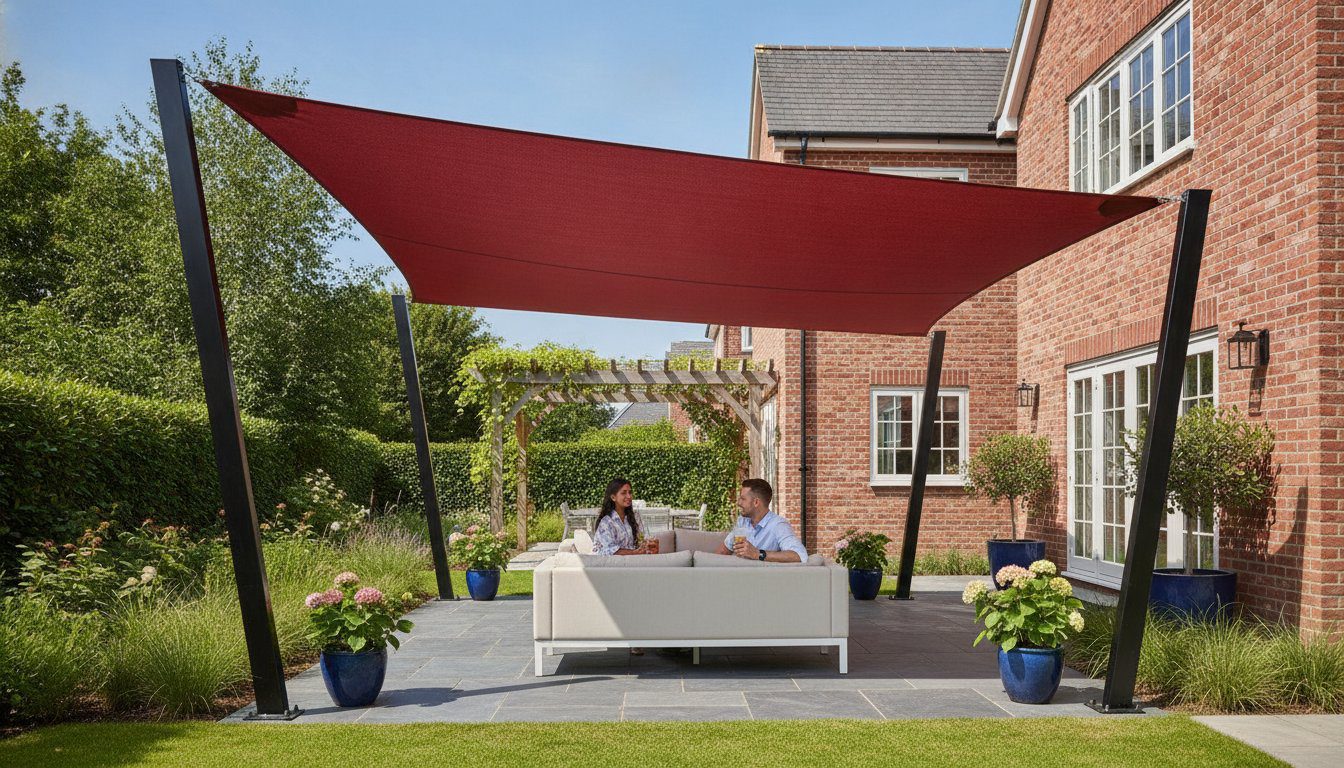
Sail Shade vs Pergola UK: How to Choose the Best Patio Shade in 2026
The traditional timber pergola is often seen as the gold standard for garden shade, yet it might actually be the less practical choice for your overheated patio. Whilst a fixed structure feels substantial, a bespoke sail shade often provides superior thermal cooling and a more striking architectural silhouette without the heavy maintenance of wood.
It’s frustrating when you’ve invested in a beautiful outdoor space only to find it’s too hot to use during a July heatwave. We understand that you want a stylish solution that doesn’t just look good; it also needs to stand up to unpredictable British storms and navigate those confusing planning regulations. Choosing between a sail shade vs pergola UK setup depends on your specific lifestyle needs and how much time you want to spend on upkeep.
For homeowners planning a larger renovation alongside their garden upgrades, Heaven Developments offers specialist residential extensions that focus on creating the perfect open-plan flow between your indoor and outdoor living areas.
This article provides the definitive comparison to help you transform your garden into a cool, usable sanctuary. You’ll discover the key differences in wind resistance, 2026 costings, and how to choose a low-maintenance setup that handles everything the UK weather throws at it.
Key Takeaways
- Learn why breathable HDPE fabrics prevent the “oven effect” that often makes traditional hard-roofed structures uncomfortably hot on still summer days.
- Understand the vital differences regarding planning permission and why a sail shade vs pergola UK comparison is essential before you begin your garden transformation.
- Discover how bespoke architectural tensioning allows modern shading to withstand UK gale-force winds whilst maintaining a sleek, professional appearance.
- Use our practical checklist to decide whether your lifestyle suits a permanent outdoor room or the light-filled, flexible protection of a rolling sun sail.
- See why custom engineering is the only way to avoid the sagging and water pooling issues commonly found with budget, off-the-shelf alternatives.
Why Your Patio is Too Hot to Use: The Cooling Science of Shade
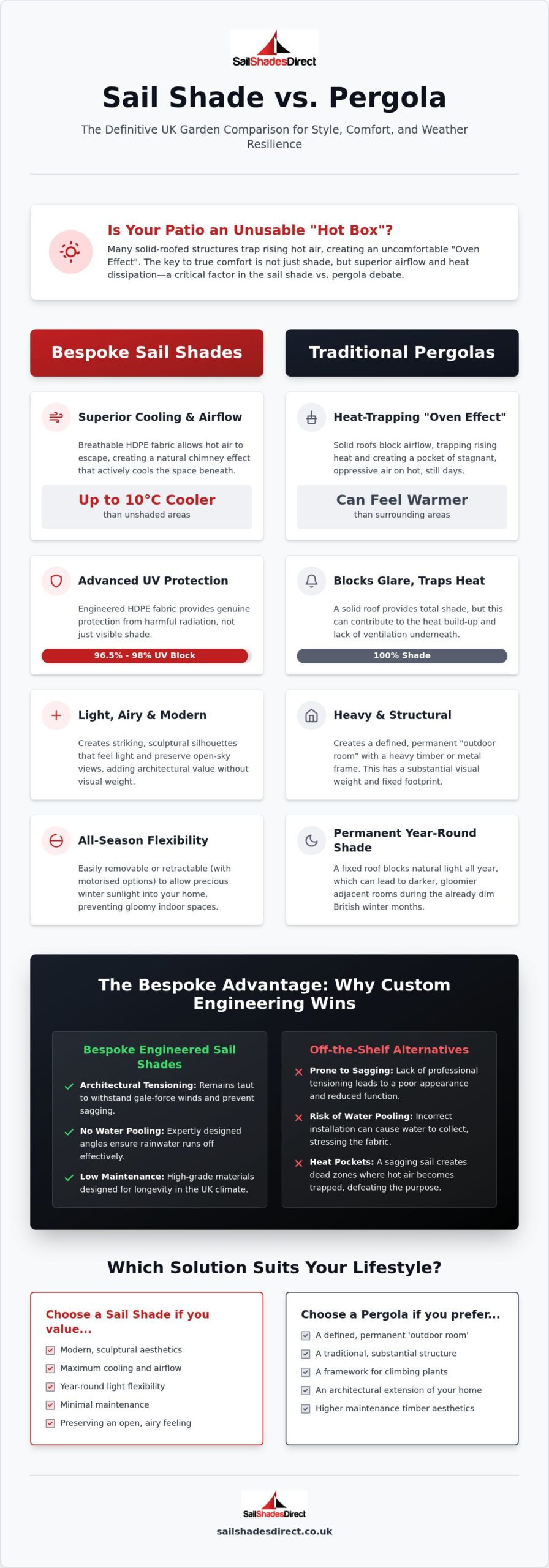
Many homeowners find that their patio becomes an unusable hot box during peak summer hours. This is often due to the “Oven Effect,” where hard-roofed structures trap rising hot air, creating a pocket of stagnant, sweltering heat directly beneath the canopy. When you’re weighing up the sail shade vs pergola UK debate, the material choice is the most critical factor for your comfort. While a solid roof provides total cover, it prevents hot air from escaping, which can make the area feel several degrees warmer than the surrounding garden.
In contrast, bespoke sail shades utilise High-Density Polyethylene (HDPE) knitted fabrics. This material is designed with thousands of tiny pores that allow hot air to rise through the fabric and escape. This continuous breathability can lower the ambient temperature of your patio by up to 10 degrees compared to an unshaded area or a structure with a solid roof. It’s the difference between sitting in a stuffy room and enjoying a gentle, cooling breeze under a canopy.
It’s also vital to distinguish between visible shade and genuine UV blocking. Standard garden umbrellas or cheap polyester sheets might block the sun’s glare, but they often fail to stop harmful radiation. High-quality HDPE fabrics are engineered to block between 96.5% and 98% of harmful UV rays, protecting your skin whilst you relax outdoors. This level of protection is essential for long afternoons spent in the garden, ensuring your sanctuary is safe as well as stylish.
Convection and Airflow in Garden Design
The physics of a well-installed sail shade goes beyond simple fabric choice. By varying the heights of the fixing points, we create a natural chimney effect. As the sun warms the air beneath the sail, the heated air rises and is drawn out through the highest point of the tensioned fabric, pulling cooler air in from the sides. Traditional wooden pergolas often lack this dynamic airflow, leading to static, heavy air that feels oppressive on humid afternoons. Thermal comfort on a UK patio is the sensation of being perfectly shielded from direct solar radiation without feeling the stifling weight of trapped, stagnant air.
Reflective vs. Absorptive Materials
Colour plays a significant role in how your patio feels. Lighter shades reflect a higher percentage of solar energy, whilst darker tones absorb more heat but often provide slightly higher UV protection. Modern Shade sail technology allows us to use commercial-grade fabrics that balance these factors perfectly. Bespoke installations outperform off-the-shelf polyester versions because they maintain their tension; a sagging, cheap sail creates dead zones where heat pools, whereas a professionally engineered sail remains taut and effective. This precision ensures your sail shade vs pergola UK choice results in a space that stays refreshingly cool all day long.
Sail Shade vs Pergola: Comparing Structure and Versatility
When you begin comparing a sail shade vs pergola UK installation, the first thing you’ll notice is the difference in physical presence. A pergola is designed to create a defined, permanent “outdoor room.” It uses a heavy timber or metal frame to ground the space, which is fantastic if you want a fixed architectural extension of your home. For those considering more extensive home alterations alongside their garden plans, DJH Property Services offers expert residential construction and extension solutions. However, this permanence comes with a trade-off; once it’s built, it’s a fixed feature of your landscape that requires a dedicated footprint on your patio.
Bespoke sail shades offer a completely different aesthetic. They rely on architectural tension to create light, airy, and modern silhouettes that feel sculptural rather than structural. Instead of a “lid” over your garden, a sail provides protection whilst preserving the open-sky views that make being outdoors so refreshing. For homeowners who want the benefits of a pergola without the heavy visual weight, rolling sun sails provide a high-end hybrid solution. These systems allow the fabric to retract completely when not in use, offering the ultimate in weather versatility.
Permanence vs. Flexibility
British weather is famously fickle, and our needs change with the seasons. One of the biggest drawbacks of a traditional pergola with a solid roof is that it blocks natural light year-round. During the dark winter months, this can make your indoor living rooms feel gloomy. Sail shades are designed for flexibility; they can be easily removed or retracted to let the winter sun flood back into your home. If you’re looking for a seamless way to manage this, motorised rolling sun sails are a premium choice that allows you to deploy or hide your shade at the touch of a button.
Space and Layout Constraints
Many UK gardens feature awkward, non-rectangular patios that don’t play well with standard pergola kits. Fitting a four-post structure into a tapered corner often results in wasted space or intrusive posts that interrupt the flow of your furniture. Bespoke sail shades excel here because they can be engineered into almost any geometric shape to suit your specific site. By utilising wall-fixings instead of ground posts where possible, we keep your patio floor clear of clutter. While most garden structures are governed by UK permitted development rights, the minimal impact of a tensioned sail often makes it a much simpler solution for smaller or more complex terrace designs. If you’re unsure which layout works best for your home, you can browse our recent bespoke projects to see how we’ve transformed similar spaces.
UK Planning Permission and Weather Resilience
One of the biggest hurdles when deciding on a sail shade vs pergola UK project is the worry about red tape and the next big storm. You don’t want to invest in a beautiful outdoor sanctuary only to find it’s a legal headache or, worse, a hazard in high winds. Generally, sail shades are classified as temporary structures because the fabric can be unclipped and removed. This often gives them a distinct advantage over permanent timber or metal pergolas, which are frequently subject to stricter scrutiny as fixed outbuildings.
Weather resilience is the other side of the coin. Whilst a pergola offers a sturdy frame, the roof is often the weak point in a storm. Conversely, a professionally engineered sail shade uses tension to its advantage. It’s a common myth that fabric is weak; in reality, a bespoke tensioned sail is designed to distribute wind loads across its entire surface and into heavy-duty fixings. This makes them remarkably stable during the typical gales we experience across the British Isles.
Navigating UK Building Regulations
Staying on the right side of the law is simpler than you might think if you follow the rules for “Permitted Development.” According to the UK planning permission rules for outbuildings, most garden structures don’t require a full application if they meet specific criteria. For instance, if your structure is within 2 metres of a boundary, the maximum height is usually restricted to 2.5 metres. Bespoke design is crucial here; we can engineer a sail to provide maximum height in the centre whilst dipping lower at the edges to satisfy these boundary requirements. We also provide professional structural calculations for wall-mounted fixings, ensuring your home’s masonry is never compromised by the tension of the shade.
Engineering for the British Climate
To handle the UK’s unpredictable weather, we utilise a specific geometry known as a “hypar” (hyperbolic paraboloid) shape. This three-dimensional curve is what defines high-end architectural sail shades UK homeowners rely on for longevity. By pulling the fabric into this double-curved shape, we create opposing tension that prevents the sail from flapping or sagging. This tension is what stops water from pooling in the centre during a downpour, a common failure point for budget alternatives. Our materials are also chosen for their durability amongst coastal salt-spray and damp winters. Whilst a timber pergola requires regular sanding and staining to prevent rot, a bespoke sail only needs an occasional wash and can be stored away during the harshest months to keep it looking pristine for years.
How to Choose: A Practical Comparison Checklist
Deciding on the right sail shade vs pergola UK solution requires looking beyond the initial price tag. You need to consider how you actually use your garden and what you want the space to feel like. If you want a permanent architectural extension that creates a heavy, defined “outdoor room,” a pergola is the traditional choice. However, if you prefer a light, modern aesthetic that protects your patio without cluttering it with heavy timber posts, a tensioned sail is often the more versatile option.
Budget analysis involves more than just the setup cost. Whilst a DIY pergola kit might seem cheaper upfront, the long-term maintenance of treating softwood every few years adds up in both time and money. A professional bespoke sail shades UK installation provides a precision-engineered solution that stays taut and effective for years without constant upkeep, offering better value over the structure’s lifetime.
Evaluating Your Patio Site
Before you commit to a design, take a walk around your patio to identify potential mounting points. Sturdy house walls or reinforced garden structures can often support a sail shade, which keeps your floor space clear for furniture. You should also observe the sun path across the day to ensure your shade is positioned where you’ll actually be sitting during those hot late-afternoon hours. If your site is particularly exposed to high winds or has limited mounting options, you might find that heavy duty arm awnings provide a robust, retractable alternative that offers the same high-end protection.
Longevity and ROI
The lifespan of your shade is a major factor in the return on your investment. Treated softwood pergolas are prone to rot and warping in the damp British climate, whereas commercial-grade HDPE fabric is designed to resist UV degradation and mould for over a decade. High-end shading solutions significantly boost the kerb appeal of UK homes, acting as a unique selling point for prospective buyers who value a ready-to-use outdoor sanctuary. Premium shading systems typically come with a 10-year warranty on fabric UV stability and structural integrity. If you’re ready to see how a custom design could fit your home, you can request a bespoke design consultation with our expert team today.
The Bespoke Advantage: Why Custom Engineering Wins
Whilst a standard pergola kit might feel like a safe bet, many homeowners discover that off-the-shelf fabric alternatives are a recipe for frustration. When you’re making the final call on a sail shade vs pergola UK installation, the engineering behind the structure is what determines if it survives the first winter. Budget sails often lack the perimeter reinforcement and curved “catenary” edges required to maintain tension. Without this precision, the fabric inevitably sags, pools water during the first heavy downpour, and eventually fails under the strain of a typical British gale.
We solve these issues through advanced 3D design software. By mapping the exact coordinates of your patio, we ensure every sail is cut with the perfect amount of tension for its specific location. This isn’t just about aesthetics; it’s about structural integrity. A custom-engineered sail remains taut and silent even in high winds, whereas a poorly fitted version will flap, drone, and eventually pull its fixings out of the wall. Our end-to-end national service means we handle everything from the initial digital render to the final tensioning, ensuring your sanctuary is as safe as it is beautiful.
Professional installation is the secret to longevity. We don’t just screw hooks into your brickwork; our teams use chemical anchoring systems to bond stainless steel fixings directly into the masonry. This level of precision is essential for handling the immense loads that a tensioned shade generates. It’s a level of security that a DIY kit simply cannot match, giving you total peace of mind when the weather turns.
Tailored Fabric Selection
No two gardens have the same exposure. We help you choose fabric weights and weaves based on whether your patio is a sheltered courtyard or a wind-swept coastal terrace. You can also custom-match the colours to your existing window frames or garden furniture to create a cohesive architectural look. For those who need protection from the low evening sun, we often integrate exterior blinds for patios. These provide vertical shade and wind protection, working amongst your sail shade to create a fully enclosed, temperature-controlled environment.
Expert Consultation and Fitting
A professional site survey is the most important step in the process. It allows us to identify structural weak points, avoid hidden utility lines, and calculate the exact sun path for your specific postcode. Because we offer nationwide coverage, you get the benefit of local expertise backed by national engineering standards. We pride ourselves on being a reliable partner, helping you navigate the sail shade vs pergola UK decision with confidence and transparency. If you’re ready to transform your patio into a cool, architectural sanctuary, contact Sail Shades Direct for a bespoke design consultation today and let’s start planning your perfect outdoor reprieve.
Ready to Reclaim Your Patio in 2026?
Creating a cool, architectural sanctuary shouldn’t be a stressful process. We’ve explored how the right choice in the sail shade vs pergola UK debate can transform a sweltering terrace into a breathable retreat. Whether you value the flexible, light-filled protection of a rolling sun sail or the structural permanence of a bespoke architectural feature, the key is choosing a solution engineered for our unique climate. By prioritising breathable, commercial-grade fabrics and professional tensioning, you avoid the common pitfalls of trapped heat and wind damage.
With 10+ years of UK engineering expertise and a commitment to nationwide professional fitting, our team is ready to help you design a space that feels personal and grounded. We use only the highest quality commercial-grade weather-resistant fabrics to ensure your investment stands the test of time. Don’t let another heatwave keep you indoors when you could be enjoying a perfectly shaded garden.
Get a bespoke quote for your garden shade today and start your journey towards a more comfortable, stylish outdoor lifestyle. We’re here to help you every step of the way!
Frequently Asked Questions
Do sail shades provide better shade than pergolas in the UK?
When comparing a sail shade vs pergola UK for heat reduction, sails often provide superior thermal comfort because the breathable fabric allows hot air to escape whilst blocking up to 98% of UV rays. Unlike a solid-roof pergola that can trap heat, a tensioned sail encourages a natural chimney effect. This keeps your patio significantly cooler on still, humid days. They can also be angled to block the sun more effectively.
Will I need planning permission for a sail shade or pergola?
Most residential installations don’t require planning permission as they fall under Permitted Development rights. For a pergola, you must stay under 2.5 metres in height if it’s within 2 metres of a boundary. Sail shades are typically considered temporary structures, which often simplifies the process. However, if you live in a conservation area or a listed building, you should always check with your local council before starting your project.
Can a bespoke sail shade stay up all year round in British weather?
Bespoke architectural sails are engineered to withstand the UK’s damp climate and moderate winds, but most homeowners choose to take them down in winter. Removing the fabric during the darkest months allows natural light to flood back into your home’s interior. If you’ve opted for a rolling sun sail, you can simply retract the fabric into its housing during a storm, protecting the material from unnecessary wear and tear whilst maintaining the structure’s longevity.
Are sail shades cheaper than pergolas to install?
Choosing a sail shade vs pergola UK setup often results in lower initial costs for the sail option, particularly when compared to high-end hardwood or aluminium pergolas. The lack of a heavy timber frame reduces both material and labour expenses. However, a bespoke, professionally engineered sail involves a higher investment than a basic DIY kit. This ensures you receive a long-lasting, safe solution that won’t sag or fail during a typical British summer storm.
How do I stop my patio from being too hot under a shade structure?
To prevent your patio from becoming an “oven,” you must prioritise airflow and material breathability. High-density polyethylene (HDPE) fabrics are the best choice because they have tiny pores that let hot air rise and escape. Avoid solid plastic or heavy canvas roofs that trap heat underneath. Positioning your shade at varying heights also creates a natural breeze, ensuring that cool air is constantly pulled across the patio surface for maximum comfort.
What happens to a sail shade during a high-wind storm?
Architectural sail shades are designed to remain stable in moderate winds, but they should be retracted or removed during severe gales. The tensioned “hypar” shape helps distribute wind loads evenly, preventing the fabric from flapping or tearing. For permanent peace of mind, professional installers use chemical anchors to ensure the fixings are securely bonded to your home’s masonry. This engineering prevents the structural failures often seen with budget, off-the-shelf garden sails.
Which option adds more value to a UK property?
Both structures add significant kerb appeal and value by extending your usable living space into the garden. A pergola is often viewed as a permanent “outdoor room,” which can be a strong selling point for traditional buyers. Conversely, a bespoke sail shade offers a contemporary, high-end look that appeals to those seeking modern architectural design. Both options are excellent investments that make your home stand out in a competitive property market.
Can I install a sail shade myself or do I need a professional?
Whilst you can install a small, lightweight sail yourself, bespoke architectural systems require professional fitting to ensure they’re safe and correctly tensioned. The loads generated by a large, tensioned sail are substantial; if the fixings aren’t perfectly aligned and anchored, they can damage your property. A professional team provides the structural calculations and specialised equipment needed to ensure your shade remains taut, silent, and secure for years to come.