
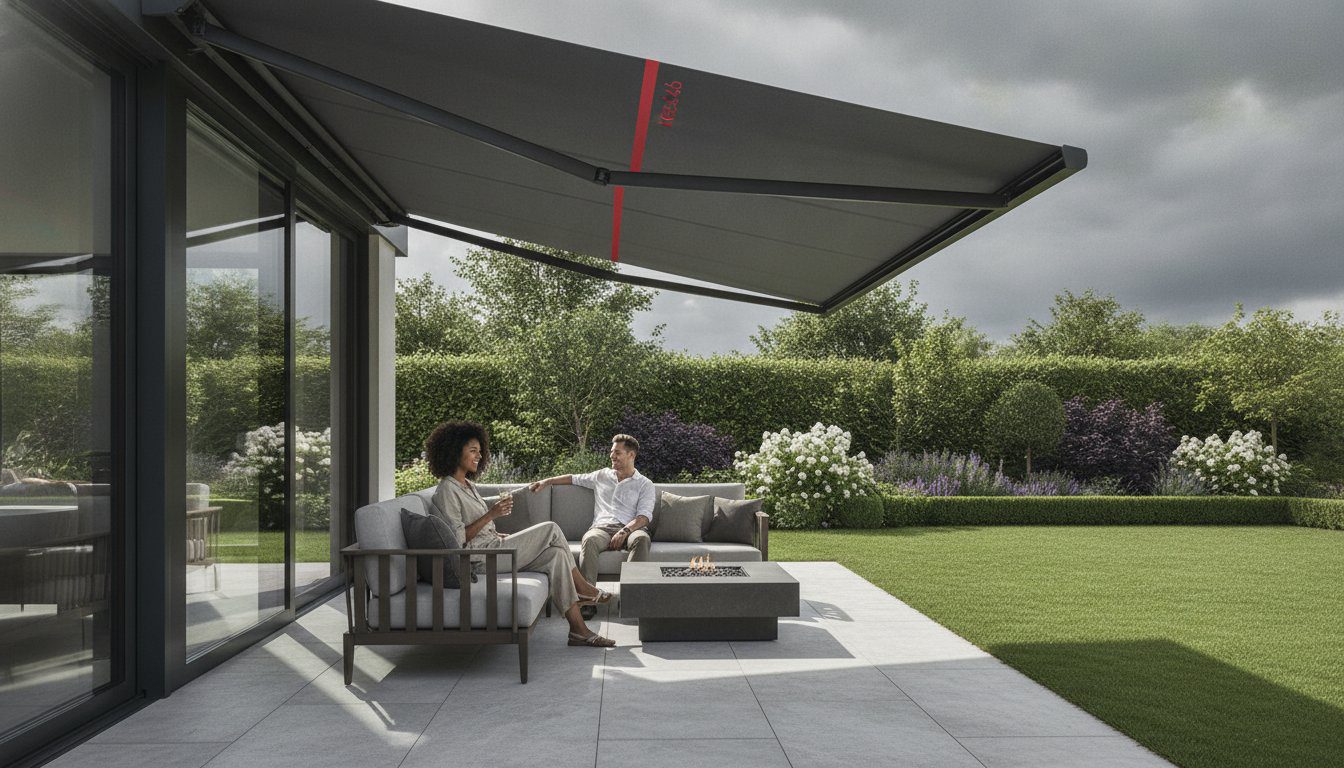
Automatic Patio Awnings: The Complete UK Guide to Smart Shading in 2026
What if your patio could think for itself, retracting your shading the moment a sudden British gust picks up, even whilst you’re miles away from home? For many, the physical effort of operating large manual systems or the fear of wind damage can spoil the experience of high-end patio arm awnings UK gardens deserve. We’ve all experienced that frantic dash to the terrace when the weather turns; it’s a stress that often makes outdoor entertaining feel more like a chore than a relaxation.
We believe your home should be a source of comfort, not a list of chores. In this guide, you’ll discover how intelligent, sensor-driven technology provides effortless protection and a touch of genuine luxury for your outdoor space. We will explore how modern automatic systems integrate with your existing smart home setup to protect your furniture from UV exposure and boost your property value, giving you a truly “set and forget” shading solution for 2026. From engineering standards to bespoke design, we’ll show you how to master the elements with precision and ease.
Key Takeaways
- Learn how intelligent sensors and tubular motors transform standard shading into a proactive safety system that reacts instantly to the unpredictable British weather.
- Discover why the patio arm awnings UK homeowners prefer are increasingly motorised to prevent wind damage and extend the lifespan of bespoke fabrics.
- Explore the seamless integration of automatic awnings with smart home ecosystems, allowing for effortless control via smartphone apps or voice commands from anywhere.
- Understand the critical importance of professional structural testing and certified electrical installation to ensure your high-end investment remains safe and durable.
- Find out how “set and forget” automation reduces the physical effort of manual operation whilst significantly enhancing your property’s kerb appeal and value.
Understanding Automatic Patio Awnings: Beyond the Manual Crank
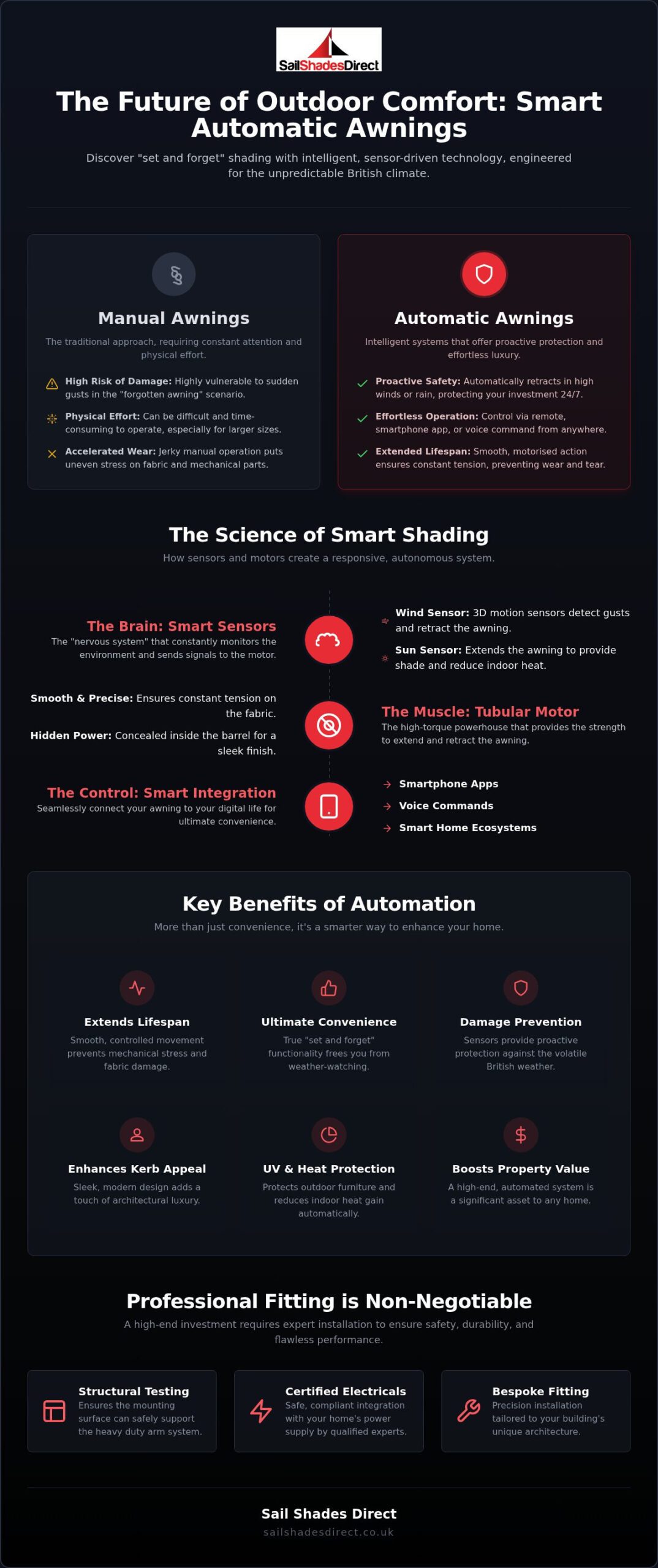
An automatic patio awning is far more than just a motorised version of a traditional sunshade. Whilst a standard motorised system simply replaces the manual handle with an electric motor, a truly automatic system is governed by intelligent logic. It uses a combination of heavy duty arm awnings, high-torque tubular motors, and remote receivers to create a responsive environment. These systems don’t just wait for your command; they monitor the surroundings and act on your behalf. In 2026, the UK market has shifted decisively toward these autonomous solutions as homeowners seek to eliminate the guesswork and physical labour associated with outdoor living.
The core of this technology lies in the tubular motor, a slim powerhouse tucked neatly inside the awning barrel. This is paired with a remote receiver that communicates with weather sensors, making the distinction between “motorised” and “smart” very clear. A motorised awning requires you to find the remote when the wind picks up; an automatic system has already retracted itself before you’ve even noticed the breeze. When selecting patio arm awnings UK residents now prioritise this “set and forget” capability to protect their investment from the volatile British climate.
The Evolution of Retractable Garden Awnings UK
Garden shading has undergone a remarkable transformation. We’ve moved away from the heavy, iron-framed Victorian shopfront blinds of the past toward sleek, architectural statements. Modern systems utilise marine-grade, powder-coated aluminium which offers incredible durability without the weight. This evolution has led to “invisible” technology where the mechanical components are hidden within compact cassettes, allowing the shading to blend seamlessly into the building’s facade when not in use. It’s a move from purely functional covers to engineered design pieces.
Manual vs. Automatic: A Quick Comparison
Why move away from the manual crank? For larger spans, the physical effort required to extend a heavy awning can be significant, often making it inaccessible for some users. Beyond accessibility, there is the issue of longevity. Manual cranking is often jerky, which puts uneven stress on the bespoke fabrics and internal springs. In contrast, Modern motorized awnings provide a smooth, constant tension that prevents fabric tearing and mechanical wear.
The most compelling argument, however, is the “forgotten awning” scenario. We’ve all seen a sudden summer storm catch a neighbourhood off guard. A manual awning left out in a gust can suffer terminal frame damage in seconds. Automatic systems remove this risk entirely, using sensors to ensure the arms retract safely the moment thresholds are exceeded. This level of protection is why many consider high quality patio awnings with automation to be a necessity rather than a luxury for the patio arm awnings UK climate demands.
The Science of Smart Shading: How Weather Sensors and Motors Work
While many homeowners view an electric motor as the peak of convenience, the real intelligence of modern patio arm awnings UK residents choose lies in the sensor array. The system’s heart is the tubular motor. It’s a slim, high-torque unit that fits entirely inside the fabric barrel, providing the muscle needed to extend and retract large spans of fabric with precision. However, a motor alone is reactive. To make a system truly “smart,” it requires a nervous system of sensors that monitor the environment in real time, making decisions so you don’t have to.
These sensors act as a protective shield for your home and the awning itself. By constantly measuring light levels, wind speed, and moisture, they ensure the system is always in the optimal position. This level of automation transforms a simple sunshade into a proactive climate control tool. It’s a sophisticated approach that moves beyond basic remote-control operation into the world of autonomous garden management.
Wind Sensors: Your Awning’s Best Friend
In the UK, wind is the primary cause of damage to external shading. Traditional anemometers with spinning cups are still used, but the gold standard in 2026 is the 3D motion or vibration sensor. These are mounted directly onto the front profile of heavy duty arm awnings to detect actual movement rather than just air speed. If a sudden gust causes the arms to bounce beyond a pre-set threshold, the sensor triggers an immediate retraction. This is vital because wind behaviour can vary wildly between a sheltered garden and an exposed coastal terrace. You can customise these sensitivity levels to suit your specific location, ensuring the system doesn’t retract too early but always stays safe.
Solar Tracking and Thermal Comfort
Sun sensors do more than just provide shade for your morning coffee. They are essential for managing “solar gain” inside your home. By deploying the awning automatically when a certain light threshold is reached, these sensors can reduce internal room temperatures by up to 10 degrees. This aligns with modern UK building regulations on overheating, which emphasise the importance of external shading to keep homes habitable during summer peaks. Beyond comfort, this protects your favourite furniture and expensive carpets from UV-induced fading, whilst significantly reducing the need for energy-hungry indoor air conditioning.
Rain sensors complete the package by detecting moisture levels. Whilst high-quality fabrics are water-resistant, they aren’t designed to hold heavy pools of water. The sensor ensures the system retracts before “puddling” can occur, which prevents the fabric from stretching or the frame from undergoing unnecessary stress. If you’re unsure which sensor combination suits your property’s orientation, we can help you design a bespoke configuration that handles the elements perfectly.
Why Automation is Essential for the Unpredictable UK Climate
The UK’s weather is notoriously fickle. One minute it’s glorious sunshine; the next, a squall is rattling the windows. This “four seasons in one day” reality is the biggest hurdle for owners of patio arm awnings UK wide. If you have a manual system, you likely find yourself leaving it retracted “just in case” or, worse, forgetting it’s out when the clouds turn grey. Automation removes this hesitation. It ensures your outdoor space is always ready for use without you having to monitor the Met Office every twenty minutes.
Beyond simple convenience, there is a strong financial case for automated shading. According to the BBSA report on energy savings, external shading is significantly more effective at reducing heat gain than internal blinds. By automating your system, you ensure it deploys exactly when needed, even if you’re at the office or out for lunch. This proactive approach keeps your home cool and protects your bespoke fabrics from unnecessary UV exposure, which significantly extends the life of your investment. It’s about making your home work for you, rather than the other way around.
Overcoming the Wind Challenge in the UK
The UK typically faces higher average wind speeds than many parts of mainland Europe, making the “sail effect” a genuine concern for large patio covers. A large awning acts like a giant wing; even a moderate gust can create massive uplift forces on the wall brackets and arm joints. Smart systems are essential because they react in milliseconds. A human might take a minute to notice a change in weather and another two to wind in a manual crank. By then, the damage is often done. An automated system senses the vibration and retracts before the wind can get a grip.
The Aesthetic Advantage of Automatic Systems
Choosing automation also pays dividends in terms of design. Without the need for manual winding mechanisms, the installation remains incredibly clean. There are no unsightly winding handles or bulky protruding brackets to clutter your exterior walls. Instead, you get smooth, consistent fabric tensioning that ensures your awning looks its best every time it’s deployed. We even offer custom colour matching for sensor housings to ensure they disappear against your awning frame or brickwork, maintaining the architectural integrity of your home.
Automation also provides a subtle security boost. By setting your system on a timer or using a smartphone app, you can make your home look occupied whilst you’re away. An awning that extends in the morning and retracts in the evening suggests someone is home, acting as a natural deterrent. When you pair this with integrated LED lighting and infrared heaters, your patio becomes a versatile, year-round room that adapts to your life. It’s a simple way to add value and functionality to your property without the stress of constant manual adjustment.
Selecting Your System: Integration, Control, and Fabric Choice
Selecting the perfect configuration for the high-end patio arm awnings UK homeowners favour is about balancing technical performance with lifestyle integration. By 2026, the standard for luxury has moved from simple hand-held remotes to full smart home integration. You can now connect your shading to ecosystems like Alexa, Google Home, or Apple HomeKit, turning your garden into a truly responsive extension of your living room. This connectivity allows your awning to work in tandem with other smart devices, creating a unified outdoor environment that adapts to your needs throughout the day.
Voice Control and App Integration
The convenience of voice activation cannot be overstated. Simply saying, “Alexa, open the awning,” allows you to transform your terrace whilst your hands are full with drinks or garden tools. Beyond simple commands, the real power lies in creating “Scenes.” You can link your awning’s movement to your outdoor lighting and music; as the sun sets, the shade retracts, the infrared heaters activate, and the ambient lights dim to a pre-set level. These smart hubs also offer app-based control, letting you manage your shade from your smartphone anywhere in the world. If you’re at work and a storm rolls in, a quick tap on your screen provides instant peace of mind.
Bespoke Fabric Selection for UK Weather
Whilst budget retailers often push polyester as a valid choice, engineered systems rely on solution-dyed acrylics for a reason. Polyester is prone to sagging and stretching under the constant tension of motorised arms, whereas acrylic maintains its shape and vibrant colour for decades. In our damp climate, we prioritise fabrics with self-cleaning coatings and high fungal resistance. This ensures that even if the awning is retracted whilst slightly damp during a sudden shower, the fabric remains protected from mildew and staining. You can browse our collection of bespoke awning fabrics to find a technical material that complements your home’s aesthetic.
Finally, you must consider the physical dimensions of your system. The projection and width must be carefully calculated to provide maximum coverage without overwhelming the building’s architecture or exceeding the structural limits of the wall. When choosing patio arm awnings UK installations require, it’s vital to ensure the fabric remains taut across the entire span. High-quality acrylics facilitate this perfectly, allowing the motor to maintain the ideal tensioning for a crisp, professional look every time the system is deployed. This attention to detail in the selection phase ensures your investment remains a beautiful and functional part of your home for years to come.
Bespoke Automatic Solutions: Why Professional Fitting is Non-Negotiable
A motorised awning is a serious piece of engineering. Whilst the convenience of a remote-controlled system is undeniable, the physical reality of the installation is often underestimated. Motorised high quality patio awnings can weigh well over 100kg; when you factor in the leverage exerted by the arms at full extension, the stress on your property’s facade is immense. This is why structural wall testing is a critical first step. We don’t just bolt a bracket to a wall; we assess the substrate to ensure it can handle the dynamic loads of a 2026 smart system.
Electrical safety is another area where professional expertise is essential. These systems aren’t “plug and play” devices. Mains-powered tubular motors require a dedicated, RCD-protected outdoor supply that complies with current UK wiring regulations. This isn’t just about making the motor turn; it’s about ensuring the entire circuit is safe for outdoor use in our damp climate. A certified electrician is a mandatory part of any reliable installation, ensuring your home’s internal power remains unaffected by your new garden luxury. If you are planning further electrical improvements, you may wish to explore Project-based installation fees for renewable energy systems to see how solar and battery tech can be integrated.
Precision calibration is the final piece of the puzzle. An automatic system is only as good as its sensors. If a wind sensor is positioned in a “dead spot” where the house blocks the breeze, it won’t retract the arms when a gust hits the front profile. Our installers ensure that every anemometer and sun sensor is positioned for maximum accuracy. We take a holistic approach at Sail Shades Direct, managing every detail from the initial bespoke design to the final national installation, ensuring your system performs exactly as promised.
The Pitfalls of DIY Awning Kits
Whilst the allure of a weekend DIY project is understandable, off-the-shelf automatic systems often fall short. Generic brackets are designed for “ideal” brickwork, but UK homes, particularly those with modern cavity walls or older, crumbly bricks, rarely offer ideal conditions. A poor fixing doesn’t just lead to a wonky awning; it can cause structural damage to your home. Furthermore, professional awning installation is usually a requirement for your warranty. If a DIY-fitted unit fails due to incorrect mounting or poor sensor calibration, you’ll likely find your guarantee is void.
Your Path to Premium Shading
Our consultation process is designed to remove the stress from your decision. We begin by identifying the specific wind exposure of your terrace and the sun paths across your garden throughout the seasons. This data allows us to tailor the automation to your lifestyle; perhaps you want the shade to deploy earlier to protect a south-facing lounge, or you need higher wind sensitivity for a coastal balcony. The next step is simple. You can book a site survey with our experts to discuss your bespoke UK project, allowing us to handle the technical complexity whilst you focus on enjoying your transformed outdoor space.
Take Control of Your Outdoor Comfort
Investing in a smart shading system is about more than just convenience; it’s about protecting your home and enhancing your lifestyle. We’ve explored how premium weather-responsive sensor technology acts as a silent guardian for the patio arm awnings UK gardens rely on, ensuring safety even when the weather turns whilst you’re away. By choosing a system that integrates with your smart home, you turn a simple sunshade into a sophisticated climate control tool.
The difference between a standard kit and a truly luxury experience lies in the precision of the fit. Our bespoke engineering ensures every installation is tailored to your specific patio size and wind exposure. It’s built to last. With our expert national installation service available across the UK, you don’t have to worry about the technical complexities of structural testing or electrical safety. Are you ready to transform your terrace into a responsive, year-round retreat? Request a Bespoke Quote for Your Automatic Patio Awning today and let us help you create the perfect environment. We’re here to ensure your outdoor space becomes the reprieve you deserve.
Frequently Asked Questions
Are automatic patio awnings waterproof enough for heavy UK rain?
High-quality patio arm awnings UK residents install are water-resistant rather than fully waterproof. Whilst the bespoke acrylic fabric sheds light showers effectively, the rain sensor is designed to retract the system before heavy water can pool on the surface. This proactive measure prevents the fabric from stretching and protects the internal arm tensioning from the immense weight of standing water.
What happens to my automatic awning during a power cut?
In the event of a power cut, your automatic awning will remain in its current position. If it’s extended, it’ll stay out until the power is restored. Some high-specification models include a manual override facility, allowing you to use a traditional crank handle in emergencies. However, most modern systems are designed to wait for the return of power for standard operation.
Do I need a special electrical supply for an automatic awning?
You do need a dedicated electrical supply for any motorised shading system. This typically involves a 230V mains connection, which must be RCD-protected and installed by a certified electrician to meet current UK safety standards. We ensure all cabling is discreetly routed and fully weatherproofed to handle our damp climate without compromising the architectural look of your home.
How long do the sensors and motors typically last in the UK climate?
When properly maintained, high-quality tubular motors and sensors typically last between 10 and 15 years in the UK climate. The motors are sealed units specifically engineered for external use, whilst sensors are built from UV-stabilised materials to prevent brittleness. Regular professional servicing helps ensure that the software and mechanical components continue to communicate effectively and reliably year after year.
Can I add automatic sensors to my existing manual awning?
You can’t usually add automatic sensors to a manual awning because they require an internal motor to receive the signals. If your awning is already motorised but lacks sensors, we can often integrate them into your existing setup. If you currently have a manual crank system, a full replacement is usually the most cost-effective way to achieve the “set and forget” automation you’re looking for.
How noisy are the motors in automatic patio awnings?
Modern awning motors are remarkably quiet during operation. You’ll hear a gentle, low-frequency hum whilst the fabric is moving, which is similar to the sound of a quiet electric car window. Once the awning reaches its full extension or retraction, the motor shuts off completely. This ensures your peaceful afternoon in the garden isn’t interrupted by any loud mechanical clatter or vibration.
Are automatic awnings safe to leave out when I am not at home?
Yes, automatic systems are specifically designed to be left unattended. The sensor array acts as a 24/7 monitor, retracting the patio arm awnings UK homeowners have invested in if wind speeds rise or light levels drop. This proactive behaviour provides genuine peace of mind, knowing your property is protected even if you’re miles away when a sudden summer storm hits.
What is the maximum wind speed an automatic awning can handle?
Most premium awnings are tested to BS EN 13561 standards and typically fall into Wind Class 2 or 3. This means they can safely handle wind speeds between 24mph and 30mph. However, our automatic sensors are typically calibrated to trigger a retraction well before these maximum limits are reached. This conservative approach ensures the long-term structural integrity of the wall fixings and the arm joints.