
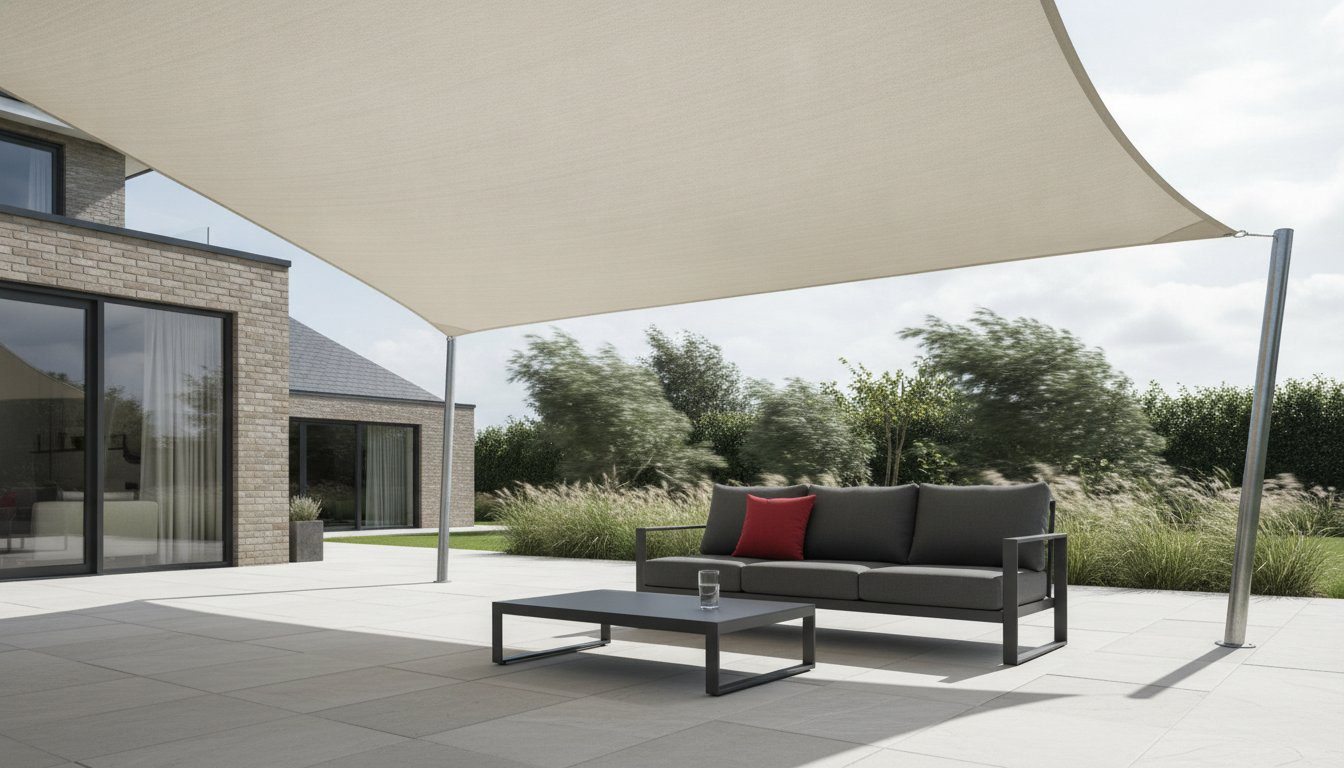
Windy Garden and Patio Solutions: 2026 UK Guide
Did you know that trying to block the wind entirely with a solid barrier often creates more turbulence and discomfort than it solves? It’s incredibly frustrating when a long-awaited afternoon in your favourite garden chair is cut short because a sudden gust has sent your umbrella flying or the wind chill has made it far too cold to sit out. If you are tired of flimsy fixes, it’s time to look at professional, engineered solutions for a windy garden or patio that actually work. We understand that feeling of unease when a standard awning begins to rattle or strain against its fixings, making your outdoor space feel more like a hazard than a retreat.
The good news is that you don’t have to retreat indoors. This guide promises to show you how to transform even the most blustery terrace into a calm, sheltered sanctuary using bespoke shading and expert tensioning. We’ll explore how high-performance rolling sun sails and architectural sail shades can filter the breeze with precision, providing year-round protection whilst looking effortlessly premium. From heavy-duty giant umbrellas to sleek exterior blinds, we’ll help you create a sophisticated outdoor dining area that remains comfortable no matter how hard the wind blows!
Key Takeaways
- Understand why solid barriers often create damaging turbulence and how to identify the “wind tunnel” effect in modern British housing developments.
- Explore professional solutions for a windy garden or patio, including bespoke sail shades engineered to withstand significant wind loads through precision tensioning.
- Learn how heavy-duty arm awnings and exterior blinds offer robust side-on protection and stability, even in exposed coastal locations.
- Discover the “40% porosity” rule and how to design a wind-resistant layout that filters the breeze rather than trying to block it entirely.
- Find out why custom-manufactured shading thrives in the UK climate whilst mass-produced garden centre alternatives often fail under pressure.
Understanding Wind Behaviour in the British Garden
Modern UK housing developments are often designed with density in mind, but this architectural efficiency has a side effect: the creation of unintended wind tunnels. When houses are built close together, narrow gaps between brickwork act like nozzles, squeezing and accelerating air directly onto your terrace. This is why standard solutions for a windy garden or patio often fail. They simply aren’t designed to cope with the concentrated force of air that has been funnelled through a housing estate before it reaches your back door.
The Problem with Solid Barriers
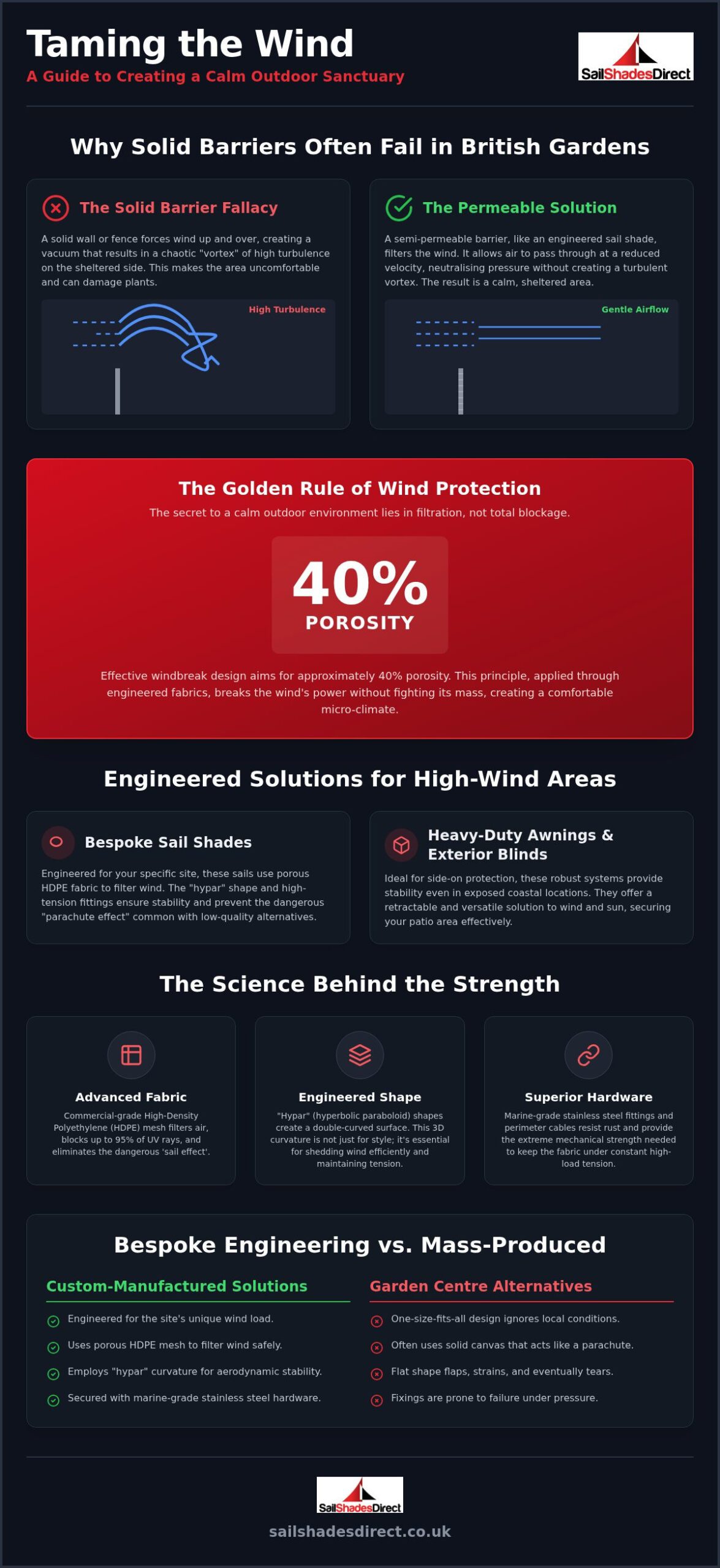
It is a common mistake to assume that a tall, solid fence is the best defence against a gale. In reality, a solid wall often makes the situation worse by creating a vacuum on the leeward side. When a gust hits a solid barrier, it’s forced upwards and over the top, where it tumbles back down in a chaotic “vortex” or “eddy”. This energy “dumping” creates a zone of high turbulence right where you want to relax. Traditional Windbreak principles suggest that a structure should be semi-permeable to be truly effective. Plants and furniture often suffer more behind a solid wall because they are buffeted by these unpredictable swirls rather than a steady stream. A porous solution allows air to pass through at a much lower velocity, neutralising the pressure without creating a vacuum.
Identifying Your Garden Micro-Climate
You need to know your enemy before you can defeat it. Whilst prevailing winds in Britain typically arrive from the South-West, the layout of your street can twist these currents into something entirely different. Use simple markers, such as ribbons tied to bamboo canes, to track how air moves through your space. Look out for “corner acceleration”, a phenomenon where wind speeds can double as they whip around the edge of a building. In a garden setting, laminar flow refers to a smooth, predictable stream of air, whilst turbulent flow is the chaotic, swirling mess that makes low-quality awnings rattle and feel unsafe. Recognising these zones is the first step toward implementing professional solutions for a windy garden or patio.
The secret to a calm outdoor environment lies in filtration rather than total blockage. By using high-tension fabrics and engineered structures, you can break the wind’s power without fighting its mass. This approach is particularly effective when using heavy duty arm awnings or bespoke sails, which are designed to remain stable even when the British weather is at its most temperamental. We believe that every garden has its own unique rhythm, and understanding that flow is the key to reclaiming your sanctuary.
Structural Solutions: Bespoke Sail Shades for High-Wind Areas
When seeking robust solutions for a windy garden or patio, the distinction between a mass-produced product and a bespoke installation is critical. Off-the-shelf sails often act like giant parachutes, catching gusts and putting immense strain on fixings. In contrast, bespoke sails are engineered specifically for the site’s unique wind load. We use High-Density Polyethylene (HDPE) mesh, which is a game-changer for blustery UK climates. Unlike solid canvas, this commercial-grade fabric features thousands of tiny pores that filter air whilst blocking up to 95% of UV rays. This reduces the “sail effect” significantly, allowing the structure to remain stable whilst you enjoy a cool, calm environment.
Whilst traditional RHS advice on shelterbelts highlights the value of living windbreaks, structural shading provides immediate, architectural protection that works in tandem with your landscaping. To ensure these structures last, we use marine-grade stainless steel tensioning hardware. These fittings don’t just resist rust; they provide the mechanical strength required to keep the fabric under constant, high-load tension.
The Science of Tension and Curvature
A flat sail is a dangerous sail. Without three-dimensional curvature, fabric flaps and eventually tears under pressure. We utilise “hypar” (hyperbolic paraboloid) shapes, where opposing corners are set at different heights. This creates a double-curved surface that sheds wind pressure efficiently. Our bespoke sail shades UK service focuses on perimeter tensioning, using stainless steel cables sewn into the hems. This ensures the fabric stays taut and silent. It’s engineering you can trust.
Fixed vs. Rolling Sun Sails
Choosing between a permanent installation and a retractable one depends on your specific needs. A fixed architectural sail is ideal for year-round exposure, provided it is professionally tensioned. However, for those who want total control over their environment, motorised rolling sun sails offer the ultimate flexibility. These systems can be equipped with automated wind sensors that detect when the breeze becomes too strong, automatically retracting the fabric to protect your investment. It’s a smart way to manage unpredictable weather.
If you’re unsure which configuration best suits your garden’s micro-climate, it is often helpful to speak with a specialist at Sail Shades Direct to find a tailored fit for your home.
Heavy-Duty Awnings and Exterior Blinds: Side-on Protection
Whilst overhead shade is essential, British weather often presents a more lateral challenge: the side-on breeze that cuts through a patio and makes outdoor dining impossible. Finding the right solutions for a windy garden or patio frequently requires looking beyond simple covers toward mechanical systems designed for stability. If you have ever watched a standard garden centre awning bounce nervously in a light wind, you’ll know that structural integrity isn’t just about the fabric; it’s about the engineering within the arms. High-quality heavy duty arm awnings utilise reinforced joints and tensioned cables that keep the canopy rigid even when the wind picks up.
For those in particularly exposed coastal areas, “drop-arm” designs offer an even more robust profile. By creating a steeper angle and using shorter, sturdier projection arms, these systems provide a low-profile silhouette that the wind struggles to get under. When not in use, a full-cassette housing ensures that both the fabric and the mechanical components are completely sealed away from salt air and driving rain, extending the life of your investment significantly; to explore similar high-end structural solutions like sunrooms or glass railings, you can read more about modern outdoor living designs.
When browsing for an awning, the “Wind Class” rating is your most reliable guide to performance. This European standard (EN 13561) categorises how much pressure a structure can safely handle. We always recommend looking for a solution that hits at least Class 2 or 3 for domestic UK settings.
| Feature | Standard Garden Awning | Commercial-Grade Arm Awning |
|---|---|---|
| Wind Class Rating | Class 0 or 1 (up to 17mph) | Class 2 or 3 (up to 31mph+) |
| Arm Construction | Lightweight aluminium | Forged aluminium with steel cables |
| Housing Type | Open or semi-cassette | Full-cassette protection |
| Installation | Standard wall brackets | Reinforced spreader plates |
Vertical Exterior Blinds as Wind Filtration
Sometimes the most effective way to stay warm is to block the wind chill directly. This is where exterior blinds for patios excel. Unlike flimsy indoor curtains, these vertical systems are locked into “zip” tracks that run down the side of the frame. This prevents the fabric from blowing out like a sail, creating a taught, weather-proof wall at the touch of a button.
Just as RHS advice on windbreaks highlights the importance of permeability in hedges to prevent turbulence, our exterior blinds use specialised translucent mesh. This fabric kills the wind chill whilst allowing enough air through to prevent a vacuum effect. You get to keep your view of the garden whilst sitting in a pocket of perfectly still air. For ultimate peace of mind, we can integrate vibration sensors that automatically retract the system if conditions exceed safe limits, protecting your home even when you aren’t there to manage it.
Designing a Wind-Resistant Garden Layout
Transforming a blustery plot into a sanctuary requires more than just buying a single product; it’s about strategic layout. Creating a sanctuary amongst the gusts starts with understanding the “40% porosity” rule. The most effective windbreaks are never fully solid; they should be approximately 40% to 50% permeable. This allows a portion of the wind to pass through, which prevents the pressure build-up and subsequent turbulence we discussed earlier. When looking for long-term solutions for a windy garden or patio, you should aim to create “zones of calm” by layering your defences.
By installing architectural sail shades UK owners can effectively deflect downdrafts. These occur when wind hits the side of a house and is forced vertically downwards onto the patio. A well-positioned sail catches this air and directs it away from your seating area. Once the overhead protection is in place, you can organise your furniture in the resulting “pockets” of still air, perhaps tucked behind a planter or a low-level exterior blind.
The Multi-Layered Approach
For total protection, we often recommend a multi-layered configuration. Combining a high-level tensioned sail with a low-level exterior blind creates a comprehensive shield against both overhead gusts and lateral breezes. If you require flexibility, giant umbrellas with reinforced masts provide heavy-duty shade that can be closed during extreme weather. For an alternative perspective on high-end structural shading, you can check out Patios Coast2Coast and their comparison of opening roof systems. These permeable or adjustable structures are often a smarter choice than permanent outbuildings. Under UK permitted development rights, structures within two metres of a boundary must stay below 2.5 metres in height. Because sails and umbrellas aren’t classified as solid outbuildings, they often provide the shelter you need whilst remaining within local guidelines.
The choice of fabric is vital for wind performance. Whilst acrylic fabrics are excellent for rain, they can act like a solid wall in a gale. High-density mesh is generally superior for wind filtration because it lets air move through the weave. When it comes to aesthetics, choosing a mid-tone colour like grey or sand is a practical way to hide the dust and debris that wind inevitably carries. For structural longevity, you must ensure your support posts are either galvanised or made from high-grade stainless steel to prevent corrosion and structural fatigue. If you are ready to reclaim your outdoor space, start your garden transformation today with a professional site assessment.
The Sail Shades Direct Approach: Engineering for the UK Climate
At Sail Shades Direct, we don’t believe in “one size fits all” because no two gardens experience the wind in the same way. The challenge of finding effective solutions for a windy garden or patio isn’t just about the fabric you choose; it’s about how that fabric is integrated into your home’s unique landscape. Whilst a garden centre sail might look fine on a calm day, it lacks the structural engineering required to survive a British summer storm. We treat every project as a bespoke engineering challenge, ensuring that your installation is a permanent, value-adding asset rather than a temporary fix.
Bespoke vs. Off-the-Shelf
The hidden risks of “budget” sails often only appear when the first gale hits. You’ll see fraying at the seams, sagging in the centre, and eventually, the total failure of cheap mounting hardware. These products aren’t designed for the high tension required to keep a sail silent and stable. We calculate specific tension loads for every installation, using commercial-grade materials that can handle the strain. Our professional fitting service ensures that every anchor point is structurally sound, giving you the confidence to leave your shading system in place without worrying about the next weather warning. It’s about precision, safety, and a finish that looks architectural rather than accidental.
Next Steps for Your Windy Garden
Our process is designed to be as stress-free as possible. It begins with a comprehensive site analysis where we look at your home’s orientation, local wind patterns, and architectural style. We want your shading solution to feel like a natural extension of your house, matching the lines and colours of your existing structure. To prepare for a site visit, it’s helpful to think about where the wind feels most intrusive and how you intend to use the space at different times of the day.
We invite you to reclaim your outdoor space and turn that blustery patio into the calm sanctuary you’ve always wanted. Whether you’re interested in a rolling sun sail for flexible protection or a permanent architectural shade, we’re here to guide you through the decision-making process. Don’t let the breeze dictate your lifestyle; contact us today to book your expert consultation and discover the difference that professional engineering can make to your home.
Reclaim Your Outdoor Sanctuary Today
Transforming a blustery terrace into a tranquil retreat is entirely possible when you move away from temporary fixes and embrace professional engineering. We have explored how understanding the “vortex effect” and applying the 40% porosity rule can neutralise turbulence before it ruins your afternoon. By choosing bespoke solutions for a windy garden or patio, such as high-tension architectural sails or heavy-duty arm awnings, you ensure your investment is built to thrive in the unpredictable British climate.
Our team at Sail Shades Direct specialises in expert UK-wide installation for both residential and commercial spaces. We utilise commercial-grade, high-tension fabrics and marine-grade hardware to create bespoke designs that don’t just work; they look stunning. It’s time to stop worrying about rattling frames or breaking umbrellas and start enjoying the calm, sheltered environment you deserve!
Book a design consultation with Sail Shades Direct to solve your windy garden problems and take the first step toward a more comfortable, architectural outdoor lifestyle. We are ready to help you transform your space into a year-round sanctuary.
Frequently Asked Questions
Can sail shades stay up in high winds in the UK?
Yes, bespoke sail shades are designed to remain in place during typical British weather, provided they are professionally tensioned. Unlike budget alternatives, these sails use marine-grade stainless steel fixings and high-load cables that prevent flapping and tearing. The double-curved “hypar” shape is essential here, as it sheds wind pressure rather than catching it. For permanent installations, we ensure the structure meets safety standards like BS 6399 to handle foreseeable wind loads.
What is the best fabric for a windy garden?
High-density polyethylene (HDPE) mesh is the superior choice for blustery environments. Unlike solid acrylic fabrics that catch the wind like a parachute, HDPE features thousands of tiny pores. This follows the 40% porosity rule, allowing air to filter through whilst killing the wind chill and blocking UV rays. It’s one of the most effective solutions for a windy garden or patio because it reduces the mechanical strain on your wall fixings and posts.
Do I need planning permission for a sail shade or awning?
Most shading structures fall under permitted development rights, meaning you won’t usually need full planning permission. However, if your structure is within 2 metres of a boundary, it must not exceed 2.5 metres in height. Additionally, outbuildings and structures shouldn’t cover more than 50% of your total garden area. For absolute certainty, you can apply for a Lawful Development Certificate (LDC), which currently carries a fee of £274 in the UK.
How do I stop my patio umbrella from blowing over?
The most effective way to secure a patio is to move away from lightweight, centre-pole umbrellas and invest in heavy-duty giant umbrellas with reinforced masts. These professional-grade systems use bolted-down steel bases or ground sleeves rather than plastic weights. If your area is exceptionally exposed, switching to a tensioned sail shade or a motorised sun sail provides a more permanent, architectural solution that won’t lift or break when a sudden gust hits the terrace.
Are rolling sun sails better than fixed sails for windy areas?
Rolling sun sails offer the ultimate flexibility for unpredictable UK weather. Whilst fixed sails are incredibly robust, rolling versions allow you to retract the fabric completely when the Beaufort scale rises into extreme territory. Many of these systems include automated wind sensors that trigger retraction if vibrations become too high. This provides a balance between permanent architectural style and the proactive safety needed in coastal or high-altitude locations where gusts can be particularly severe.
How much wind can a bespoke arm awning actually handle?
A commercial-grade bespoke arm awning should ideally meet Wind Class 2 or 3 standards. This means the structure is engineered to handle wind speeds up to 31mph or more, depending on the specific model and installation method. We use forged aluminium arms and internal steel cables to maintain rigidity. It’s vital to ensure your installer uses spreader plates on the wall to distribute the load, as the fixings are often the weakest point in high winds.
What is the “vortex effect” and how does it affect my patio?
The vortex effect occurs when wind hits a solid barrier, like a brick wall or fence, and is forced upwards before tumbling back down in a chaotic swirl. This creates a zone of high turbulence on the leeward side, which is often where people place their seating. By using permeable solutions for a windy garden or patio, you allow the air to filter through at a reduced speed, which neutralises the pressure and prevents these uncomfortable eddies.
Can exterior blinds really reduce wind chill?
Exterior blinds are remarkably effective at reducing wind chill by creating a pocket of still air on your terrace. When locked into “zip” tracks, the fabric stays taut and won’t billow out. By using specialised translucent mesh, the blind filters the breeze rather than blocking it entirely, which stops the vacuum effect. You’ll find that your patio feels several degrees warmer once the biting wind is neutralised, allowing you to stay outdoors much longer.