
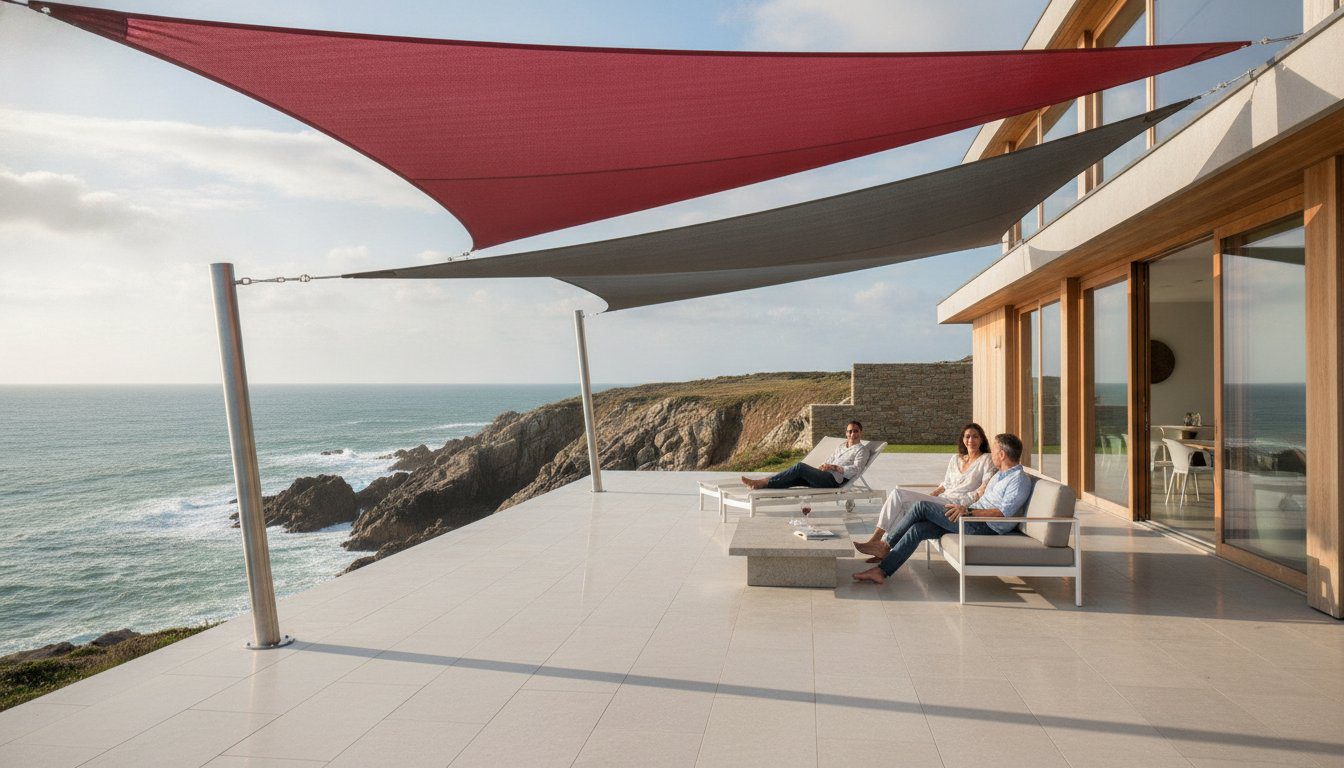
Coastal Shade Sails UK: The Professional Guide to Seaside Shading in 2026
In a British coastal environment, a shade sail isn’t just a piece of fabric; it’s a serious structural engineering project. You’ve likely felt the frustration of a snapped garden umbrella or watched a standard awning succumb to the relentless salt spray and gale-force winds of the Atlantic. It’s disheartening to see your outdoor investment fade and degrade under intense UV rays while the very breeze you want to enjoy threatens to tear the structure apart. We understand that finding the coastal shade sails UK homeowners can actually rely on is a matter of safety as much as style.
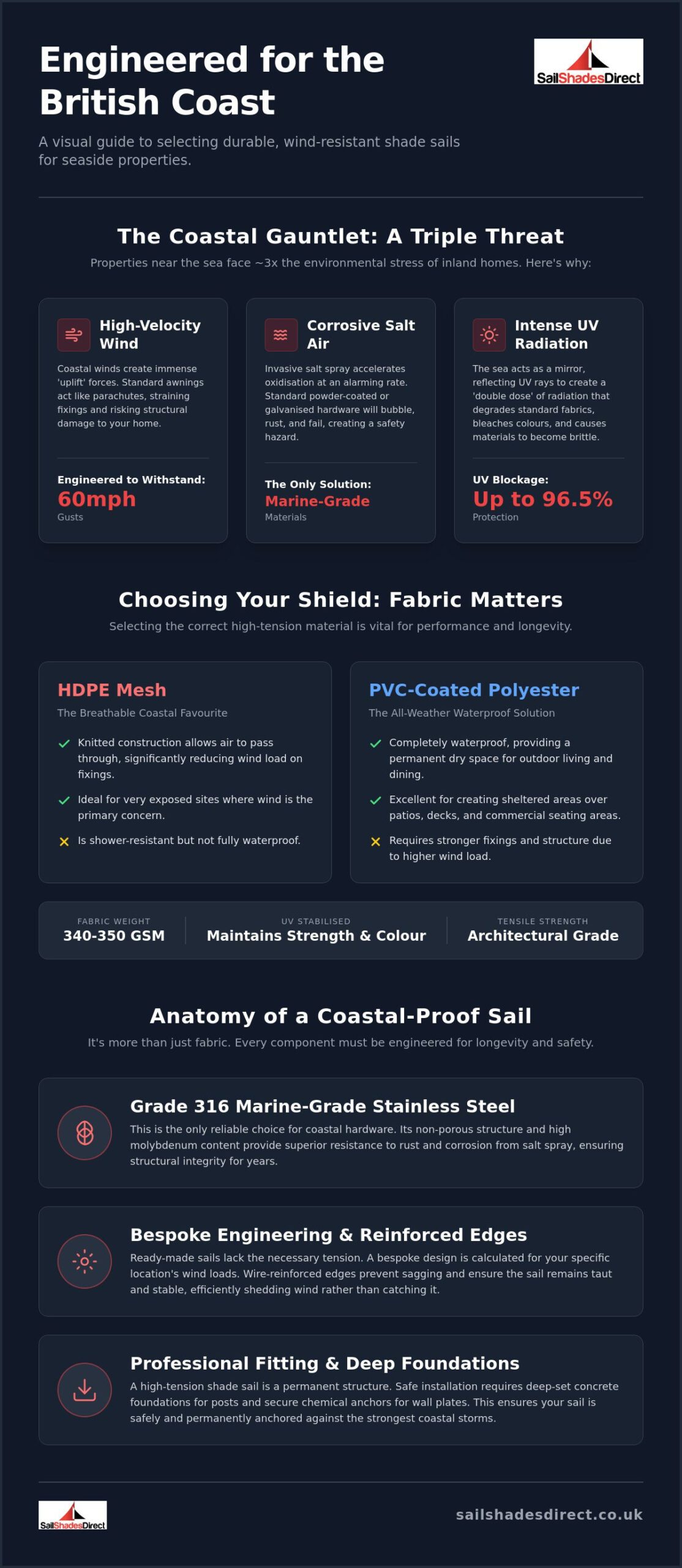
This guide will show you how to protect your seaside property with bespoke, wind-resistant solutions engineered for our unique climate. You’ll learn how to achieve a permanent outdoor living space using marine-grade materials that can withstand 60mph winds and block up to 96.5% of harmful UV rays. We’ll explore the bespoke design process, the necessity of professional installation, and how to ensure your coastal retreat remains durable and beautiful for years to come.
Key Takeaways
- Understand why seaside properties face triple the environmental stress of inland homes and how to prevent salt spray from corroding your outdoor structures.
- Learn the vital differences between breathable HDPE mesh and waterproof PVC fabrics to select the right high-tension material for your specific microclimate.
- Discover why bespoke engineering and wire-reinforced edges are necessary for coastal shade sails UK to withstand high-velocity winds and gusty conditions.
- Identify why Grade 316 marine-grade stainless steel is the only reliable hardware choice for preventing rust and ensuring structural longevity in salt-heavy air.
- Explore the professional fitting process that ensures your shade sail is safely anchored with deep-set foundations for a stylish, permanent outdoor retreat.
The Unique Challenges of Coastal Shading in the UK
Living by the British coast is a dream for many, but for outdoor structures, it’s a constant battle against the elements. Properties within 20 miles of the shoreline face roughly three times the environmental stress of their inland counterparts. This isn’t just about the occasional winter storm; it’s the relentless, abrasive combination of salt, high-velocity wind, and reflected light that defines the seaside microclimate. When planning coastal shade sails UK homeowners must look beyond aesthetics and consider the harsh physics of the coast.
The sea acts as a giant mirror, reflecting UV rays back up towards your property. This creates a double-dose of radiation that quickly degrades standard fabrics and causes colours to bleach within a single season. Modern Shade sail technology has evolved to combat this, utilising UV-stabilised high-density polyethylene that maintains its structural integrity even under constant solar assault. Without this professional-grade engineering, a simple garden canopy will likely become brittle and fail just when you need it most.
Corrosion and Salt Air: The Silent Killer of Outdoor Shading
Salt air is incredibly invasive. It’s a hygroscopic force that pulls moisture from the air and traps it against metal surfaces, accelerating oxidisation at an alarming rate. Standard powder-coated hardware that thrives in a suburban setting will often fail near the sea because salt finds its way into microscopic pores in the coating. Once the metal bubbles and rusts from the inside, the entire structure becomes a safety hazard. This is why “water-resistant” finishes are never enough for the British coast. We prioritise non-porous, marine-grade materials that can withstand the corrosive “salt-fog” that rolls in off the Atlantic or the North Sea, ensuring your investment doesn’t literally rust away.
Wind Loading: Why Standard Umbrellas Fail
The UK uses a zonal system to categorise wind loading, and most coastal regions sit in the highest-pressure brackets. In these areas, wind doesn’t just blow horizontally; it creates massive “uplift” as it hits house walls and gets trapped under fabric surfaces. A standard garden umbrella or a cheap, ready-made sail lacks the tensioning required to handle these loads. Instead of shedding the wind, they act like a parachute, putting immense strain on fixings and potentially causing structural damage to your home. Professional coastal shade sails UK are designed as high-tension systems that remain stable during 60mph gusts, providing peace of mind during the unpredictable British summer.
Selecting the Right Fabric for Coastal Shade Sails UK
To survive the British coastline, a fabric must be more than just thick; it requires specific molecular engineering. Coastal-grade fabric refers to high-density polyethylene (HDPE) or PVC-coated polyester that has been treated with advanced UV inhibitors and designed for high-tension applications. Unlike standard retail fabrics that often stretch or sag after a single season, these materials are built to maintain their structural memory under the constant “buffeting” of coastal winds. When investing in coastal shade sails UK homeowners should look for materials that offer a balance between tensile strength and atmospheric resistance.
UV protection is a non-negotiable factor in seaside environments. Because the sea reflects radiation back towards your property, your shading must provide a shield from both direct and reflected light. Professional-grade fabrics typically offer a minimum of 95% UV blockage, with many high-end options reaching up to 96.5%. This doesn’t just protect your skin; it prevents the underlying furniture and decking from bleaching in the sun. Choosing a fabric with a weight of 340-350 GSM ensures the weave is dense enough to provide this protection whilst remaining strong enough to be tensioned to architectural standards.
Colour choice also plays a practical role in maintenance. Whilst deep blues and charcoals are aesthetically striking and offer slightly higher UV blockage, they can highlight white salt residue more clearly than lighter tones. Sand, silver-grey, and ivory are popular seaside favourites because they mask salt crusting effectively whilst complementing the natural coastal palette. If you’re unsure which material or colour suits your specific terrace, our team can help you compare bespoke sail shades tailored to your local microclimate.
HDPE Mesh: The Breathable Coastal Favourite
High-density polyethylene (HDPE) mesh is often the preferred choice for exposed coastal sites. The knitted construction allows air to pass through the fabric, which significantly reduces the wind load on your wall fixings and posts. This “breathable” quality also creates a superior cooling effect; hot air isn’t trapped beneath the sail but is allowed to rise and escape through the mesh. For permanent installations, we recommend a heavy-duty HDPE of at least 340 GSM to ensure the structure remains stable during the gusty conditions typical of the British shore.
Waterproof PVC: Maximum Protection for UK Weather
If you want to use your outdoor space regardless of the drizzle, waterproof PVC-coated polyester is the ideal solution. These fabrics are completely non-porous, making them excellent for protecting outdoor kitchens or dining areas from both rain and salt spray. However, they require much higher tension and more precise angling than mesh sails to prevent “ponding,” where rainwater collects in the centre of the fabric. Regular rinsing with fresh water is essential for PVC sails to prevent salt crystals from scratching the protective coating over time.
Bespoke Engineering vs. Ready-Made Coastal Sails
Choosing between a ready-made sail and a bespoke installation is often the difference between a temporary garden accessory and a permanent architectural fixture. In a sheltered inland garden, a mass-produced sail with “taped edges” might survive a few seasons of light use. On the British coast, however, these products are frequently outmatched by the first significant gale. For coastal shade sails UK properties require a level of engineering that ready-made options simply cannot provide, starting with how the fabric handles tension.
The fundamental flaw in ready-made sails is their reliance on simple webbing or taped perimeters. When the wind hits, the fabric stretches unevenly, leading to sagging and “flapping” that eventually tears the material at the corners. Professional bespoke sails utilise a stainless steel perimeter wire rope hidden within the hem. This cable acts as the skeleton of the structure, distributing the immense wind loads evenly across the entire surface and transferring that energy into the heavy-duty wall plates or posts. This ensures the sail remains “drum-tight” and silent, even during the gusty conditions typical of a seaside terrace.
Accuracy is another critical factor. Coastal homes often feature complex layouts with glass balustrades, varying roof heights, and specific sightlines that must be preserved. We use 3D precision measuring to account for every millimetre of structural movement and potential tension loss. This bespoke approach ensures your sail fits perfectly within your architectural footprint without obstructing those all-important sea views or putting undue stress on delicate masonry. Whilst a DIY kit might cost less upfront, a professional installation has a life expectancy of 10 to 15 years, whereas cheap alternatives often fail within 24 months. For a deeper understanding of how to plan a structure that balances engineering with aesthetics, our guide to custom exterior shading design for UK spaces walks you through every key decision from fabric selection to fixing points.
Structural Integrity and Wire Reinforcement
The secret to a long-lasting seaside installation lies in how it manages force. Our bespoke designs replace flimsy D-rings with heavy-duty, marine-grade corner plates that can withstand significantly higher tension. By using a continuous stainless steel cable around the perimeter, we ensure the sail maintains its shape and tension for years rather than weeks. To understand more about the physics of these high-tension systems, you can explore our detailed guide on Wind Resistant Sun Sails.
Tailored Fit for Coastal Architecture
Seaside properties are rarely standard shapes. Whether you’re shading a cantilevered balcony or a multi-level deck, the sail must be designed to complement the building’s lines. A bespoke design allows for creative, overlapping “Hypar” shapes that provide maximum UV protection whilst maintaining a sense of openness. This level of customisation is essential for Architectural Sail Shades UK, where the goal is to enhance the property’s value and aesthetic appeal without compromising on safety or durability in high-exposure zones.
Installation and Marine-Grade Hardware Requirements
In coastal environments, the hardware is just as critical as the fabric itself. Whilst many suppliers offer basic fixing kits, these are often inadequate for the high-exposure zones of the British coastline. For coastal shade sails UK installations, every turnbuckle, shackle, and wall plate must be engineered to resist salt-water corrosion and extreme mechanical stress. If the hardware fails, the entire structure becomes a liability rather than an asset. We focus on the invisible details that ensure your sail remains secure through every Atlantic gale.
Securing a sail to a seaside property requires more than just a standard drill and plug. We utilise chemical anchoring systems for wall fixings, where a high-strength resin is injected into the masonry to create a bond that’s effectively stronger than the brick itself. For freestanding posts, deep-set foundations are a necessity. A professional installation typically requires concrete footings reaching depths of over a metre to counteract the “lever” effect of high winds. This ensures that the structure remains rooted, providing the peace of mind that a DIY solution simply cannot offer. For coastal properties where wall fixings are not viable, freestanding sail shades offer a compelling architectural alternative that stands entirely on its own without requiring any attachment to your home’s exterior.
Grade 316 vs. Grade 304 Stainless Steel
The chemical difference between Grade 304 and Grade 316 stainless steel is subtle but vital. Grade 316 contains molybdenum, an element that provides superior resistance to chlorides and salt. In seaside areas, Grade 304 often develops “tea staining,” which is a brown, rusty discolouration that isn’t just unsightly but indicates the metal is being eaten away. We exclusively use Grade 316 marine-grade hardware because it maintains its structural integrity and polished finish even when subjected to constant sea spray. It’s the only way to guarantee a rust-free lifespan for your coastal shade sails UK project.
Post and Wall Attachments for High-Exposure Areas
High-exposure areas demand hardware that can handle wind sheer and horizontal tension. Standard eye bolts are prone to bending under the pressure of a 60mph gust. Instead, we use reinforced heavy-duty wall plates that spread the load across a larger surface area. This protects your property’s facade from structural stress and cracking. Additionally, the use of adjustable turnbuckles allows for precise tensioning. A loose sail is a dangerous sail; professional tensioning keeps the fabric taut, preventing the “flapping” that leads to material fatigue and hardware failure. If you’re ready to secure your terrace with a system built to last, you can book a professional installation consultation with our coastal experts today.
Designing Your Coastal Retreat with Sail Shades Direct
At Sail Shades Direct, we believe an outdoor space should be a sanctuary from the daily grind. Our process for installing coastal shade sails UK homeowners love begins with a comprehensive site assessment. We don’t just measure the distance between two points; we evaluate your property’s orientation, the prevailing wind direction, and the specific masonry or ground conditions. This thorough approach ensures that every bespoke structure we create is perfectly balanced between aesthetic beauty and structural resilience.
Integrating your new shade sail with existing features is where the design truly comes to life. Whether you have a weathered timber deck or contemporary porcelain tiling, we design our systems to feel like a natural extension of your architecture. Our sails can be positioned to provide relief for specific seating areas whilst leaving other zones open to the sky. This allows you to curate the perfect atmosphere for your seaside retreat, ensuring you can enjoy the coastal air without the discomfort of relentless sun or unpredictable gusts.
Residential Coastal Elegance
Creating a sheltered pocket amongst the dunes or on a cliff-top terrace requires a deep understanding of local conditions. By using a palette of slate, sand, and navy, we can harmonise your shading with the natural tones of the British coastline. Our goal is to provide more than just shade; we want to create a wind-protected zone where you can enjoy alfresco dining in peace. For more inspiration on customising your home, see our guide to Bespoke Sail Shades UK.
Commercial Seaside Shading Solutions
For coastal businesses, outdoor space is often the primary driver of revenue during the summer months. Our durable solutions allow pubs, hotels, and cafes to increase their covers whilst providing customers with a premium, protected experience. We offer branding opportunities through bespoke colours and shapes, ensuring your terrace stands out on the promenade. These structures are built for longevity, meaning you won’t have to worry about replacing them after a single season of heavy use. Businesses can find more technical details in our Commercial Shading Solutions UK resource.
Ready to transform your seaside property? The path to a safer, more stylish outdoor environment starts with a conversation. We take pride in our craftsmanship and our ability to solve complex shading problems for properties of all scales. Organising a consultation is simple; just get in touch to discuss your vision, and we’ll help you navigate the journey from initial concept to professional fitting.
Secure Your Seaside Sanctuary Today
Your seaside property deserves more than a temporary fix that fails at the first sign of a storm. We’ve explored why architectural-grade engineering is the only way to combat the triple threat of salt, wind, and intense UV reflection. By choosing bespoke UK manufacturing and marine-grade 316 stainless steel hardware, you’re not just buying a canopy; you’re investing in a durable extension of your home. The right choice ensures your outdoor space remains a reprieve rather than a source of maintenance stress.
From precise 3D site assessments to expert nationwide installation, the difference lies in the technical details that keep your structure safe and silent. Don’t let the unpredictable British weather dictate how you use your terrace. It’s time to reclaim your view and enjoy the coastal breeze with complete peace of mind. Design your perfect coastal retreat with our bespoke shade sails and discover why professional coastal shade sails UK are the gold standard for seaside living. We’re ready to help you create a beautiful, resilient space you’ll love for years to come.
Frequently Asked Questions
Can coastal shade sails stay up all year round in the UK?
Professional-grade sails are designed for permanent installation, but we generally recommend removing the fabric during the winter months to protect it from heavy snow and ice loading. Whilst the high-tension systems can handle coastal storms, ice can stretch the fibres. The hardware remains in place, allowing you to re-attach the sail easily in spring.
What is the best fabric for high-wind seaside locations?
High-density polyethylene (HDPE) mesh is the gold standard for high-wind areas because its knitted construction allows air to pass through. This significantly reduces the pressure on your wall fixings compared to solid fabrics. For coastal shade sails UK installations, we recommend a heavy-duty weight of 340-350 GSM for maximum durability and UV protection.
How do I clean salt residue off my coastal shade sail?
You should rinse your sail with fresh water from a garden hose every few months to prevent salt crusting. For more stubborn residue, use a soft brush and a mild, pH-neutral soap solution. Never use a pressure washer or harsh chemicals; these can damage the UV-stabilised coating and weaken the fabric’s structural integrity over time.
Do I need planning permission for a bespoke sail shade near the coast?
In most cases, a retractable or removable shade sail at the rear of a residential house is considered permitted development. However, if you live in a conservation area, a National Park, or a listed building, you will likely need consent. Flats and leasehold properties also usually require permission from the freeholder before any external alterations are made.
How much wind can a professional coastal shade sail actually withstand?
A properly tensioned, architectural-grade sail is engineered to withstand constant winds of 60mph and gusts of up to 100mph. This is significantly higher than the capacity of DIY kits or standard umbrellas. The secret lies in the 3D precision design and the use of stainless steel perimeter cables that distribute the wind load evenly.
Will the salt air rust the fixings of my shade sail?
Standard steel or lower-grade stainless steel will rust, but Grade 316 marine-grade hardware is specifically designed to resist salt-water corrosion. This material contains molybdenum, which prevents the “tea staining” and pitting common in seaside environments. We exclusively use Grade 316 fixings to ensure the structural safety of every coastal shade sails UK project.
Is a bespoke coastal sail better than a heavy-duty arm awning?
It depends on your specific needs, but sails are often superior for highly exposed coastal sites where wind is a constant factor. Whilst arm awnings provide excellent retractable shade, they are more vulnerable to damage if caught in a sudden gust. A bespoke sail is a fixed, high-tension structure that can remain stable in conditions that would force an awning to retract.
How long does a professional coastal shade sail installation take?
The physical installation typically takes between one and two days, depending on whether we are installing freestanding posts or wall fixings. This follows a bespoke manufacturing period where your sail is precision-cut in the UK. We handle the entire process from the initial coastal site assessment to the final professional fitting to ensure a perfect, safe result.